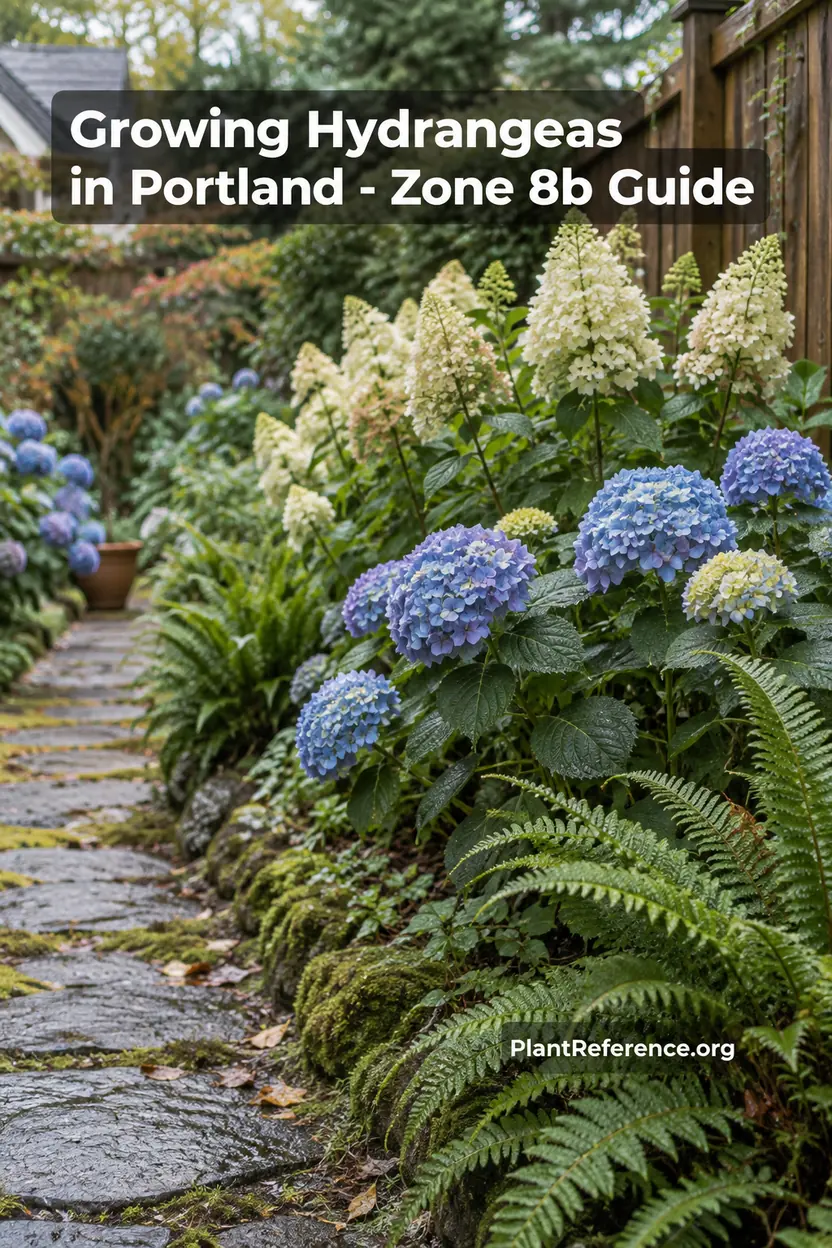
Growing Hydrangeas in Portland: Zone 8b Guide
Pets & Toxicity
Recorded toxicity for plants linked in this guide. An unknown status is not a safety assessment.
Toxic to pets: bigleaf hydrangea, nikko blue hydrangea, BloomStruck Hydrangea and 2 moreDetailsHide
Hydrangea macrophylla — Toxicity Warning
Toxic to pets and humansView Hydrangea macrophylla plant profileHydrangea macrophylla 'Nikko Blue' — Toxicity Warning
Toxic to pets and humansView Hydrangea macrophylla 'Nikko Blue' plant profileHydrangea macrophylla 'BloomStruck' — Toxicity Warning
Toxic to pets and humansView Hydrangea macrophylla 'BloomStruck' plant profileHydrangea paniculata 'Limelight' — Toxicity Warning
Toxic to petsView Hydrangea paniculata 'Limelight' plant profileHydrangea arborescens 'Incrediball' — Toxicity Warning
Toxic to petsView Hydrangea arborescens 'Incrediball' plant profile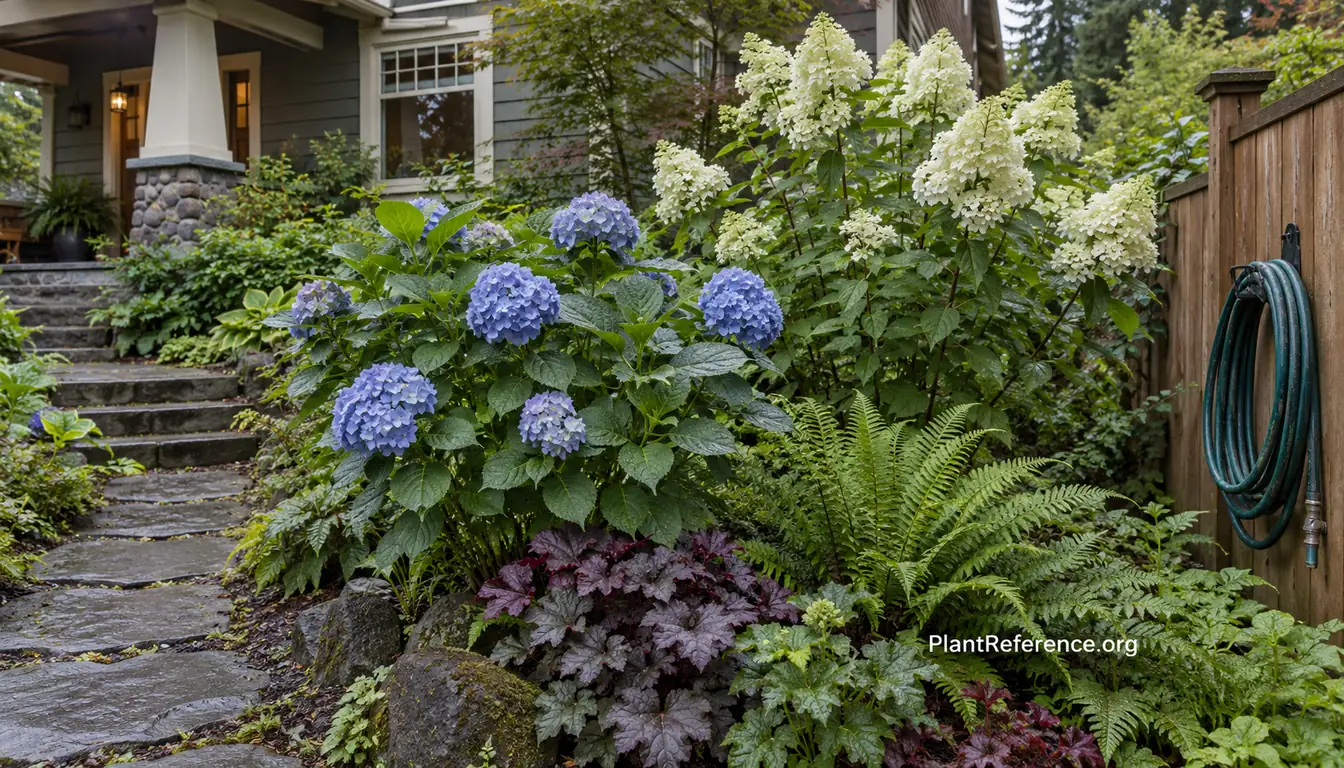
— Image © PlantReference.org 2026
Growing hydrangeas in Portland takes advantage of one of the most forgiving hydrangea climates in the United States. Zone 8b winters usually spare old-wood flower buds, cool spring weather slows petal aging, and acidic soils can favor blue bigleaf flowers. The important correction is summer water: Oregon's wet-season reputation hides a reliably dry July-through-September period when shallow hydrangea roots cannot depend on rainfall.
Hydrangeas respond to Portland's maritime pattern through plant physiology. Cool temperatures reduce the respiration and water loss that shorten flowers in hotter cities, while mild winters preserve the dormant buds carried on older stems. Begin by matching species to space and light using Hydrangea Types Explained: Pruning, Color & Care Guide, then build irrigation and pruning around that biology.
Best Hydrangea Varieties for Portland's Climate
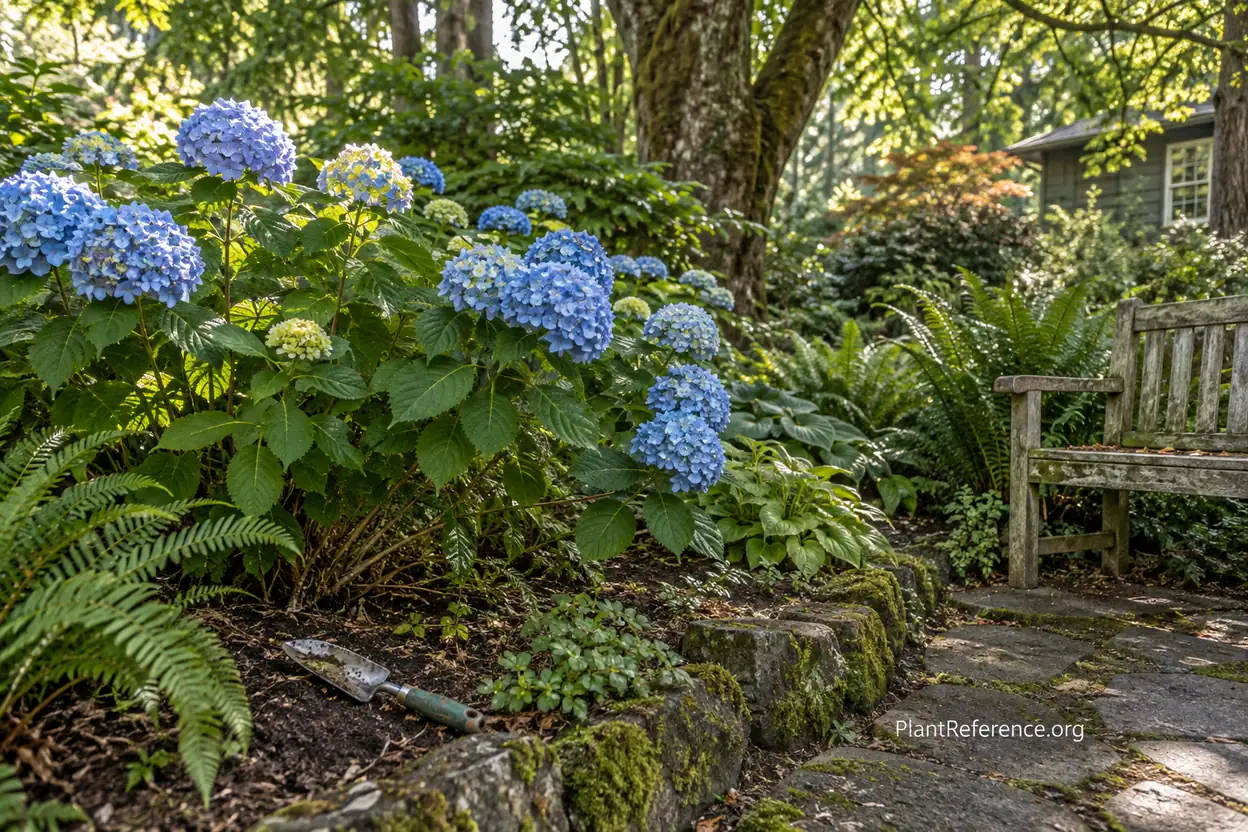
Bigleaf hydrangea 🌿Hydrangea macrophylla is at its best here because Portland rarely combines severe winter bud kill with extreme summer heat. Traditional old-wood cultivars can produce the early, abundant display that becomes unreliable in colder zones. 🌿Hydrangea macrophylla 'Nikko Blue' gives classic mophead flowers and grows about 4-6 feet (1.2-1.8 m) tall and wide. In acidic soil with available aluminum, its sepals develop saturated blue rather than pink.
For repeat flowering, 🌿Hydrangea macrophylla 'BloomStruck' adds new-wood bloom to its preserved old-wood display. The advantage is not immunity to damage; it is a second physiological route to flowers. Its stronger stems also hold up well under the weight of long-season bloom. Hydrangea macrophylla 'Twist-n-Shout' supplies lacecap flowers and a lighter visual texture for woodland borders.
Mountain hydrangeas bring smaller leaves, lacecap flowers, and a restrained scale. Hydrangea serrata 'Tuff Stuff' reaches about 2-3 feet (60-90 cm), fitting narrow side gardens and mixed shade borders. Although its extra bud hardiness is less essential in Zone 8b, its compact form and refined flowers remain valuable. Both bigleaf and mountain species can change color; How to Change Hydrangea Color: Blue, Pink & Purple explains how soil pH controls aluminum availability rather than directly coloring the flower.
Panicle hydrangeas tolerate brighter exposure and bloom later. 🌿Hydrangea paniculata 'Limelight' matures at 6-8 feet (1.8-2.4 m), making it useful for hedges or the back of a deep border. Hydrangea paniculata 'Little Lime' brings similar lime, cream, and pink color progression to a 3-5 foot (90-150 cm) shrub. Both flower on current-season stems, so pruning errors and winter weather are less likely to eliminate bloom. Compare their proportions in Panicle Hydrangea Guide: Limelight, Little Lime & More before placing them near a path.
Smooth hydrangea Hydrangea arborescens suits woodland margins but may need support in heavy shade. 🌿Hydrangea arborescens 'Incrediball' improves on the classic floppy habit with stronger stems and large white heads. Oakleaf hydrangea offers burgundy fall color and exfoliating bark, yet wet winter soil is its critical limitation. Hydrangea quercifolia 'Ruby Slippers' stays around 3-4 feet (90-120 cm) and belongs in a raised or freely draining position, never a saturated low spot.
Variety | Mature Size | Best For | Notes for Portland |
|---|---|---|---|
4-6 ft (1.2-1.8 m) | Classic blue mopheads | Acidic soil often supports strong blue color | |
3-4 ft (90-120 cm) | Repeat flowering | Old- and new-wood bloom extends the season | |
Hydrangea macrophylla 'Twist-n-Shout' | 3-5 ft (90-150 cm) | Lacecap texture | Good for layered woodland borders |
Hydrangea serrata 'Tuff Stuff' | 2-3 ft (60-90 cm) | Small shade gardens | Compact, fine-textured, and bud hardy |
Hydrangea paniculata 'Little Lime' | 3-5 ft (90-150 cm) | Brighter sites | Reliable new-wood bloom and compact habit |
Hydrangea quercifolia 'Ruby Slippers' | 3-4 ft (90-120 cm) | Fall color | Requires excellent winter drainage |
Use mature dimensions as biological facts, not suggestions. Crowded leaves remain humid longer after dew and rain, creating the boundary layer that powdery mildew exploits. A planting that looks sparse in year one usually becomes healthier and more coherent by year three. For compatible understory plants, How to Grow Heuchera (Coral Bells) in Shade Gardens offers combinations with contrasting leaf size and seasonal color.
Specific Planting Dates for Portland
Portland's average last frost is March 20 and first frost is November 10, creating a 235-day frost-free span. Because nursery hydrangeas are woody, container-grown shrubs rather than tender seedlings, soil condition and root establishment matter more than a single frost night. The preferred late-winter and spring window is February 20 through March 31, provided soil is not saturated or frozen.
Planting before leaf expansion lets roots begin growing while shoot demand remains low. Roots require oxygen as well as water; working saturated soil destroys pore space and smears planting-hole walls. If a handful of soil forms a shiny ribbon instead of crumbling, postpone digging until drainage improves.
The second preferred window is October 1 through October 31. Autumn rain reduces irrigation demand, while soil retains enough heat for root initiation. Complete planting before November 1 when possible, giving the shrub several weeks to settle before the average November 10 frost. Mulch after planting, but keep organic material away from the crown.
The practical annual schedule is:
February 1-19: Observe drainage, test soil pH, and prepare irrigation routes.
February 20-March 31: Complete the main cool-season planting.
April 1-May 15: Plant successfully with consistent follow-up moisture.
July 1-September 30: Avoid transplanting and monitor irrigation closely.
October 1-31: Use the preferred autumn planting window.
By November 10: Check drainage, renew mulch, and stop routine fertilizer.
Hydrangeas purchased in flower during summer can wait in a bright, sheltered holding area until October. Keep the container evenly moist and prevent roots from circling indefinitely, but do not move an established shrub during July or August. Summer transplanting increases water loss from leaves precisely when damaged roots absorb less water.
Complete Growing Guide for Portland
Choose Light by Species
Bigleaf and mountain hydrangeas perform well with three to five hours of morning sun followed by bright shade. Panicle hydrangeas accept six hours or more, particularly east of the West Hills where brighter summer light supports sturdy flowering stems. Oakleaf hydrangeas tolerate sun after establishment but prefer filtered afternoon protection. Deep shade reduces flower-bud formation because the plant cannot produce enough carbohydrates to support abundant bloom.
Observe winter exposure too. A site under roof runoff may be dry despite months of rain, while a low lawn edge may remain saturated. Regional principles in Pacific Northwest Gardening Guide: Climate, Soil & Plant Selection help interpret these microclimates before shrubs become difficult to move.
Build an Oxygenated Root Zone
Dig a hole two to three times the root-ball width and exactly as deep as the root ball. Set the root flare level with or 1 inch (2.5 cm) above grade. Backfill primarily with native soil so roots cross the interface instead of circling in a pocket of amended material. Incorporate 1-2 inches (2.5-5 cm) of compost across the broader bed rather than pouring it into the hole.
Portland lots vary from well-drained volcanic soils to dense clay and compacted construction fill. Run a drainage test: fill a 12-inch (30 cm) hole with water, let it drain, refill it, and note the second drainage rate. Water that persists beyond 24 hours signals a need to raise the bed or choose another site. Fix PNW Garden Drainage: Glacial Till, Hardpan & Raised Beds gives useful options for compacted Pacific Northwest sites.
Irrigate for the Dry Summer
Once the rains taper, supply 1-2 inches (2.5-5 cm) of water weekly, adjusted for soil, exposure, and shrub size. Hydrangeas concentrate many fine roots in the upper soil, so they show drought stress early. A slow soaker hose or dripline spread across the root zone is more effective than a short blast beside the trunk.
Check moisture 2-3 inches (5-8 cm) deep at several points. A shrub that wilts on a hot afternoon but recovers by morning may simply be reducing leaf water loss; a shrub that stays limp at dawn needs diagnosis. Watering automatically whenever leaves droop can saturate roots and exclude oxygen.
Apply 2-3 inches (5-8 cm) of arborist chips or aged mulch after soil warms, leaving 3 inches (8 cm) clear around stems. Mulch slows summer evaporation and supports soil structure as it decomposes. It cannot correct a perched water table, so solve drainage first.
Fertilize and Prune with Restraint
Use a soil test before changing pH or applying significant fertilizer. A balanced slow-release product in early spring is usually sufficient. Excess nitrogen drives leaf and stem growth while reducing flowering, and dense succulent growth creates a more favorable mildew canopy. Stop feeding by July so tissues mature before autumn.
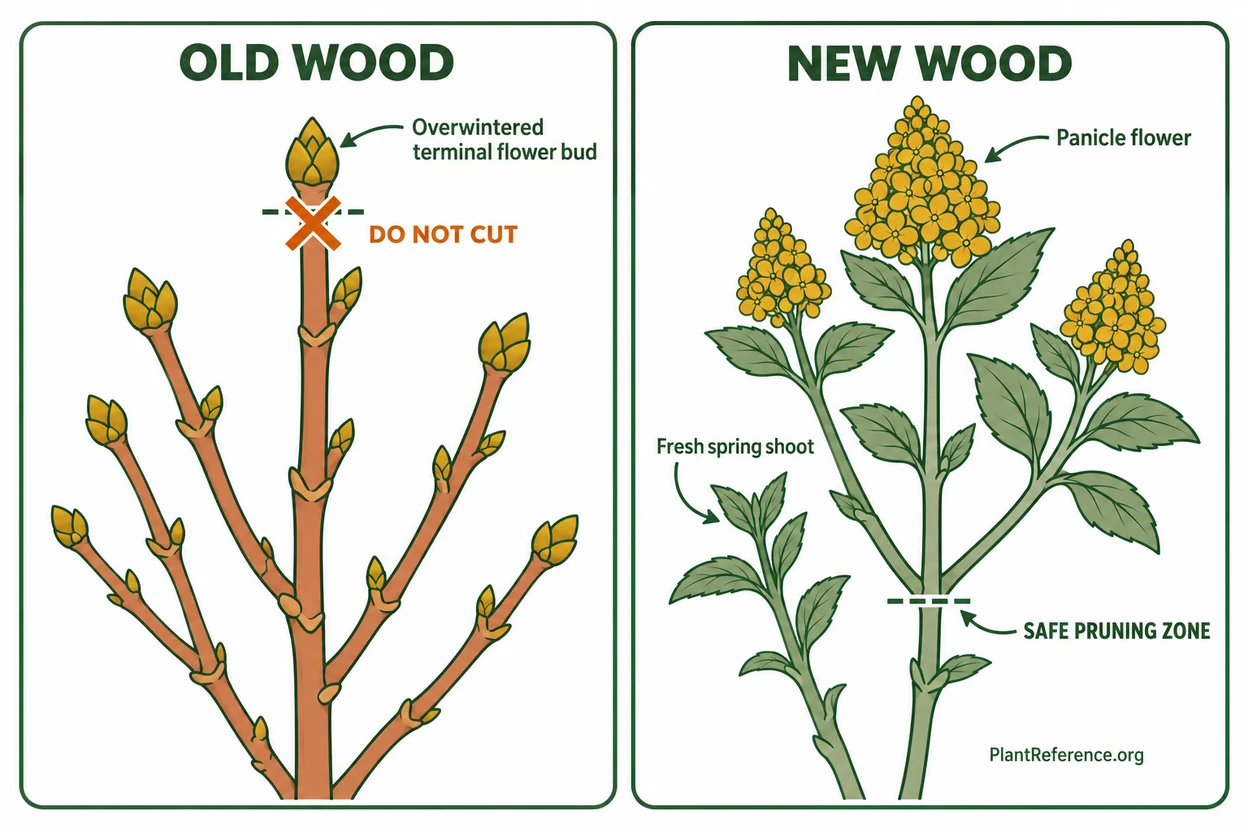
Panicle and smooth hydrangeas bloom on new wood and may be pruned in late winter. Bigleaf, mountain, oakleaf, and climbing hydrangeas carry most flower buds on old stems, so late winter pruning removes the coming display. Finish any shaping immediately after flowering and leave rebloomers largely untouched. How to Prune Hydrangeas: Old Wood vs New Wood Guide provides species-specific diagrams, while Hydrangea Not Blooming? 7 Causes and the Old Wood Fix helps troubleshoot missing flowers.
Containers suit patios and gardens with poor drainage. Choose a vessel at least 18-24 inches (45-60 cm) wide, use a bark-based mix, and expect more frequent summer watering. Hydrangea paniculata 'Little Lime' and Hydrangea serrata 'Tuff Stuff' fit containers better than full-size shrubs. Hydrangeas in Pots: Container Care & Winter Protection covers root insulation and repotting.
Troubleshooting Portland-Specific Problems
Powdery mildew, rather than Cercospora leaf spot, is Portland's signature foliar issue. The fungus appears as white-gray patches on upper leaf surfaces, often late in summer. Unlike many leaf diseases, powdery mildew does not require free water on the leaf. It thrives when nights are humid, days are dry, and airflow is limited—the exact combination found in a crowded, irrigated border during an Oregon summer.
Prevention begins with spacing and light. Allow air to move through mature shrubs, avoid dense shearing, water the soil early in the day, and remove heavily affected leaves at season's end. Do not apply high-nitrogen fertilizer that produces tender, crowded growth. Neem or labeled fungicides work best as preventive or early treatments; they cannot restore already damaged leaf tissue.
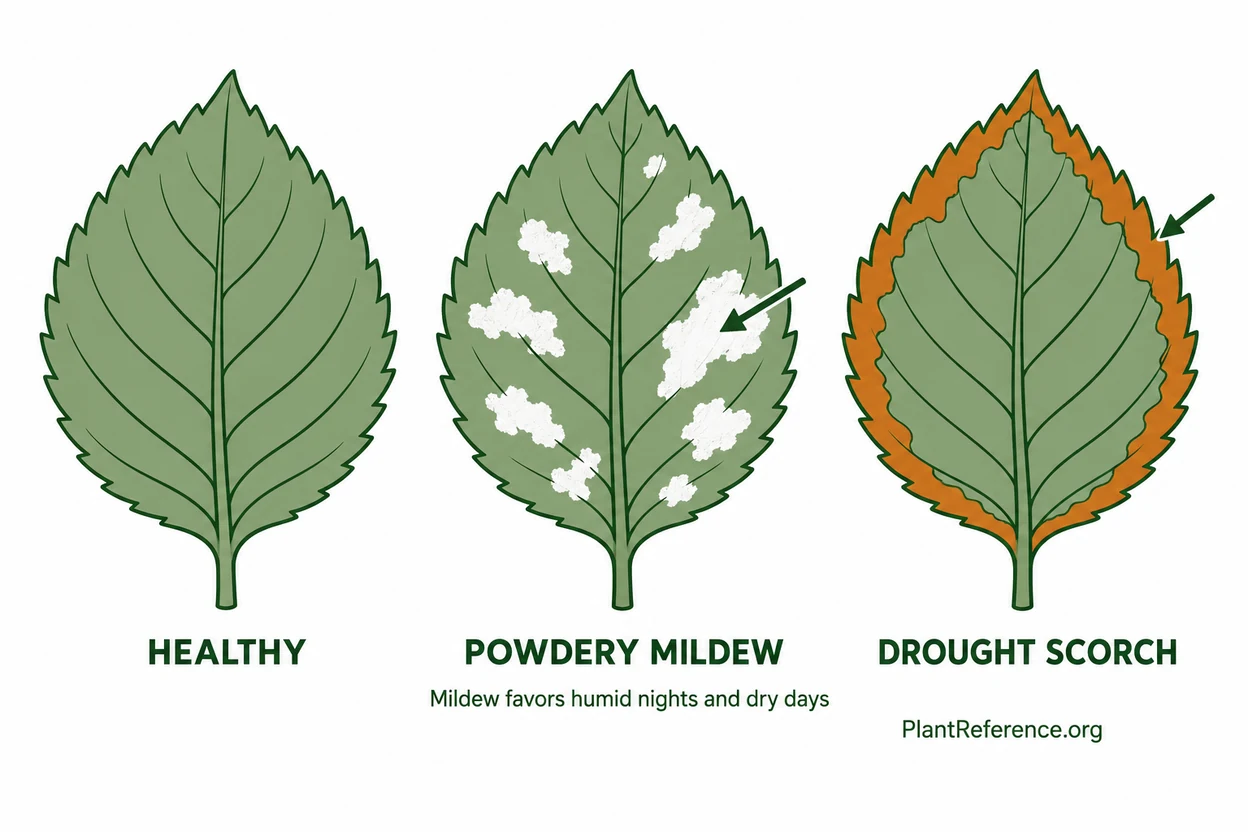
Brown leaf edges during August usually indicate water deficit, reflected heat, or root restriction rather than infection. Check soil moisture, pot volume, and western exposure before treating disease. Hydrangea Leaves Turning Brown: Causes and Solutions compares scorch, underwatering, overwatering, Cercospora, and anthracnose signs.
Persistent wilt in wet winter soil points toward oxygen-starved roots or root rot. Healthy roots are firm and pale inside; damaged roots turn dark and soft. Improve drainage before adding water, and relocate oakleaf hydrangeas from saturated pockets during the next cool planting window. Winter yellowing can also reflect root stress rather than a nutrient shortage.
Slugs and snails may chew young leaves during wet spring weather, while aphids cluster on soft tips. Hand-pick, reduce hiding places, and protect beneficial predators before reaching for broad treatments. Deer browse removes old-wood buds as efficiently as pruning, so protect shrubs with fencing or repellents where pressure is high.
If a bigleaf hydrangea remains pink in acidic soil, phosphorus may be binding aluminum or the cultivar may be genetically resistant to blueing. Test rather than guessing. White-flowered cultivars, panicle hydrangeas, smooth hydrangeas, and oakleaf hydrangeas do not turn blue regardless of amendment.
Cut Flowers, Winter Care, and Storage
Cut hydrangea stems early in the morning when flowers are fully open and sepals feel slightly papery. Choose stems 12-18 inches (30-45 cm) long, remove leaves below the waterline, and place them directly into a clean bucket. Recut each stem under water before arranging. This reduces the air embolisms that can block water movement through xylem vessels.
For drying, harvest as color begins to soften. Stand stems in 1-2 inches (2.5-5 cm) of water and let the water evaporate slowly in a cool room out of direct sun. Store dried stems upright where humidity remains low. Panicle and smooth forms hold shape especially well, while tender freshly opened mopheads tend to wilt instead of drying.
Portland hydrangeas rarely need elaborate winter wrapping. Leave sound stems and buds intact, maintain a 2-3 inch (5-8 cm) mulch layer, and avoid waterlogged soil. Remove diseased leaves after they drop, but keep healthy faded flower heads if you enjoy their winter structure. How to Prepare Perennial Gardens for Winter by Species gives broader cleanup priorities for mixed borders.
Clean and dry pruners after cutting diseased tissue, then store them closed with a light coat of oil. Drain and store soaker hoses before a freeze. The goal is not to make the garden sterile; it is to remove concentrated disease inoculum while preserving soil organisms and beneficial habitat.
Frequently Asked Questions
Reading about plants and recognising them are different skills. These three build the second.
- Daily PlantIdentify the day’s mystery plant from a close-up photograph.
- Keyed OutWork a dichotomous key, lead by lead, to name a hidden specimen.
- Name That PlantName a specimen from botanical clues dealt hardest first.
Free to play, no account needed
Tagged with
Sarah earned her doctorate in plant biology and spent time working in botanical garden education before transitioning to freelance writing and consulting. Now based in Portland, Oregon, she teaches plant identification workshops at local community centers and maintains a modest collection of over 60 houseplants in her small apartment. Sarah specializes in helping beginners understand plant science without the jargon—her approach focuses on practical observation over theory. She's killed her fair share of fiddle leaf figs and finally cracked the code on keeping them alive.