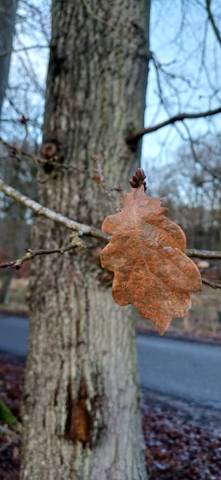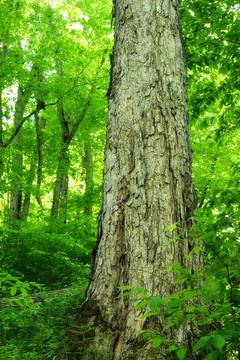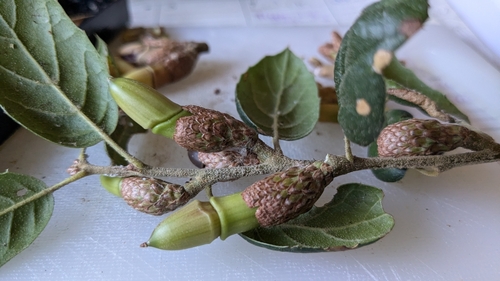
Quercus, Genus, agrifolia, Species,
- Genus & species
coast live oak
Native to coastal California and Baja California, from Mendocino County south to the Sierra San Pedro Mártir; the species occurs on coastal hillsides, valleys, and canyons from sea level to approximately 5,000 ft (1,500 m); the iconic tree of the California coastal landscape — the spreading canopy defines the visual character of the coastal hills and valleys; protected by law in many California municipalities — removal requires permits
Overview
Quercus agrifolia is an evergreen oak in the beech family (Fagaceae), growing 30-60 ft (9-18 m) tall and 40-70 ft (12-21 m) wide with a broad rounded spreading crown that often extends wider than the tree is tall. The wide low-branching canopy creates dense shade. Leaves are evergreen, oval to round, 1-3 inches (2.5-8 cm) long, convex (cupped upward), leathery, dark green above with a holly-like spiny margin — the spiny leaves separate Q. agrifolia (epithet 'agrifolia' = field-leaf, referencing the holly-like character) from other California oaks. The trunk is short, 2-5 ft (60-150 cm) in diameter on mature trees, with dark grey-brown bark developing deep furrows. Acorns are 0.75-1.5 inches (2-4 cm) long, slender, with a pointed tip and a thin scaly cap covering one-third of the nut. The species is the iconic tree of the California coastal landscape — the spreading canopy defines the visual character of the coastal hills and valleys from Mendocino County south to Baja California. Protected by law in many California municipalities — removal requires permits. The root system is sensitive to soil disturbance, compaction, and changes in drainage — the most common cause of coast live oak death in urban areas is grade change and irrigation within the root zone. Summer irrigation of established trees promotes Phytophthora root rot, Armillaria, and crown rot.
Native Range
Quercus agrifolia is native to coastal California and Baja California, from Mendocino County south to the Sierra San Pedro Mártir. The species occurs on coastal hillsides, valleys, and canyons from sea level to approximately 5,000 ft (1,500 m).Suggested Uses
The defining landscape tree of coastal California — preserved and protected in residential and commercial developments. In new plantings, used as a shade tree, specimen, and wildlife habitat tree on large properties. Gives dense shade, acorn mast for wildlife (over 100 vertebrate species use coast live oak acorns), and year-round evergreen canopy. In landscape design, the wide spreading crown defines outdoor rooms and shade zones. Not suited to irrigated lawns or gardens — the species requires a dry summer regime within the root zone.How to Identify
Appearance
Size & Dimensions
Height30' - 60'
Width/Spread40' - 70'
Bloom Information
Inconspicuous catkins in March-April. Wind-pollinated. Acorns develop and ripen in a single season (unlike many oaks that take 2 years), maturing in October-November. Acorn mast years (heavy production) occur every 2-3 years.
Detailed Descriptions
Foliage Description
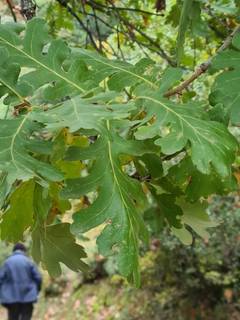
Dark green leathery convex (cupped upward) oval to round leaves 1-3 inches (2.5-8 cm) long with a holly-like spiny margin; the spiny leaves separate Q. agrifolia (epithet 'agrifolia' = field-leaf, referencing the holly-like character) from other California oaksGrowing Conditions
Sun Requirements
Requires 6-12 hours of direct sunlight daily
• Full Sun: 6+ hours of direct sunlight
• Partial Shade: 3-6 hours of direct sunlight
• Full Shade: Less than 3 hours of direct sunlight
Care & Maintenance
Care Guide
Plant in full sun in well-drained soil at pH 6.0-8.0. Tolerates drought, heat, poor soil, and coastal exposure. Space 30-40 ft (9-12 m) apart. Do not irrigate established coast live oaks in summer — summer irrigation is the most common cause of decline, since it promotes root rot pathogens. Water only during the first 1-2 years of establishment, then cease summer irrigation permanently. Do not change the soil grade within the dripline — even 2-4 inches (5-10 cm) of added fill can kill the tree over 3-5 years. Do not pave, compact, or trench within the dripline. In the Pacific Northwest, the species is marginally hardy (zones 8b-9) and uncommon.Pruning
Prune only in the dry season (June-September) to minimize oak wilt and fungal infection through pruning wounds. Remove dead and structurally weak branches. Thin the canopy lightly if needed for air circulation. Do not lion-tail (strip interior branches) — this destabilizes the tree. Topping is illegal in many California jurisdictions.Pruning Schedule
Prune: June–September
summer