Quercus, Genus, virginiana, Species,
- Genus & species
southern live oak
Native to the southeastern United States, from Virginia south to Florida and west along the Gulf Coast to Texas, with disjunct populations in Mexico and Central America; the species occurs on sandy coastal plains, maritime forests, and upland sites from sea level to approximately 1,000 ft (300 m); the iconic tree of the Deep South — the cathedral-like tunnel effect of live oak allées draped with Spanish moss ({Tillandsia usneoides}) is a defining cultural landscape image
Overview
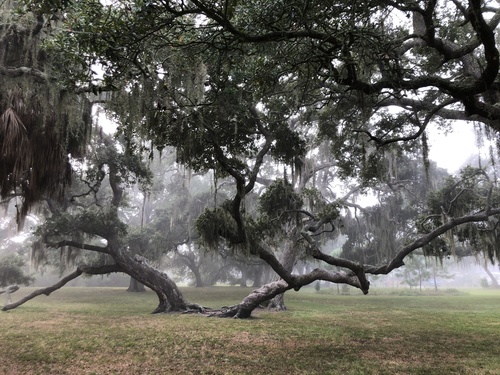
Quercus virginiana is a massive evergreen to semi-evergreen oak in the beech family (Fagaceae) growing 40-60 ft (12-18 m) tall and 60-100 ft (18-30 m) wide — the spread frequently exceeds the height by a factor of 1.5-2×, creating one of the wider canopies of any North American tree. Lower limbs are massive, horizontal, and may touch the ground 40-50 ft (12-15 m) from the trunk. Trunk diameter on old specimens reaches 4-8 ft (1.2-2.4 m). Leaves are evergreen, simple, elliptic to oblong, 2-5 inches (5-13 cm) long, leathery, dark green above, grey-green and pubescent beneath, with an entire (unlobed) margin — unlike most oaks. Leaf exchange occurs in spring — old leaves drop over 2-3 weeks as new leaves emerge, producing a brief semi-deciduous period. The species is the iconic tree of the Deep South — the cathedral-like tunnel effect of live oak allées draped with Spanish moss (Tillandsia usneoides) is a defining cultural landscape image. Acorns are small, 0.5-1 inch (12-25 mm), dark brown to black, on a stalk 0.5-3 inches (12-75 mm) long. Cold-hardy to approximately 10°F (-12°C) — the species is not suited to the Pacific Northwest except in the very mildest zones (9a). Tolerates salt spray, wind, compacted soil, and coastal exposure. Wind-resistant — among the trees most likely to survive hurricanes intact.
Native Range
Quercus virginiana is native to the southeastern United States, from Virginia south to Florida and west along the Gulf Coast to Texas, with disjunct populations in Mexico and Central America. The species occurs on sandy coastal plains, maritime forests, and upland sites from sea level to approximately 1,000 ft (300 m).Suggested Uses
The defining shade tree of the Deep South — planted as specimen, allée, and shade tree on large properties, parks, and institutional grounds throughout zones 8-10. The massive canopy gives shade over 0.5 acre (2,000 m²) or more on mature specimens. Coastal planting — wind and salt tolerant. Hurricane-resistant. Long-lived: specimens exceeding 500 years are documented. Not suited to small residential lots.How to Identify
Appearance
Size & Dimensions
Height40' - 60'
Width/Spread60' - 100'
Bloom Information
Yellowish catkins in March-April. Acorns ripen September-October in one season. Acorns consumed by squirrels, deer, turkeys, and wood ducks.
Detailed Descriptions
Flower Description
Yellowish catkins in March-April; wind-pollinated; acorns ripen September-October in one season; small, 0.5-1 inch (12-25 mm), dark brown to black, on a stalk 0.5-3 inches (12-75 mm) longFoliage Description
Dark green above, grey-green and pubescent beneath; evergreen simple elliptic to oblong leaves 2-5 inches (5-13 cm) long with leathery texture and entire (unlobed) margins — the unlobed margin separates the species from most oaksGrowing Conditions
Sun Requirements
Requires 6-12 hours of direct sunlight daily
• Full Sun: 6+ hours of direct sunlight
• Partial Shade: 3-6 hours of direct sunlight
• Full Shade: Less than 3 hours of direct sunlight
Care & Maintenance
Care Guide
Plant in full sun in any well-drained soil at pH 5.0-7.5. Tolerates sand, clay, compacted soil, and salt spray. Space 40-60 ft (12-18 m) apart — the mature canopy is massive. Water during the first 2-3 years; once established, drought-tolerant. Growth rate is moderate — 24 inches (60 cm) per year on good sites. Hardy to zone 7b-8 (10°F / -12°C). Not suited to the Pacific Northwest except the warmest sites.Pruning
Prune in winter (dormant season). Remove dead branches and crossing limbs. The massive horizontal limbs are natural and should not be removed unless safety requires it. Do not lion-tail — interior leaf mass is important for structural integrity. Hurricane-resistant — the broad dense canopy withstands high winds.Pruning Schedule
Prune: December–February
winter