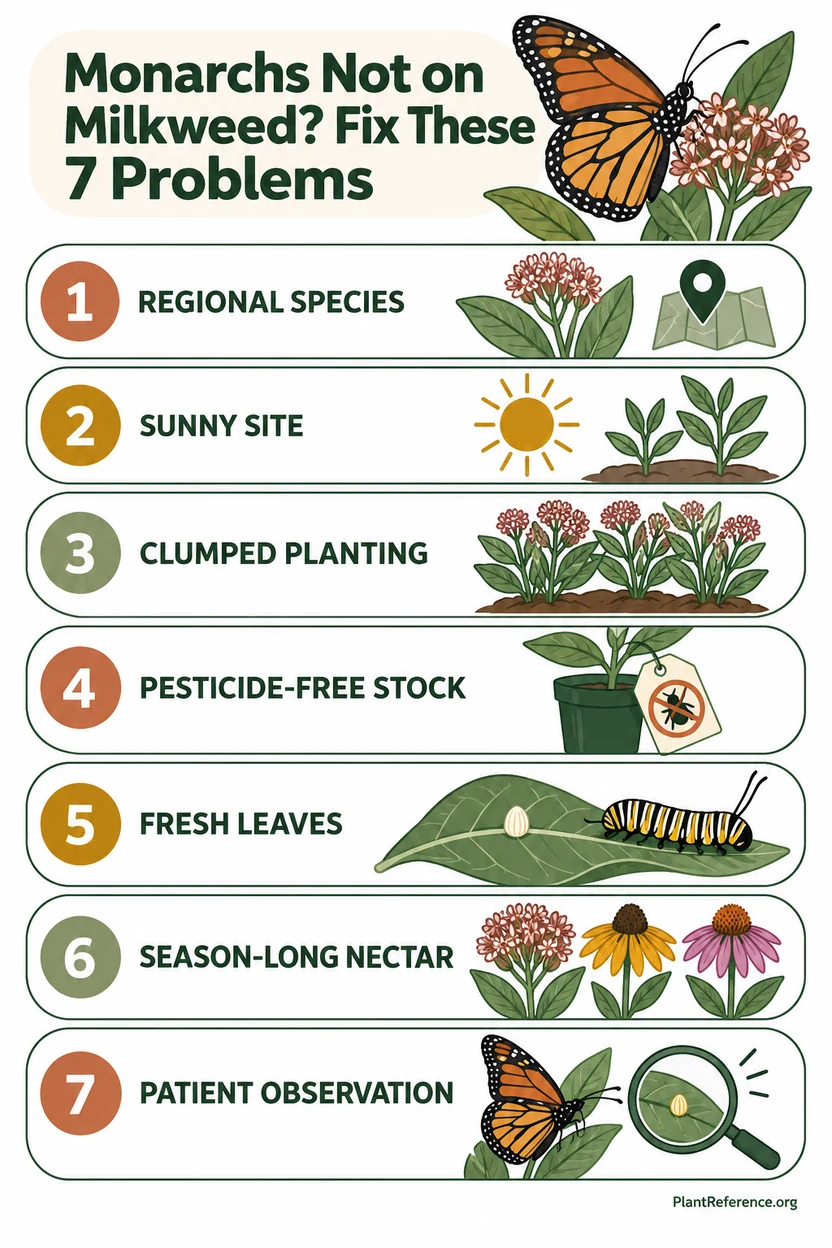
Monarchs Not on Milkweed? 7 Problems to Fix
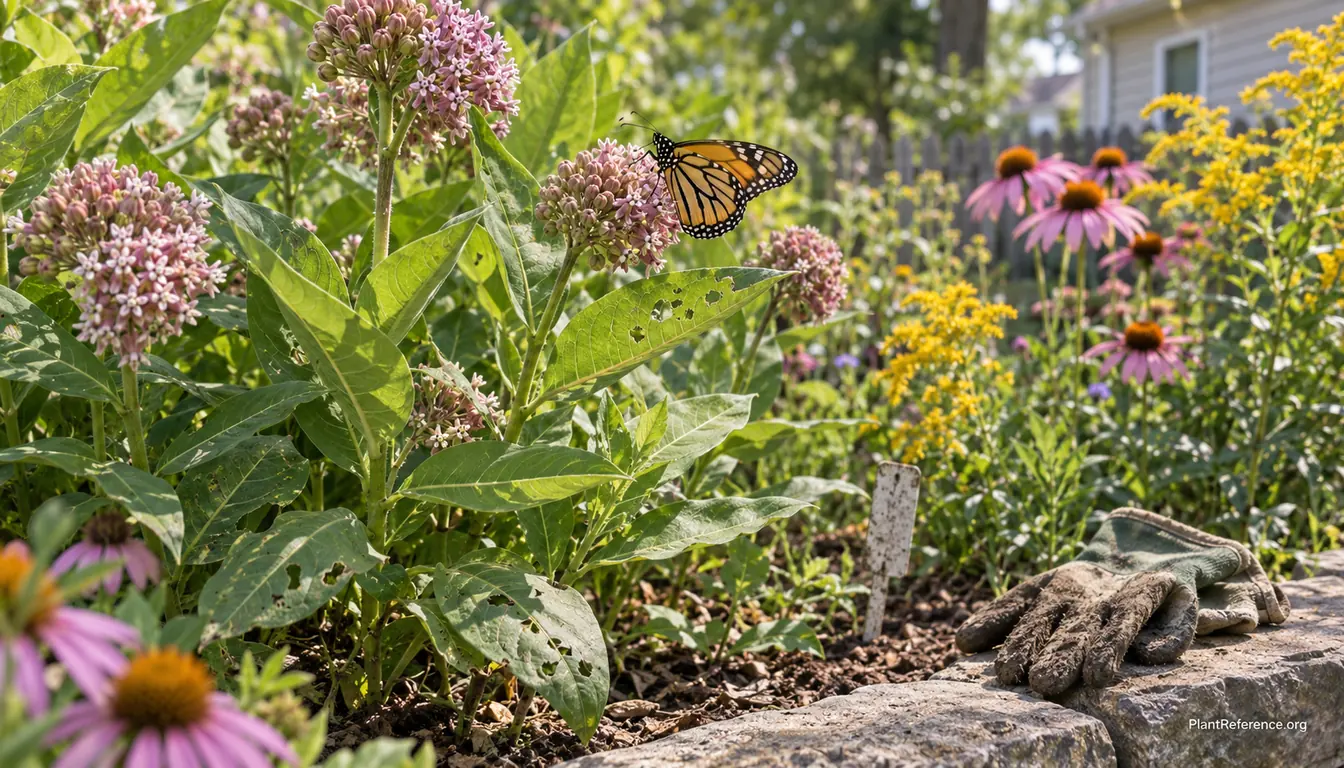
— Image © PlantReference.org 2026
Pets & Toxicity
Recorded toxicity for plants linked in this guide. An unknown status is not a safety assessment.
Toxic to pets: native milkweed selections, common milkweed, butterfly weed and 3 moreDetailsHide
Asclepias tuberosa — Toxicity Warning
Toxic to pets and humans (cardiac glycosides — cardenolides — at moderate concentration; less toxic than other milkweed species but still toxic if ingested in quantity)View Asclepias tuberosa plant profileAsclepias incarnata — Toxicity Warning
Toxic to pets and humansView Asclepias incarnata plant profileAsclepias curassavica — Toxicity Warning
Toxic to pets and humansView Asclepias curassavica plant profileWhen monarchs are not on your milkweed, the plant itself is only one part of the diagnosis. Monarch larvae require milkweeds 🌿Asclepias spp., but adult females still have to encounter a visible, healthy, pesticide-free patch during their seasonal movement. A lone plant in shade, the wrong regional species, treated nursery stock, or a short observation window can all produce the same result: no obvious eggs or caterpillars.
Start with identification and source history, then inspect planting layout, light, moisture, and nearby pesticide use. Do not buy more fertilizer or spray insects “just in case.” Those reactions can weaken habitat or kill the animals you hope to attract.
Confirm the Milkweed Species Fits Your Region
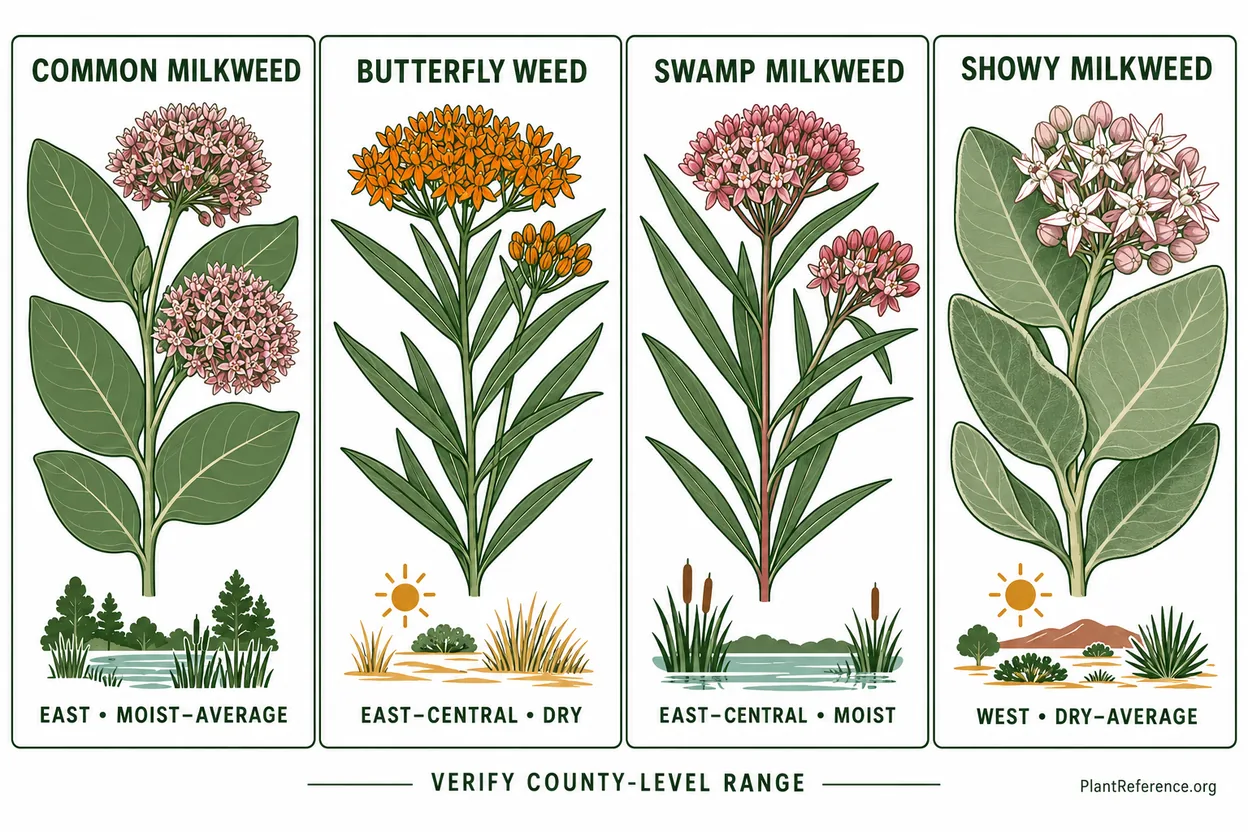
Milkweed is a genus, not one universal garden plant. Common milkweed 🌿Asclepias syriaca fits much of eastern and central North America and spreads by rhizomes. Butterfly weed 🌿Asclepias tuberosa prefers sun and draining soil. Swamp milkweed 🌿Asclepias incarnata needs consistent moisture. Showy milkweed 🌿Asclepias speciosa is a major western species. Match county-level native range and soil conditions before judging performance.
Milkweed species | Broad regional role | Site match | Common mistake |
|---|---|---|---|
Common milkweed 🌿Asclepias syriaca | Eastern and central landscapes | Full sun; dry to average soil | Planting where spreading roots cannot be accommodated |
Butterfly weed 🌿Asclepias tuberosa | Broad but region-dependent dry-site choice | Full sun; well-drained soil | Overwatering or transplanting repeatedly after its taproot forms |
Swamp milkweed 🌿Asclepias incarnata | Moist eastern and central sites | Sun; moist to seasonally wet soil | Putting it in a hot, dry bed and treating wilt as insect damage |
Showy milkweed 🌿Asclepias speciosa | Western landscapes | Sun; dry to average soil by local ecotype | Substituting an eastern species without checking regional range |
The plan identifies tropical milkweed 🌿Asclepias curassavica as a known problem in southern climates because persistent growth can disrupt normal migration behavior. Replace it with locally native milkweed rather than relying on annual cutting as the entire solution. Regional plant lists matter; Pacific Northwest Native Plants: 10 Resilient Picks shows how strongly a native palette can change across geography.
Make the Planting Easy for Monarchs to Find
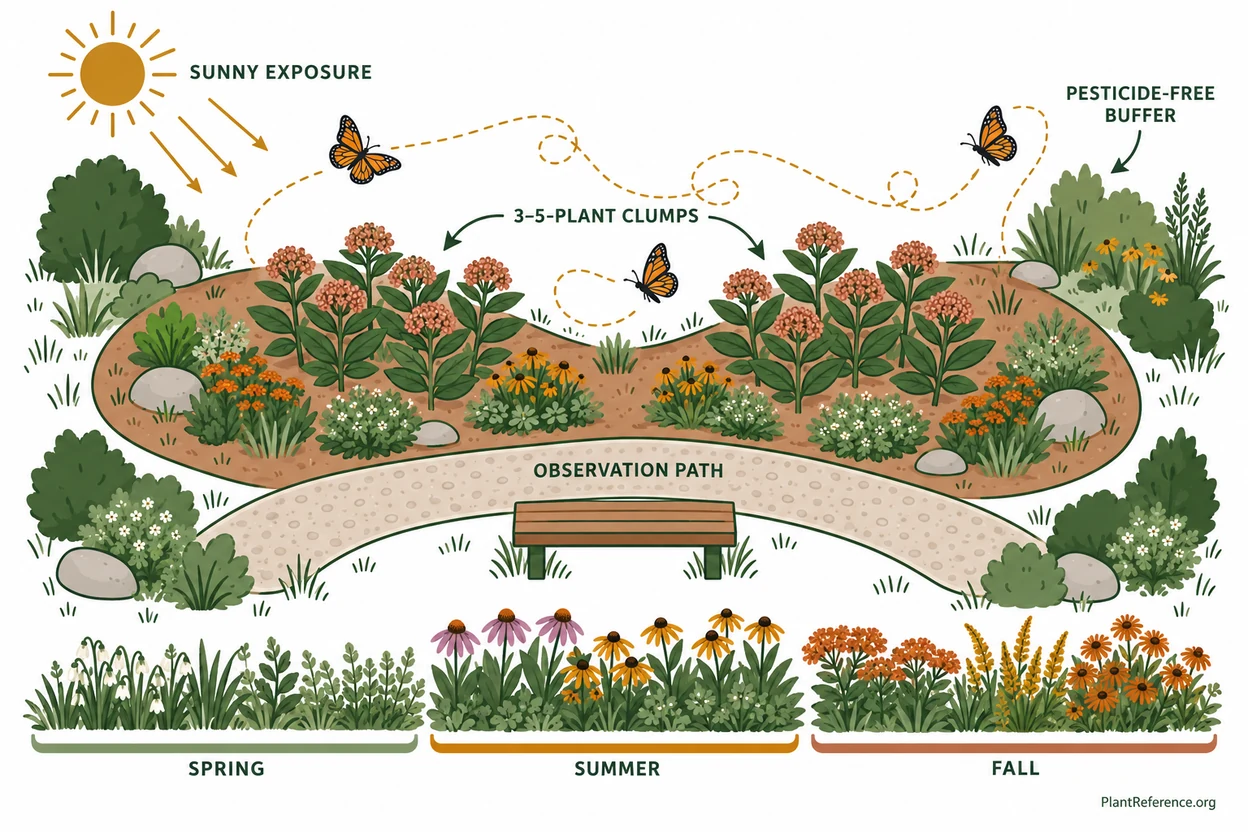
Adult monarchs search a large visual landscape. The research emphasizes planting forage and host plants in clumps or drifts rather than isolated individuals, which improves detection. Put at least three to five milkweeds of one locally appropriate species together, then repeat a second group if space allows. Do not create a rigid monoculture; the goal is a visible host patch within diverse habitat.
Give the patch open access and sun. Dense shrubs can hide leaves and reduce flight space, while deep shade produces weak stems on many milkweed species. Use low companion plants around crowns and keep taller nectar plants behind or between groups. Perennial Combinations That Look Good Together helps organize repeated forms without scattering every species.
Do not expect instant discovery. Monarch abundance changes by location, weather, migration timing, and year. A healthy first-year patch may spend most of its energy below ground. Track dates, photograph plants weekly, and compare multiple seasons before declaring failure.
Eliminate Pesticide and Nursery-Stock Risks
Ask the nursery whether the exact plants were treated with systemic insecticides at any point in production. “Pollinator friendly” on a retail sign does not answer that question. If treatment history is unknown, do not place the plants immediately into an active monarch nursery. Buy from a native nursery that can document propagation and pest-management practices, or grow from responsibly sourced regional seed.
Stop broad-spectrum spraying across the bed. Insecticides do not distinguish an aphid from a monarch caterpillar, and some fungicide or herbicide programs can also reduce habitat quality. Use hand removal, a water spray, or tolerance for minor damage when appropriate. Never apply soap, oil, or homemade mixtures while eggs or larvae are present.
Check neighboring practices too. Lawn treatments, mosquito fogging, drift from adjacent beds, and treated seedling stock can expose the patch even when you never spray the milkweed directly. The wider principles in Best Perennials for Pollinators: Bees & Butterflies help turn a flower bed into safer habitat rather than a nectar-only display.
Check Site Conditions and Plant Health
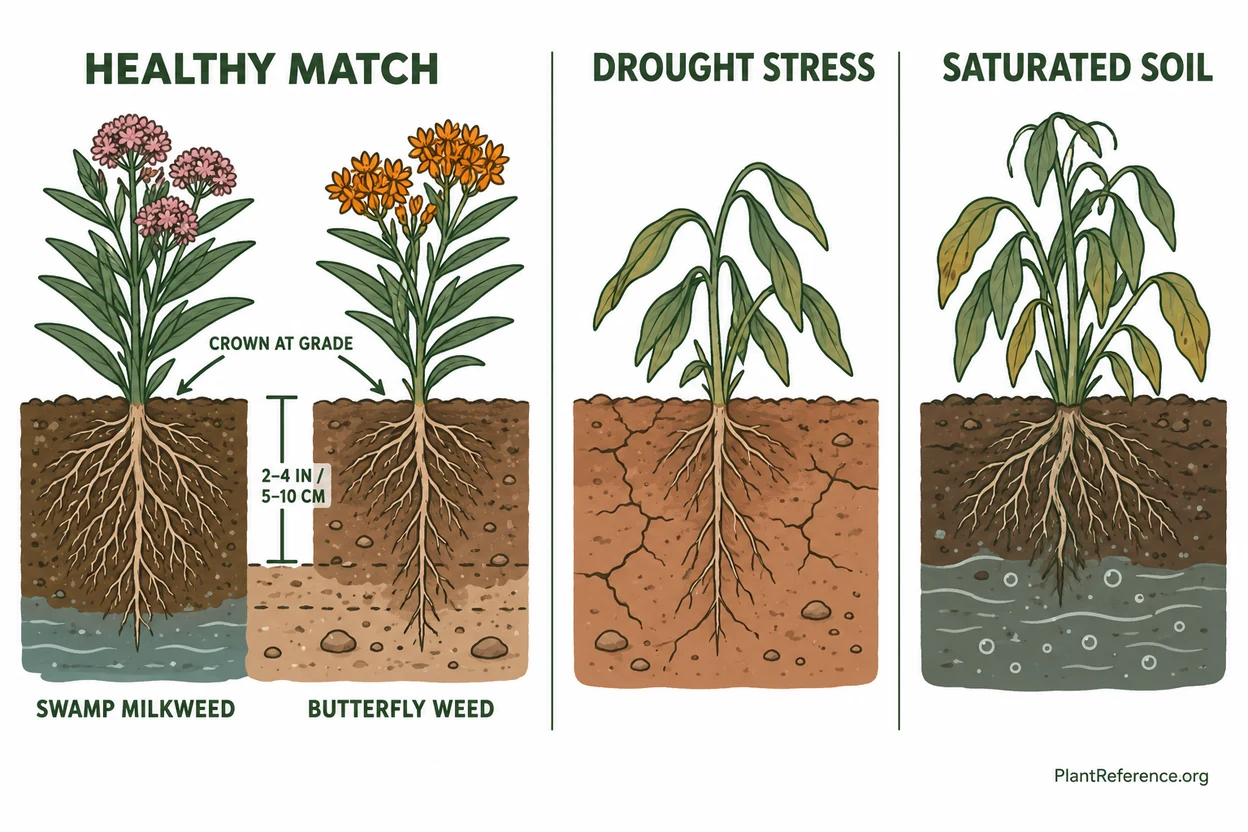
Stressed milkweed offers less usable foliage. Confirm at least 6 hours of direct sun for sun-loving species, then check moisture 2 to 4 inches (5 to 10 cm) below the surface. Swamp milkweed 🌿Asclepias incarnata should not be managed like butterfly weed 🌿Asclepias tuberosa; one accepts wet ground, while the other needs drainage.
Avoid high-nitrogen fertilizer. It can create soft growth, increase aphid pressure, and solve nothing if roots sit in compacted or saturated soil. Test soil before amending. Correct crown depth, drainage, competition, and irrigation first. When to Plant Perennials: Season-by-Season Timing can reduce transplant stress, while How to Prepare Perennial Gardens for Winter by Species helps protect young crowns without burying them.
Confirm the exact milkweed species and county-level native range.
Provide the light and moisture that species requires.
Keep crowns at soil level and mulch away from stems.
Water deeply during establishment, then adjust by root-zone moisture.
Avoid routine fertilizer and all broad-spectrum insecticide treatments.
Look for Eggs and Caterpillars More Carefully
Monarch eggs are tiny, pale, and usually laid singly, often beneath leaves. Early caterpillars can be only a few millimeters long and may hide along veins or in folded new growth. Inspect both sides of leaves with a hand lens and look for small chewing marks or frass before assuming nothing is present.
Predation is normal. Spiders, wasps, true bugs, birds, and other animals are part of the same food web. Do not spray the entire plant to protect one caterpillar. Outdoor monarch habitat is not a sterile rearing enclosure, and natural losses do not mean the planting has no value.
Observe at different times of day for several weeks. Record adults, eggs, larvae, aphids, predators, bloom, and weather. This turns a vague absence into evidence: no adults arrived, adults visited but did not lay, or eggs appeared but larvae disappeared. Each pattern points to a different fix.
Build Habitat Beyond Milkweed
Milkweed feeds larvae, but adult monarchs need nectar throughout migration and reproduction. Add locally native flowers that overlap from spring through fall. Coneflowers, blazing stars, asters, and goldenrods may fit some regions; verify every species locally. How to Grow Coneflowers (Echinacea) That Feed Pollinators and Perennials That Bloom All Summer: 12 Longest Bloomers can help identify calendar gaps.
Leave some stems and leaf litter, maintain a shallow water or puddling source safely, and preserve small patches of bare ground for ground-nesting bees. Avoid landscape fabric across the entire bed. Plan a Perennial Garden That Blooms Spring to Fall helps audit bloom continuity, and When to Cut Back Perennials in Fall (And What to Leave) explains why over-cleaning removes habitat.
The final fix is patience backed by records. A regionally correct, healthy, untreated clump with season-long nectar cannot guarantee a monarch visit in any particular week. It does create the conditions a passing female can use. Build those conditions, watch carefully, and judge success across seasons rather than one afternoon.
Frequently Asked Questions
Reading about plants and recognising them are different skills. These three build the second.
- Daily PlantIdentify the day’s mystery plant from a close-up photograph.
- Keyed OutWork a dichotomous key, lead by lead, to name a hidden specimen.
- Name That PlantName a specimen from botanical clues dealt hardest first.
Free to play, no account needed
Tagged with
Priya is a soil scientist at an agricultural extension office who gardens on a quarter-acre suburban lot in Indianapolis. Her professional work focuses on soil health and nutrient management, which gives her a perspective most gardening writers don't have—she thinks about what's happening underground before worrying about what's happening above it. Priya maintains a large pollinator garden, grows herbs and vegetables, and is slowly converting her conventional lawn to a mix of native grasses and low-growing groundcovers. She writes about soil health, composting, fertilizer use, and building the kind of foundation that makes plants thrive without constant intervention.