Asclepias, Genus, speciosa, Species,
- Genus & species
showy milkweed
Overview
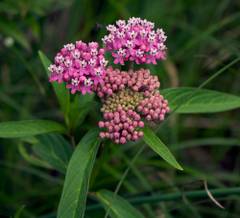
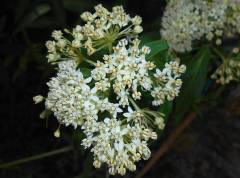
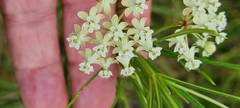
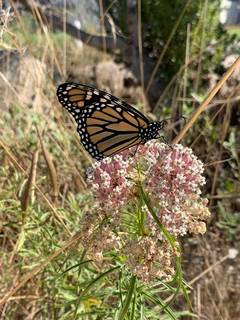
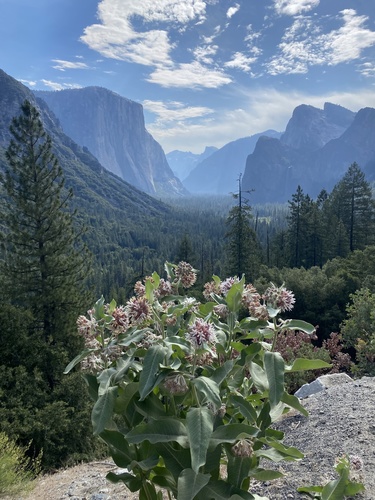
Asclepias speciosa is a clump-forming herbaceous perennial reaching 24-60 inches (60-150 cm) tall and 18-36 inches (45-90 cm) wide via creeping rhizomes. Stems erect, stout, gray-green and densely pubescent, exuding milky white latex when broken. Leaves opposite, broadly oblong to ovate, 4-8 inches (10-20 cm) long and 2-4 inches (5-10 cm) wide, gray-green and softly hairy on both surfaces. Flowers in dense globular umbels of 20-50 flowers on terminal and upper-axillary peduncles; each flower 0.5-0.8 inch (12-20 mm) across, with 5 reflexed pink petals surrounding 5 elongated pink-and-white hoods bearing horns. Bloom May through August. Sweetly fragrant, with a vanilla-jasmine scent in evening. Seed pods (follicles) ovoid to oblong, 3-5 inches (7.5-13 cm) long, gray-green and densely woolly, splitting in fall to release flat brown seeds with white silky pappus. Spreads 6-12 inches (15-30 cm) per year by rhizomes in moist soils; mature colonies reach 4-6 feet (1.2-1.8 m) wide within 5-7 years. Larval host for monarch butterfly (Danaus plexippus) across western and central North America. Foliage dies back to ground level after first hard frost; plants resprout from rhizomes in spring.
Native Range
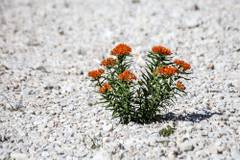
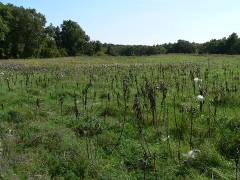
Native to western and central North America from British Columbia and Saskatchewan south through the Pacific Northwest, Rocky Mountains, and Great Plains to southern California, New Mexico, and Texas. Found in moist meadows, stream banks, roadsides, irrigated pastures, and disturbed grasslands at 1,000-9,000 feet (300-2,750 m) elevation. Most populations occur in sites with seasonally moist soils.Suggested Uses
Planted in pollinator gardens, monarch waystations, prairie-style and naturalistic plantings, and roadside restoration at 24-36 inch (60-90 cm) spacing in zones 3-9. Rhizomatous spread suits naturalistic plantings but limits use in formal beds without root barriers. Used in hedge plantings along fence lines for monarch and bumblebee habitat across the western United States.How to Identify
Appearance
Size & Dimensions
Height2' - 5'
Width/Spread1'6" - 3'
Colors
Bloom Information
May through August across most of the range, with peak bloom in June and July. In zones 8-9, bloom may begin in late April; in subalpine sites above 7,000 feet (2,100 m), bloom may extend into early September. Individual umbels last 2-3 weeks; each plant produces 3-8 umbels for a total bloom of 6-10 weeks. Fragrance strongest in late evening.
Detailed Descriptions
Flower Description
Pink to purple-pinkFoliage Description
Gray-greenGrowing Conditions
Sun Requirements
Requires 6-12 hours of direct sunlight daily
• Full Sun: 6+ hours of direct sunlight
• Partial Shade: 3-6 hours of direct sunlight
• Full Shade: Less than 3 hours of direct sunlight
Care & Maintenance
Care Guide
Plants establish from seed sown in fall with cold stratification, from rhizome divisions in spring, or from 1-gallon container stock at 24-36 inch (60-90 cm) spacing. Mature plants tolerate 4-6 weeks without water in zones 4-8 and benefit from occasional supplemental water in zones 9-10 during dry summers. Container plants are short-lived (2-3 seasons) due to taproot disruption. Aphids (Aphis nerii — oleander aphid) colonize new growth in summer; populations are usually controlled by beneficial insects. Monarch caterpillars consume foliage in mid-summer and may defoliate plants temporarily; plants resprout. All parts contain cardenolides and are toxic to livestock if ingested in quantity. Rhizomatous spread can be aggressive in moist soils; root barriers limit spread in mixed plantings.Pruning
Cut stems to ground level in late fall after first hard frost or in early spring before new growth emerges. Deadhead spent umbels through summer to reduce self-seeding and to extend bloom by 2-3 weeks; alternatively, leave for fall seed dispersal. Damaged stems exude milky latex when cut; latex causes skin irritation in sensitive individuals.Pruning Schedule
Prune: March & November
fallearly spring
Container Growing
Minimum container size: 5 gallons