Asclepias, Genus, syriaca, Species,
- Genus & species
common milkweed
Overview
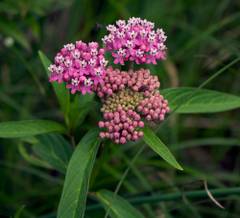
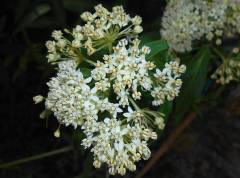
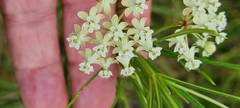
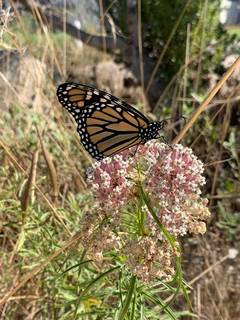
Asclepias syriaca is an upright herbaceous perennial native to eastern and central North America, growing 3-5 feet (0.9-1.5 m) tall from deep, spreading rhizomes that form colonies. The stout, unbranched stems carry opposite, oblong leaves 4-8 inches (10-20 cm) long with prominent pale midribs and a velvety underside; broken stems and leaves exude a milky white latex. From early to midsummer it produces rounded, drooping clusters 2-4 inches (5-10 cm) across of pink to mauve, sweetly scented flowers, each with five reflexed petals and a raised central crown. Pollinated flowers develop into warty, teardrop-shaped seedpods 3-5 inches (7.5-13 cm) long that split open in fall to release flat brown seeds, each carried on a tuft of silky white hairs. The species spreads by seed and by its rhizomes, often forming broad stands in old fields, roadsides, and prairie remnants. It is a larval host plant for monarch butterflies, whose caterpillars feed on the foliage. The milky latex contains cardiac glycosides that are toxic to livestock, pets, and humans if eaten, and the sap can irritate skin and eyes. In gardens the rhizomes spread widely, and the plant self-sows readily from windborne seed.
Native Range
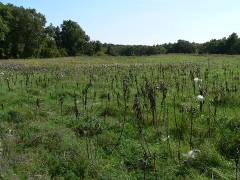
Asclepias syriaca is native to eastern and central North America, from southern Canada through the central and eastern United States. It grows in prairies, old fields, roadsides, and other open, disturbed ground.Suggested Uses
Asclepias syriaca is planted in wildlife and pollinator gardens, meadow plantings, and naturalized areas as a larval host for monarch butterflies and a nectar source for many insects. Its spreading rhizomes suit it to large, informal plantings rather than small, tidy borders. It also establishes in restored prairies and roadside plantings.How to Identify
Appearance
Size & Dimensions
Height3' - 5'
Width/Spread2' - 3'
Bloom Information
Flowering runs from early to midsummer, roughly June through August. The domed clusters of pink to mauve flowers are fragrant and draw a wide range of bees, wasps, and butterflies. As blooming ends, the warty seedpods form and ripen through late summer and fall.
Detailed Descriptions
Flower Description
pink to mauveFoliage Description
greenGrowing Conditions
Sun Requirements
Requires 6-10 hours of direct sunlight daily
• Full Sun: 6+ hours of direct sunlight
• Partial Shade: 3-6 hours of direct sunlight
• Full Shade: Less than 3 hours of direct sunlight
Care & Maintenance
Care Guide
Asclepias syriaca grows in full sun in average to dry soils and tolerates poor, sandy, or gravelly ground once established. It is drought tolerant through its deep taproot and rhizome system and needs no supplemental watering or fertilizing in most sites. The deep rhizomes spread outward and send up new shoots several feet from the parent plant, so colonies enlarge year to year. Plants are slow to establish from seed, which needs a period of cold stratification to germinate. The milky latex stains and irritates skin, and the foliage is toxic to grazing animals. Cutting stems back in late fall removes the spent pods where self-seeding is not wanted.Pruning
Stems can be cut to the ground in late fall or early spring, after the seed has dispersed or before the pods split, depending on whether self-seeding is wanted. Removing developing pods limits the spread of windborne seed. The rhizomes are not controlled by cutting and continue to expand the colony.Pruning Schedule
Prune: March & November
fallearly spring