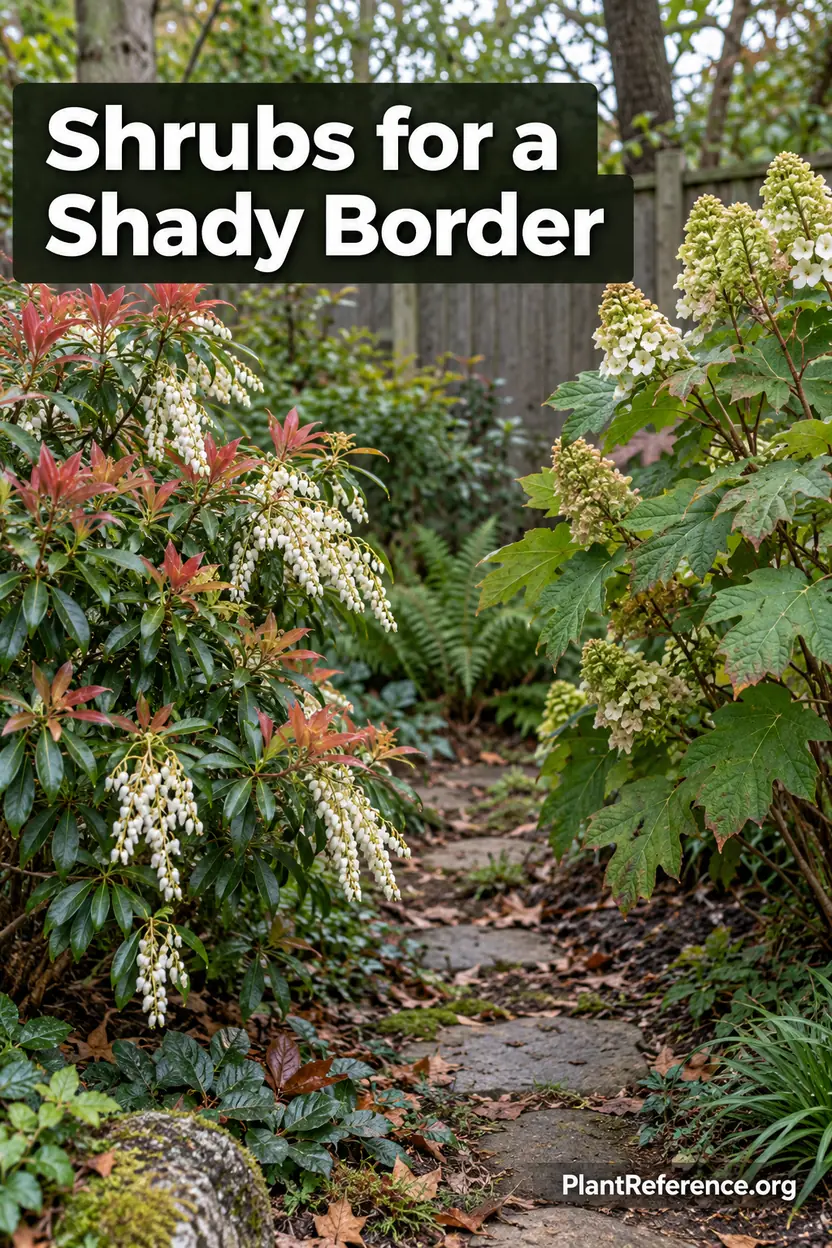
Shade Tolerant Shrubs: Laurel, Pieris and Hydrangea
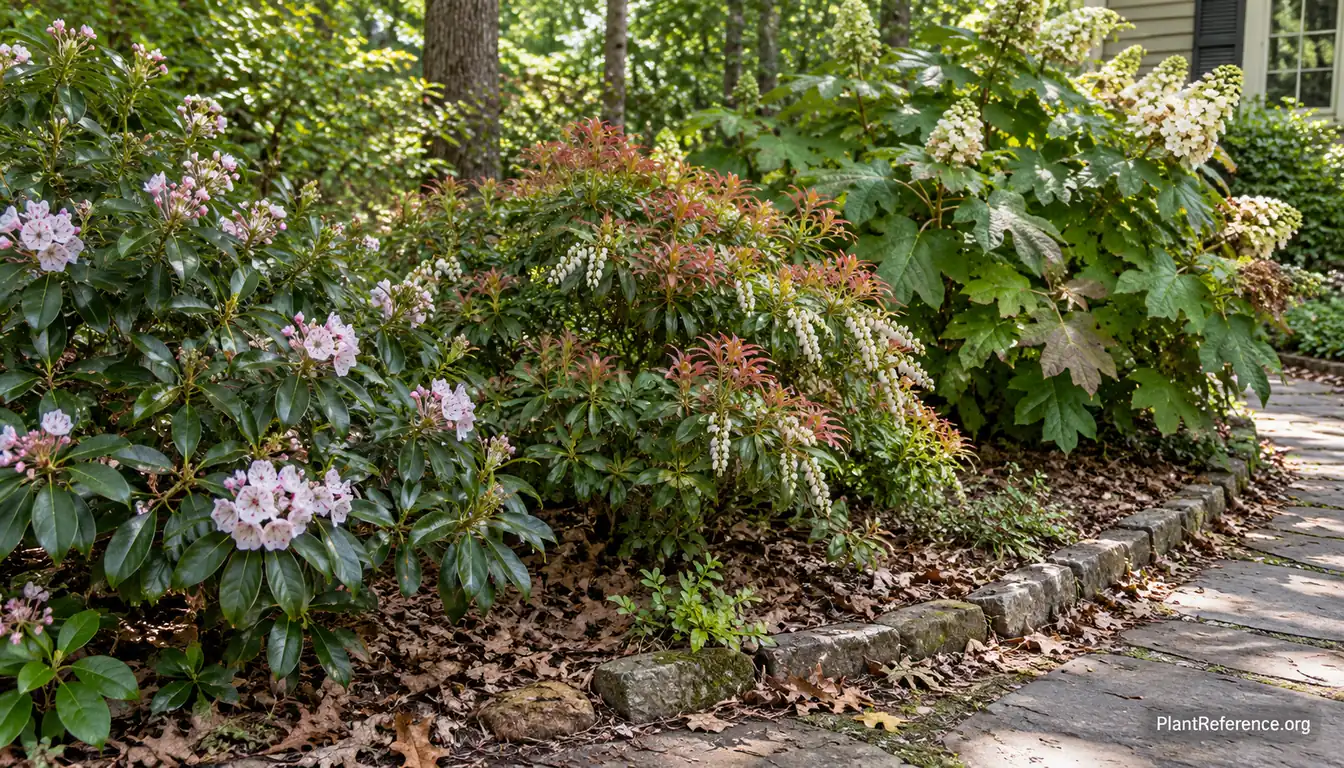
— Image © PlantReference.org 2026
Pets & Toxicity
Recorded toxicity for plants linked in this guide. An unknown status is not a safety assessment.
Toxic to pets: mountain laurel, Japanese andromeda, oak-leaf hydrangea and 3 moreDetailsHide
Hydrangea quercifolia — Toxicity Warning
Toxic to pets and humansView Hydrangea quercifolia plant profileKalmia latifolia 'Olympic Fire' — Toxicity Warning
Toxic to pets and humansView Kalmia latifolia 'Olympic Fire' plant profileKalmia latifolia 'Minuet' — Toxicity Warning
Toxic to pets and humansView Kalmia latifolia 'Minuet' plant profileKalmia latifolia 'Keepsake' — Toxicity Warning
Toxic to pets and humansView Kalmia latifolia 'Keepsake' plant profileShade tolerant shrubs are the framework of a border, not simply a way to add flowers beneath trees. Mountain laurel, pieris, and oakleaf hydrangea offer different combinations of foliage, form, and seasonal interest. Choose the role first, then check whether the light, soil, and available space will support the plant you want.
Give Shade Tolerant Shrubs a Clear Design Role
A well-planned border still makes sense when nothing is flowering. An evergreen can hold the corner of a path, a broad-leaved shrub can soften a fence, and an open gap can keep the composition from feeling crowded. Begin with those permanent relationships rather than a photograph of peak bloom.
Look at the bed from the places you actually use: a kitchen window, the patio, or the entrance path. Decide which view needs screening and which should remain open. The same shrub can be helpful at the back of a border and obstructive beside a narrow doorway.
Distinguish shade tolerance from a flowering promise
Filtered light moving through branches differs from the dense darkness under a closed evergreen canopy. Bright shade can supply useful ambient light without direct sun. In very deep shade, a shrub may grow slowly, become more open, or produce fewer flowers than its nursery photograph suggests.
Watch the space during the growing season. Morning sunlight and hot afternoon exposure are not interchangeable, even when the number of direct-sun hours is similar. Notice reflected heat from walls and paving as well as the canopy overhead.
Use foliage as the dependable layer
Small glossy leaves, larger textured leaves, and fine perennial foliage create contrast without needing simultaneous bloom. Repeat a limited set of forms instead of collecting one of everything. The result is easier to read and usually easier to maintain.
How to Grow Heuchera (Coral Bells) in Shade Gardens offers possibilities for the lower layer where conditions suit them. Leave room for those companions after accounting for the shrubs' eventual spread; a newly planted border should not need to look completely full on its first day.
Compare Mountain Laurel, Pieris and Oakleaf Hydrangea
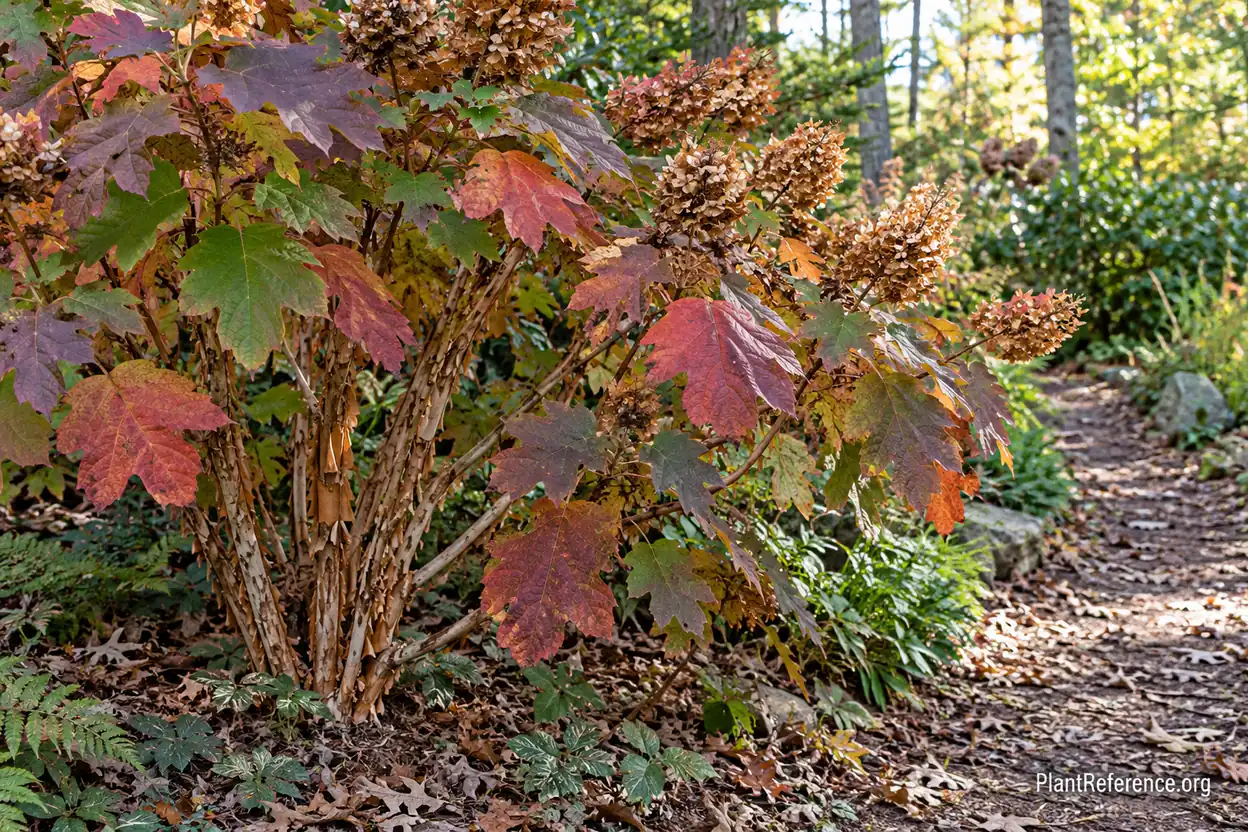
Mountain laurel 🌿Kalmia latifolia supplies glossy evergreen foliage and distinctive flower clusters. Japanese pieris 🌿Pieris japonica adds cascading spring blooms and reddish new growth. Oakleaf hydrangea 🌿Hydrangea quercifolia offers a different kind of structure through broad leaves, fall color, and peeling bark.
These are candidates, not universal recommendations for every climate. Confirm the exact selection's local hardiness, heat tolerance, mature dimensions, and nursery guidance before buying. A location-free comparison cannot replace those checks with one zone or planting calendar.
Shrub | Structural contribution | Seasonal interest | Main siting question |
|---|---|---|---|
Mountain laurel 🌿Kalmia latifolia | Glossy evergreen framework | Geometric flower clusters; cultivar-dependent colors | Does the site provide suitable acidic woodland conditions? |
Japanese pieris 🌿Pieris japonica | Evergreen background with a distinct foliage rhythm | Cascading spring flowers and reddish new growth | Is shade accompanied by suitable moisture and drainage? |
Oakleaf hydrangea 🌿Hydrangea quercifolia | Bold deciduous foliage and visible branching | Flowers, fall foliage, and peeling winter bark | Is there room for the selected plant's mature outline? |
Rhododendrons | Broadleaf evergreen structure in suitable selections | Showy flowers when light and care are appropriate | Does the exact selection suit acidity, light, and local climate? |
Mountain laurel for a lasting anchor
Mountain laurel 🌿Kalmia latifolia works well when the design needs a persistent leafy form rather than a temporary flower display. Its flower clusters reward close viewing, so place it where the detail can be appreciated without pushing the mature branches into a walkway.
The species is noted for deer resistance, but resistance is not immunity. Local browsing pressure still matters, especially while plants are small. Do not design an entire border around a promise that wildlife will never touch it.
Pieris for spring movement and new growth
Japanese pieris 🌿Pieris japonica brings another texture to the evergreen layer. Its hanging flower clusters soften a composition that might otherwise consist only of rounded foliage masses. Reddish new growth adds interest without needing a separate annual planting.
Allow the plant's natural form to remain visible. If every shrub is sheared into the same tight shape, the very differences that justified choosing them disappear. Position it so mature growth can develop without regular cutting simply to maintain access.
Oakleaf hydrangea for seasonal change
Oakleaf hydrangea 🌿Hydrangea quercifolia is useful when a border needs broad foliage and a clear transition through the seasons. Fall leaves and winter bark extend its value beyond flowers. It does not replace an evergreen screen where year-round opacity is essential.
Hydrangea Types Explained: Pruning, Color & Care Guide helps distinguish this plant from other hydrangea groups. Do not apply every pruning or flower-color rule associated with a different hydrangea to it merely because the common name is shared.
Choose Mountain Laurel Cultivars for the Space
Flower color is enjoyable, but scale should decide the shortlist. A compact selection can work near the front of a mixed border, while a larger plant belongs where its spread will not become an annual pruning problem. Check the nursery's mature width as carefully as its height.
The supported choices below differ in flower appearance, and one has a specifically compact stature. Where a precise size is not established here, confirm it for the actual plant rather than assuming all mountain laurels mature alike.
Cultivar | Distinctive feature | Useful design role | Check before purchase |
|---|---|---|---|
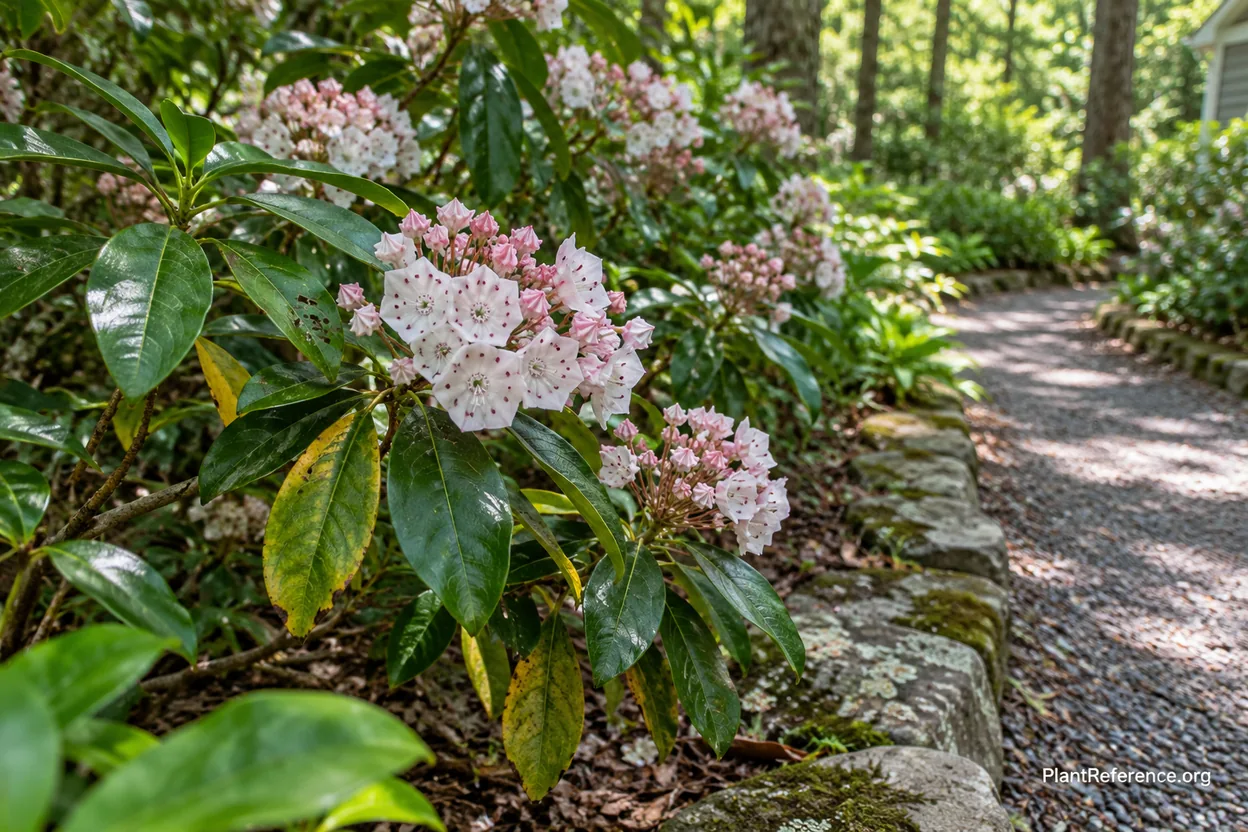
Red buds opening to bright pink flowers | A noticeable flowering accent against quieter foliage | Mature height and width for the available space | |
Dwarf form around 3 feet (90 cm) tall; bicolor striped blooms | Smaller-scale evergreen accent | Eventual width and local performance | |
Deep red cup-shaped flowers with white accents | Close-view flower detail near a suitable path | Mature dimensions and placement clear of traffic |
Use compact plants where the border must stay open
🌿Kalmia latifolia 'Minuet' offers a smaller starting framework for a modest planting. Its reported height does not mean it can be placed against a step with no lateral allowance. Mark out the expected width from the nursery information before deciding how many plants fit.
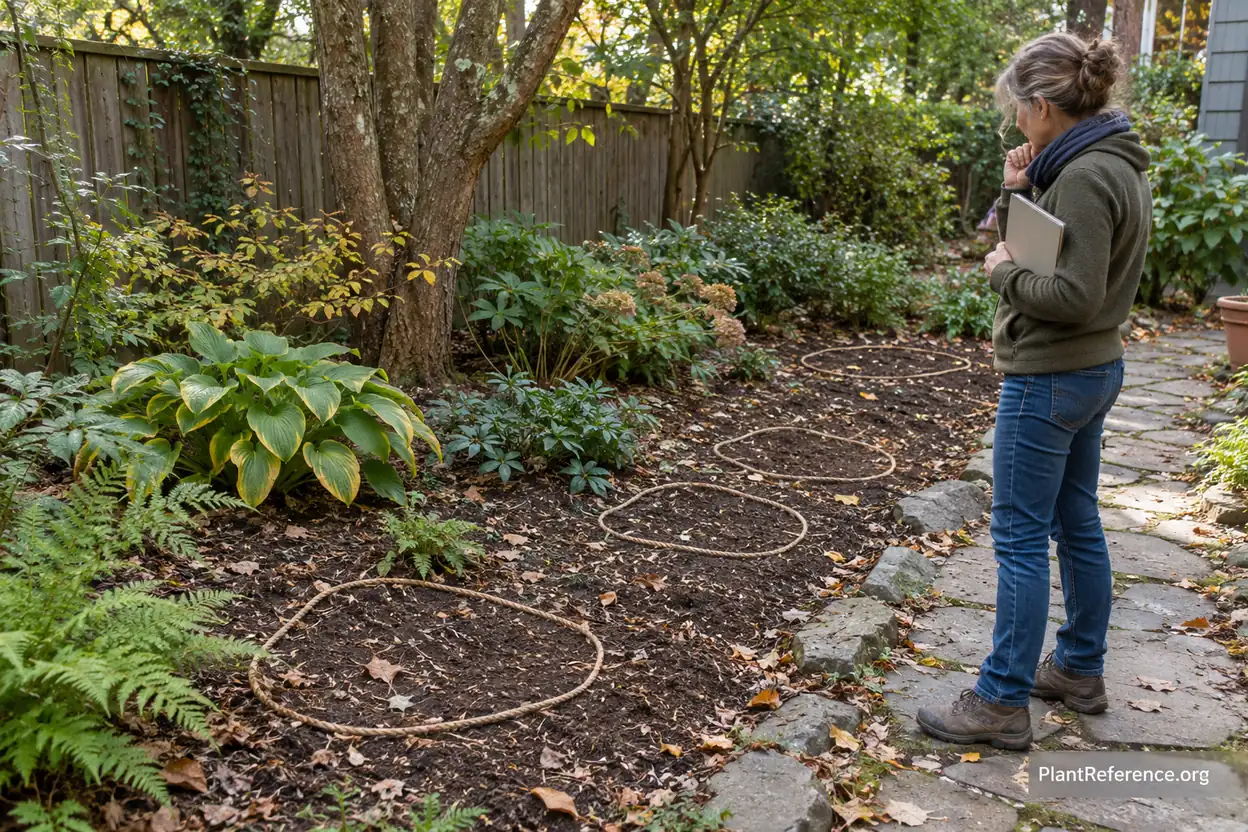
Measure from the center of the proposed plant to the nearest path or wall. If the mature spread would cross that boundary, move the plant or choose another selection. It is easier to adjust a position on paper than to keep a shrub permanently smaller than its natural form.
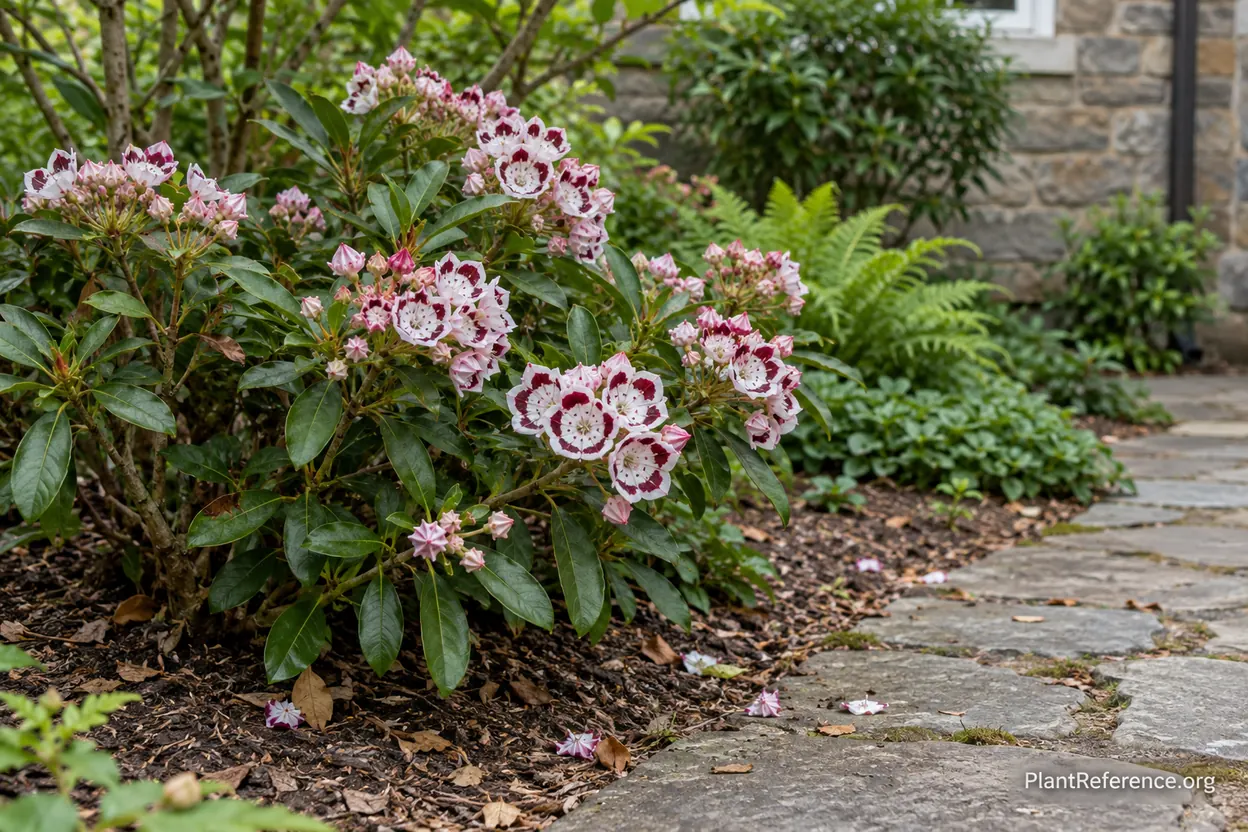
Choose flower detail without overcrowding the palette
🌿Kalmia latifolia 'Olympic Fire' creates a clearer pink note, while 🌿Kalmia latifolia 'Keepsake' contributes darker cups with contrasting white detail. Either can be the focal point of a small composition. Using both is not necessary to make the border feel complete.
Surround the chosen accent with simpler foliage and enough visual space to notice it. A background of repeated greens can make flower detail easier to appreciate than a busy collection of competing colors. Outside the flowering period, the foliage arrangement should still look intentional.
Match Soil, Moisture and Tree Roots
Test the soil before buying acid-loving shrubs
Mountain laurel and pieris belong in a discussion of acidic woodland planting conditions. Rhododendrons likewise favor acidic soil, with the research highlighting roughly pH 4.5–5.5 for that group. Do not transfer this exact range indiscriminately to every plant in a mixed border.
How to Test Garden Soil: Jar, Ribbon & pH Tests is the starting point before adding amendments. A test can reveal whether the desired shrub already suits the site or whether maintaining it would require continuing intervention. Choosing a better-matched plant is often the simpler design decision.
Do not assume fallen needles automatically produce the required acidity. Nor should you add lime because it is customary elsewhere in the garden. Use measurements and the actual plant's requirements, not a general impression of what woodland soil ought to be.
Moisture must come with drainage
A shaded bed can be dry beneath competitive trees or wet where runoff collects. Neither condition is visible from the word “shade” on a plant label. Check after rain and during a dry period before deciding where to install a substantial root ball.
Soil Health 101: How to Build Living, Productive Garden Soil explains why roots need both moisture and air. A low spot that holds water is not automatically a good location for a shrub that prefers evenly moist conditions.
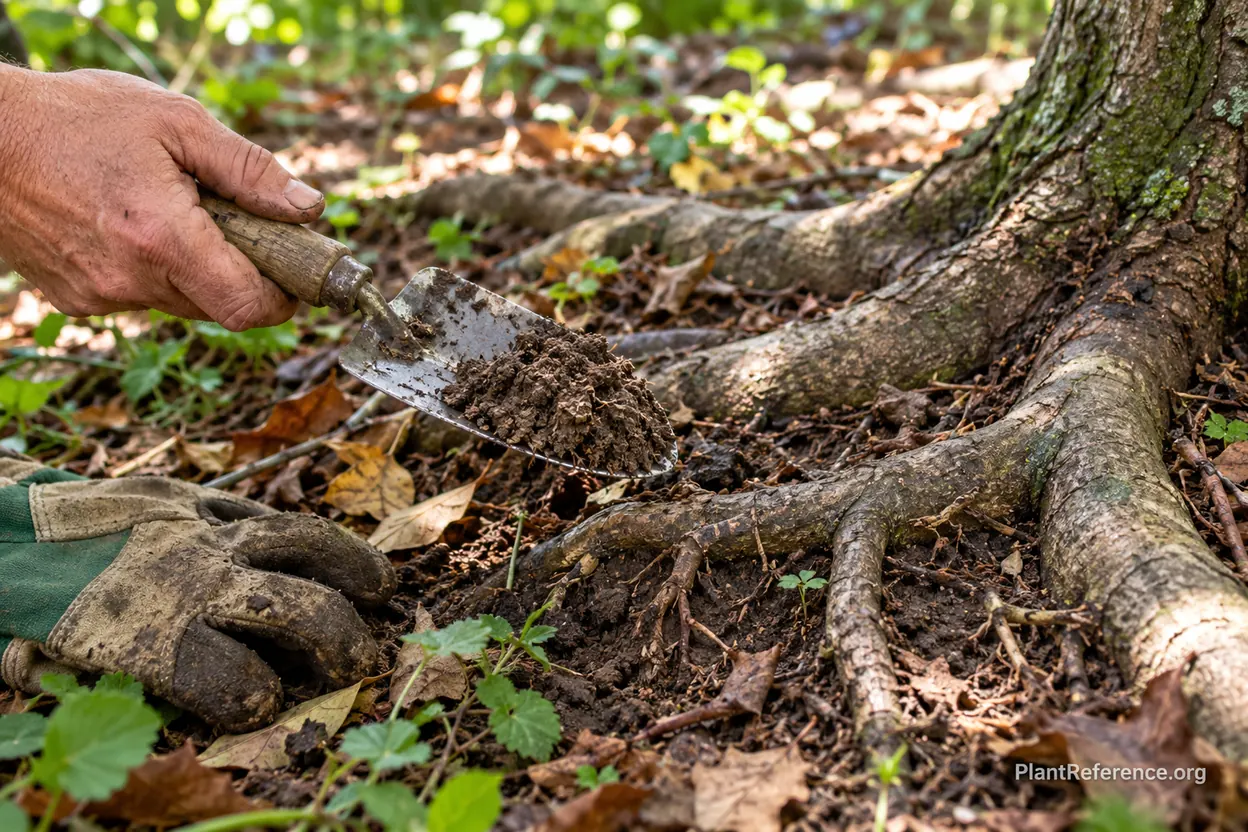
Protect the trees providing the shade
Much tree-root activity occupies the upper 12–18 inches (30–46 cm) of soil. A large shrub container may not fit safely into that space. Look for a natural planting gap, consider a smaller nursery plant, or place the shrub farther from the crowded root area.
Do not cut important woody roots or pile imported soil over the tree's root zone to make room. The canopy is part of the garden's structure too. Damaging it to install an understory shrub defeats the purpose of the planting.
For difficult soil away from critical tree roots, How to Improve Clay Soil Without Making It Worse can help with broader planning. Under established trees, use particular restraint: recommendations for cultivating an empty bed do not automatically apply to a root-filled woodland border.
Plant for the Shrub's Mature Shape
Arrange the plants before making holes
Set containers in their proposed positions and look from several viewpoints. Check the path, the view from indoors, and the space needed for maintenance. A pleasing arrangement from one angle can still block a gate or crowd a neighboring plant.
Leave deliberate openings. Groundcover and smaller perennials can eventually occupy suitable spaces, but the shrub framework should have breathing room. This is especially helpful where humid shade can keep crowded foliage damp.
Use this sequence once the site and season are suitable:
Confirm the selected plant's local suitability and mature dimensions.
Check for buried utilities and important existing roots before digging.
Water a dry container root ball before planting and allow excess water to drain.
Prepare a hole that accommodates the root system without burying the plant deeper than intended.
Backfill gently, water the root zone, and check for settling.
Apply a modest surface mulch while keeping stems and root flares uncovered.
Keep the root ball connected to surrounding soil
A shrub planted into an isolated pocket of rich material still has to grow into the surrounding ground. Avoid treating the planting hole as a separate pot buried in the garden. The aim is a stable transition, not a small oasis that masks an unsuitable site.
Check the original root ball after watering. Moist surrounding soil can coexist with a dry container-grown root mass, particularly early in establishment. Direct water where the roots currently are while monitoring the wider planting area for saturation.
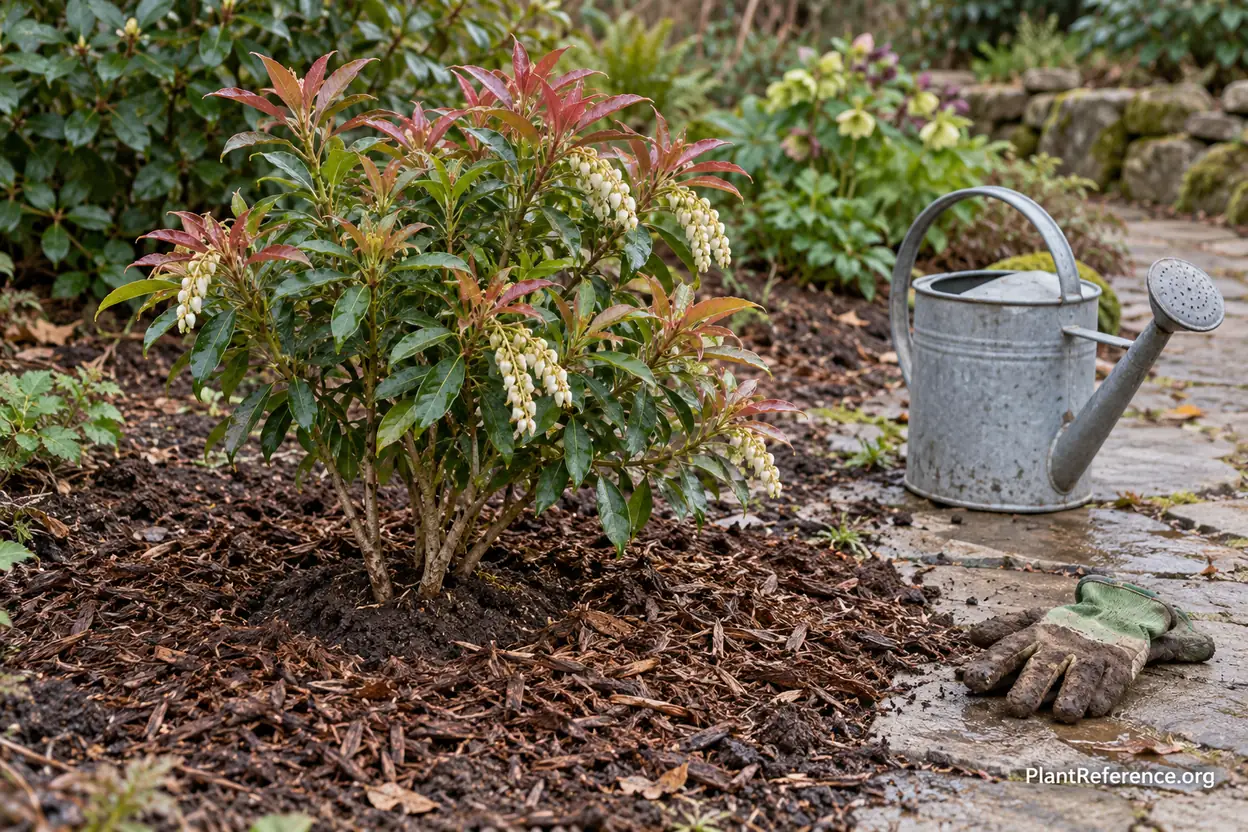
Use mulch as surface care, not a raised planting mound
Composted bark, leaf mold, or an appropriate aged wood mulch can help moderate the exposed soil surface. Keep the application clear of the shrub's base and existing tree trunks. More material is not automatically more protection.
In a shared border, consider the smallest plants as well as the shrubs. A deep layer that looks tidy around a woody plant may bury nearby perennial crowns. Spread carefully, retain visible planting levels, and check the surface again after rain moves loose material.
Maintain Structure and Diagnose Problems
Let form guide pruning
Begin by observing the natural outline, not by reaching for shears. Remove clearly damaged material as appropriate, but avoid routine cutting solely to force a plant into a space it has outgrown. A recurring conflict with a path usually points back to selection or placement.
Flowering and pruning responses differ among shrubs. For hydrangeas, consult Hydrangea Types Explained: Pruning, Color & Care Guide before cutting healthy stems; the shared common name does not imply identical timing. Preserve the seasonal qualities that led you to choose the plant.
Separate poor flowering from poor health
An evergreen can have healthy foliage yet flower sparsely in excessive shade. Adding fertilizer cannot replace missing light. Consider whether the canopy has become denser or whether the plant was selected for a darker position than its flowering performance supports.
Why Your Rhododendron Isn't Blooming (and How to Fix It) explores that diagnosis for rhododendrons. For regional details on that group, use Growing Rhododendrons and Azaleas in the PNW rather than applying the same care assumptions to every shade shrub.
Check symptoms before choosing a treatment
Wilting can occur when roots lack water, but damaged or waterlogged roots can also fail to supply the foliage. Check the root ball and drainage before increasing irrigation. Hydrangea Wilting Even When Watered? 6 Causes is useful when that pattern appears in a hydrangea rather than assuming every wilted shrub is simply thirsty.
Pieris and rhododendrons can suffer root-weevil damage. Notched leaves are a clue, but leaf appearance alone does not establish the extent of root damage or justify a treatment. Identify the pest and assess the plant before choosing a control; do not apply a general pesticide schedule to the whole border.
Keep circulation around plants, remove clearly diseased fallen material as appropriate, and watch how the garden changes through a full year. The best shrub arrangement is not the one with the most labels. It is the one whose shapes, moisture needs, and seasonal qualities fit together without constant correction.
Frequently Asked Questions
Reading about plants and recognising them are different skills. These three build the second.
- Daily PlantIdentify the day’s mystery plant from a close-up photograph.
- Keyed OutWork a dichotomous key, lead by lead, to name a hidden specimen.
- Name That PlantName a specimen from botanical clues dealt hardest first.
Free to play, no account needed
Tagged with
Sophie is a garden designer in Charlotte who came to the U.S. from France about a decade ago. Her design sensibility blends the structured formality of French garden traditions with the looser, more naturalistic style that works well in the Southeast. She has a degree in landscape architecture and worked at several design firms in Charlotte before going independent. She specializes in year-round garden structure, mixed borders, and creating outdoor spaces that feel intentional without being rigid. Sophie writes about garden design principles, plant combinations, and creating visual interest across seasons—always grounded in what actually grows well in the Piedmont.