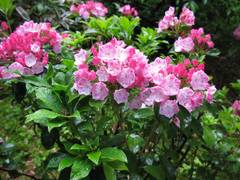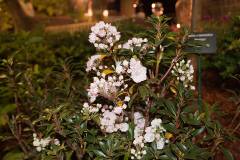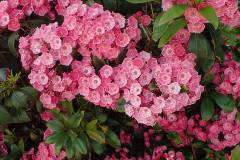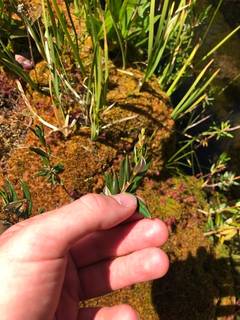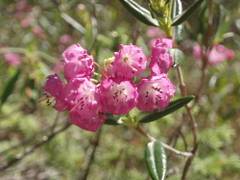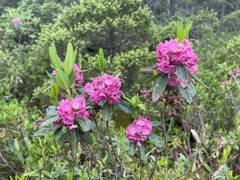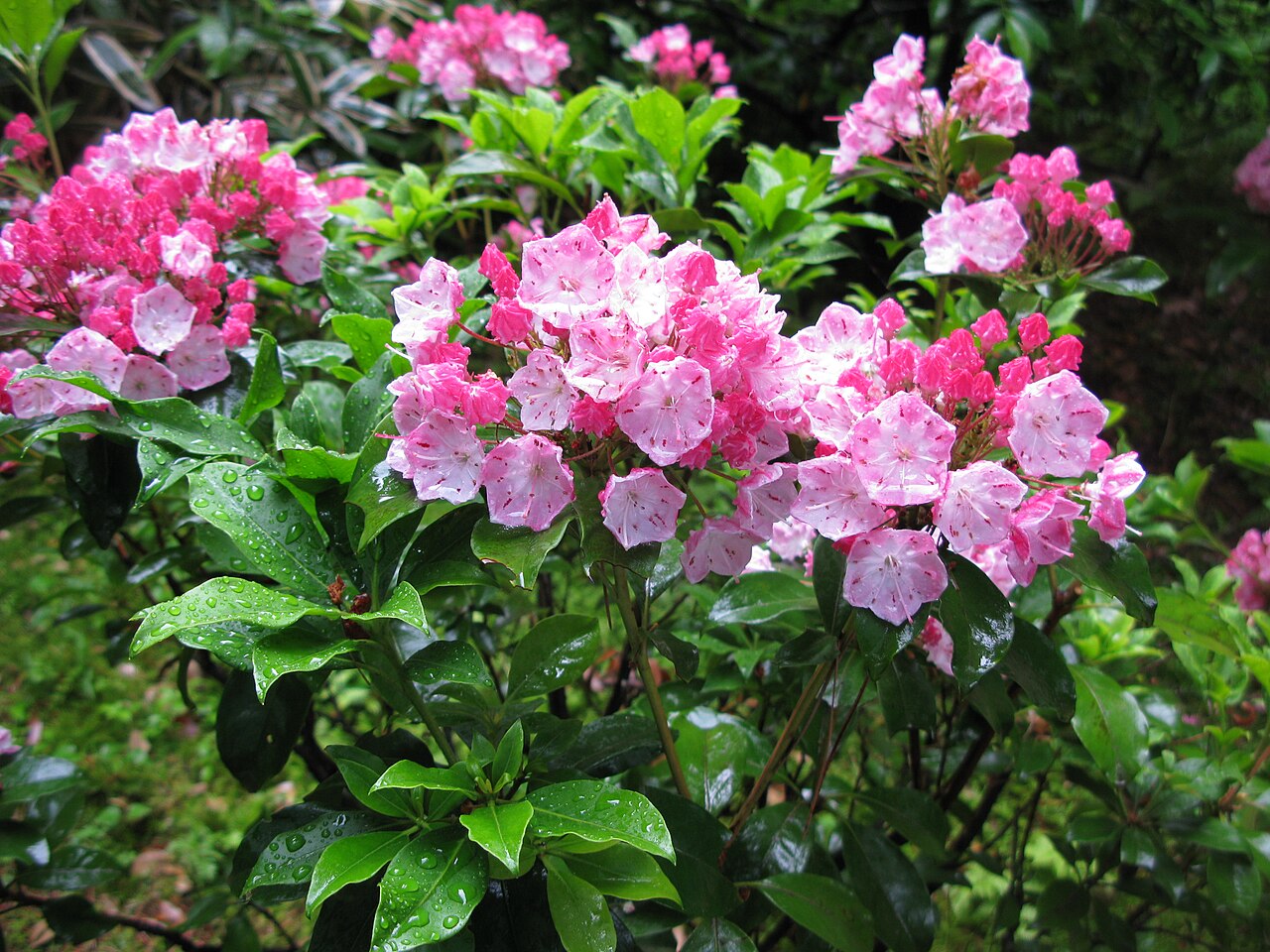
Species photo — your cultivar may vary
© Qwert1234, some rights reserved (CC-BY-SA) · Wikimedia Commons
Kalmia, Genus, latifolia, Species, 'Keepsake', Cultivar,
- Genus & species
- Cultivar
Keepsake Mountain Laurel
Eastern North America (Maine to Florida, west to Louisiana); cultivar from Richard Jaynes, Connecticut
Overview
Kalmia latifolia 'Keepsake' is an upright, evergreen broadleaf shrub reaching 5-7 feet (1.5-2.1 m) tall with a spread of 4-6 feet (1.2-1.8 m). The cultivar produces bicolored cup-shaped flowers in late May through June: deep burgundy-red buds open to reveal white interiors marked with a continuous maroon-burgundy band 3-4 mm wide around the inner cup, with a thin burgundy edge on the rim. Individual flowers are 0.75-1 inch (2-2.5 cm) across and carried in dense terminal corymbs 4-5 inches (10-13 cm) wide. Flower buds show geometric 10-sided symmetry before opening. The dark green, leathery, glossy, elliptic leaves are 3-5 inches (8-13 cm) long and persist year-round. Stems are stiff and upright with smooth gray-brown bark. Requires acidic soil (pH 4.5-6.0) and moist conditions; does not tolerate alkaline or waterlogged soils. All parts contain grayanotoxins and are toxic to pets and humans if ingested. Growth rate is slow to moderate; 5-7 years to reach mature size. Hardy to USDA zone 5. Developed by Richard Jaynes at the Connecticut Agricultural Experiment Station.
Native Range
The species Kalmia latifolia is native to eastern North America, from Maine south to Florida and west to Louisiana, where it grows in rocky acidic forest understory, mountain slopes, and pine-oak woods. The cultivar 'Keepsake' was developed by Richard Jaynes at the Connecticut Agricultural Experiment Station and is propagated vegetatively.Suggested Uses
Used in woodland gardens, shade borders, and mixed evergreen plantings at 4-5 foot (1.2-1.5 m) spacing. The continuous burgundy band against the white cup creates high-contrast bicolor pattern at close range. Pairs with other acid-loving evergreens such as rhododendrons and Pieris japonica. Requires acidic soil and consistent moisture; not suited to alkaline, dry, or full-sun exposed sites in hot climates. All parts are toxic to pets and humans if ingested. Not suited for container culture long-term given mature 5-7 foot (1.5-2.1 m) size.How to Identify
Appearance
Size & Dimensions
Height5–7 feet (1.5–2.1 m)
Width/Spread4–6 feet (1.2–1.8 m)
Height1.5–2.1 m (5–7 feet)
Width/Spread1.2–1.8 m (4–6 feet)
Bloom Information
Bicolored cup-shaped flowers 0.75-1 inch (2-2.5 cm) across in dense terminal corymbs 4-5 inches (10-13 cm) wide, from late May through June. Deep burgundy-red buds open to white cups marked with a continuous maroon-burgundy band 3-4 mm wide on the inner cup and a thin burgundy edge on the rim. Bloom duration is 3-4 weeks and does not rebloom.
Detailed Descriptions
Flower Description
White with a continuous maroon-burgundy band 3-4 mm wide on the inner cup surface; deep burgundy-red buds; 0.75-1 inch (2-2.5 cm) across in corymbs 4-5 inches (10-13 cm) wideFoliage Description
Dark green, leathery, glossy, elliptic, 3-5 inches (8-13 cm) long, evergreenGrowing Conditions
Sun Requirements
Requires 2-5 hours of direct sunlight daily
• Full Sun: 6+ hours of direct sunlight
• Partial Shade: 3-6 hours of direct sunlight
• Full Shade: Less than 3 hours of direct sunlight
Care & Maintenance
Care Guide
Grows in partial shade to full shade in acidic (pH 4.5-6.0), moist, well-drained soil rich in organic matter. Hardy to USDA zone 5. An acidic mulch of pine needles or shredded oak leaves helps maintain soil pH and conserve moisture. Does not tolerate alkaline soils, drought, or waterlogging. The bicolor flower pattern is consistent in both partial shade and dappled sun. Lace bugs can cause foliage stippling in sunny, dry positions.Pruning
Deadhead spent flower clusters after bloom by snapping off below the corymb to redirect energy into next year's flower buds. Minimal shaping is typically needed. Heavy cuts into old wood often fail to resprout. Remove dead or crossing branches in late winter.Pruning Schedule
Prune: June–July
summer