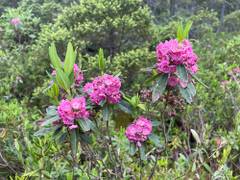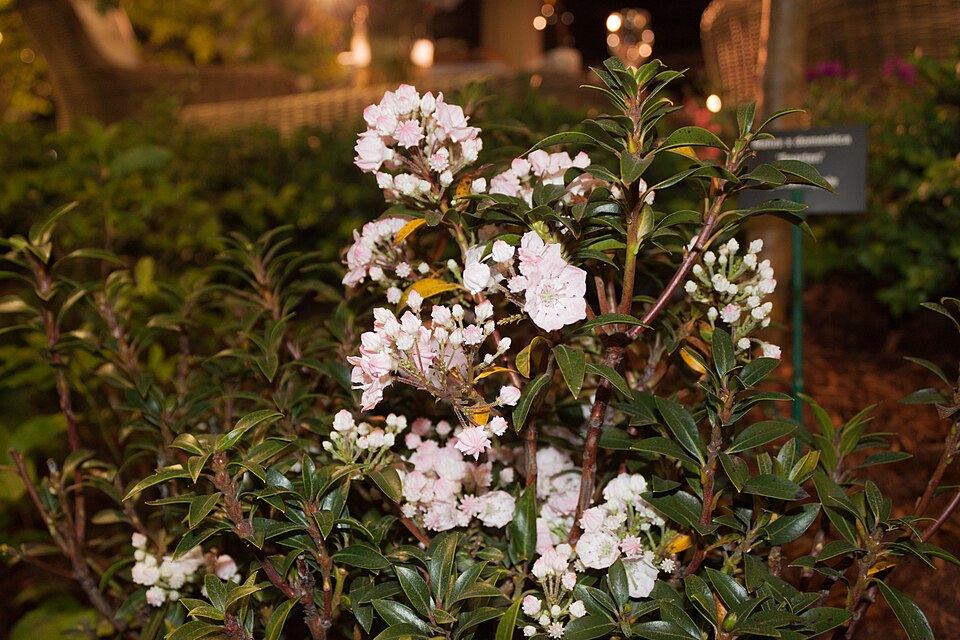
Kalmia, Genus, latifolia, Species, 'Elf', Cultivar,
- Genus & species
- Cultivar
elf mountain laurel
Eastern North America (Maine and southern Quebec south to Florida, west to Louisiana)
Overview
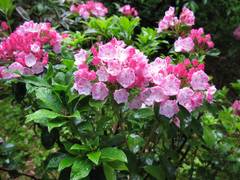
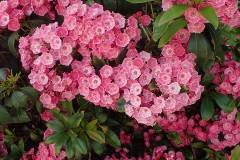
Kalmia latifolia 'Elf' is a compact, evergreen, mounding shrub reaching 3–4 feet (0.9–1.2 m) tall and 3–4 feet (0.9–1.2 m) wide — roughly half the mature dimensions of the species type, which reaches 6–10 feet (1.8–3 m). Flowers are cup-shaped, 0.5–0.75 inches (1.3–2 cm) across, with five fused petals forming a pentagonal bowl. Flower buds are light pink and open to near-white corollas 2–3 days after bud break. Flowers are borne in dense terminal corymbs 3–4 inches (8–10 cm) wide from late May through June over a 3–4 week window. Each corolla holds 10 stamens with anthers tucked into small pockets in the petal surface; the stamens are held under spring tension and release explosively onto visiting pollinators, flinging pollen 0.5–1 inch (1.3–2.5 cm) when triggered. Leaves are elliptic, 2–4 inches (5–10 cm) long, glossy dark green, leathery, evergreen, arranged alternately on stems. Growth rate is slow at 3–6 inches (8–15 cm) per year, reaching mature size in 6 years. Hardy to USDA zone 5. All plant parts contain grayanotoxins (including andromedotoxin); ingestion of as little as 0.2% of body weight of leaves or flowers causes vomiting, salivation, bradycardia, and in larger doses convulsions and cardiac arrest in pets, livestock, and humans. Honey produced from Kalmia nectar is also toxic.
Native Range
Kalmia latifolia is native to eastern North America, from Maine and southern Quebec south to Florida and west to Louisiana and southern Indiana, occurring in acidic forest understories, rocky outcrops, and mountain slopes from sea level to 4,000 feet (1,200 m). The cultivar 'Elf' is a horticultural selection made for compact habit.Suggested Uses
Used in partial-shade borders, woodland gardens, acid-soil foundation plantings, and containers 7 gallons (26 L) or larger at 3–4 foot (0.9–1.2 m) spacing. The 3–4 foot (0.9–1.2 m) mature size fits residential beds where the species type at 6–10 feet (1.8–3 m) exceeds available space. All parts are highly toxic (grayanotoxins) to pets, livestock, and humans; honey from Kalmia nectar is also toxic. The shrub requires acidic soil and does not tolerate alkaline soils, drought, full sun in hot climates, or waterlogged sites.How to Identify
Appearance
Size & Dimensions
Height3' - 4'
Width/Spread3' - 4'
Bloom Information
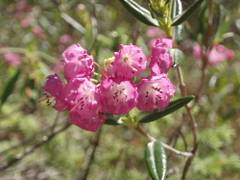
Dense terminal corymbs 3–4 inches (8–10 cm) wide of cup-shaped flowers 0.5–0.75 inches (1.3–2 cm) across appear from late May through June over a 3–4 week window. Flower buds are light pink and open to near-white corollas. Each corolla carries 10 stamens held under spring tension in small pockets in the petal surface; stamens release when triggered by pollinator contact, flinging pollen 0.5–1 inch (1.3–2.5 cm).
Detailed Descriptions
Flower Description
Light pink buds opening to near-white cup-shaped corollas 0.5-0.75 inches across; dense terminal corymbs 3-4 inches wide; 10 spring-loaded stamens per flowerFoliage Description
Glossy dark green, leathery, elliptic, 2-4 inches long; evergreenGrowing Conditions
Sun Requirements
Requires 2-5 hours of direct sunlight daily
• Full Sun: 6+ hours of direct sunlight
• Partial Shade: 3-6 hours of direct sunlight
• Full Shade: Less than 3 hours of direct sunlight
Care & Maintenance
Care Guide
Grow in partial shade to full shade with 2–5 hours of dappled morning light in acidic (pH 4.5–6.0), moist, well-drained loam or peat-amended soil rich in organic matter. Alkaline or neutral soils cause chlorosis and progressive decline; a soil test is recommended before planting in unknown soils. Mulch 2–3 inches (5–8 cm) deep with acidic organic matter such as pine needles, composted pine bark, or oak leaf mold, refreshed annually. Water deeply during establishment for the first two growing seasons, then maintain consistent moisture through summer — the shallow root system is sensitive to drought. Lace bug (Stephanitis rhododendri) damage appears as stippled silver-green foliage on plants in sunny or dry positions and is reduced in shaded moist siting. Hardy to USDA zone 5.Pruning
The compact habit requires minimal pruning. Remove spent corymbs after bloom by snapping them off at the base of the flower cluster, which redirects energy into vegetative growth and the following year's flower buds. Hard pruning into old wood regrows slowly, which limits it to rejuvenation of declining plants.Pruning Schedule
Prune: June–July
summer
Container Growing
Suitable for container growing
Minimum container size: 7 gallons