Pieris, Genus, japonica, Species,
- Genus & species
Japanese andromeda
Japan, eastern China, and Taiwan; mountain forests and thickets at low to middle elevations on acidic soils
Overview
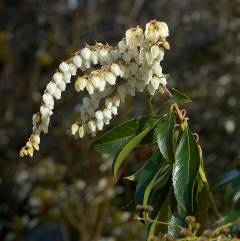
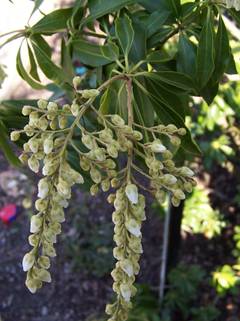
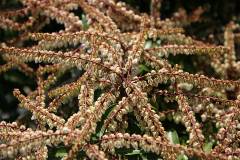
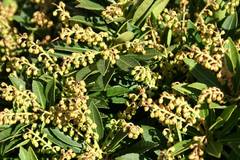
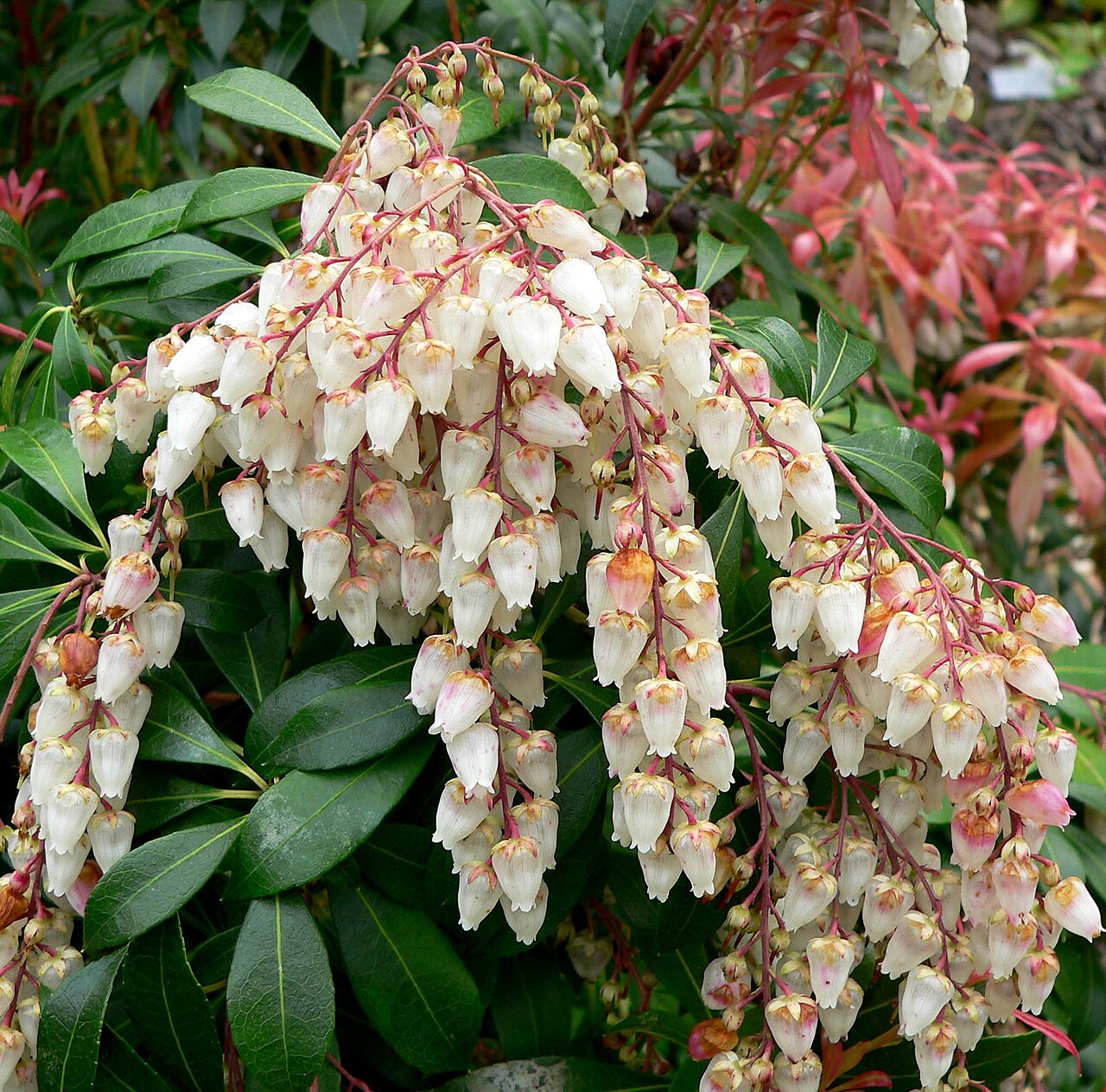
Pieris japonica is an upright broadleaf evergreen shrub in the heath family Ericaceae growing 8–12 feet (2.4–3.6 m) tall and 6–10 feet (1.8–3 m) wide from a multi-stemmed base that produces a dense rounded canopy with the foliage arranged in whorled clusters near the stem tips. The species' alternative common name lily-of-the-valley shrub reflects the resemblance of the small urn-shaped white flowers in pendant racemes to the flowers of true lily of the valley (Convallaria majalis), and the pendant cascading raceme form is the species' primary identifying ornamental character. White urn-shaped flowers 0.25 inch (6 mm) long open in pendant terminal racemes 3–6 inches (7–15 cm) long that cascade downward from the branch tips through the February through April bloom window across a 4-week bloom period, and the cultivars supply a color range from white through pink to deep rose — 'Valley Valentine' carries deep rose flowers, 'Dorothy Wycoff' opens pink buds to white flowers, and 'Cavatine' is a compact white-flowered selection for tighter garden positions. The pendant raceme form and the glossy dark green foliage with bronze new-growth flush separate P. japonica from the related Appalachian P. floribunda (mountain pieris), which carries upright rather than pendant flower racemes and produces no bronze new growth. New spring growth emerges in bronze to reddish-bronze tones that contrast with the surrounding mature dark green canopy and that develop in particularly vivid red on the cultivars 'Mountain Fire' and 'Forest Flame' selected for the intensified spring color expression. Leaves are glossy dark green, lance-shaped, leathery, and 1.5–3.5 inches (4–9 cm) long. Limitation: all parts of the plant — leaves, stems, flowers, and nectar — contain grayanotoxin, the same sodium-channel-binding diterpenoid present in the related Kalmia latifolia and Rhododendron species, and ingestion produces severe gastrointestinal distress, oral burning, and (at higher quantities) cardiac and neurological effects in humans, livestock, cats, dogs, and horses. Lace bug (Stephanitis takeyai, the Andromeda lace bug) is the primary pest pressure on the species in cultivation and produces stippled yellowed foliage on the upper leaf surface from feeding damage on the underside; lace bug populations are most severe on plants in full-sun positions and on plants under drought stress, and the species' shade-and-moisture cultural preference is partly the practical management of the lace bug pressure. Phytophthora root rot develops in poorly drained or waterlogged soils. The species calls for strictly acidic soil with a pH of 4.5–6.0 and develops chlorosis at higher pH levels — this strict acid soil requirement and the lace bug susceptibility are the primary cultural limitations. Native to Japan, eastern China, and Taiwan. Not drought-tolerant. Deer-resistant (the grayanotoxin chemistry deters browsing).
Native Range
Native to Japan, eastern China, and Taiwan, growing in mountain forests and thickets at low to middle elevations on acidic forest soils. The species was introduced to western horticulture from Japan in the 19th century during the period of expanded plant collecting in East Asia by E. H. Wilson, Robert Fortune, and other plant collectors, and the species has been a foundation broadleaf evergreen shrub for acidic-soil shade gardens across temperate regions of Europe and North America since the late 19th century introduction.Suggested Uses
Used in acidic shade gardens, woodland understory plantings under high deciduous canopy, mixed shade borders alongside Rhododendron and Kalmia companions, foundation plantings on the north or east side of buildings, and container specimens in containers of at least 7 gallons (26 L) with acidic potting mix at 6–10 foot (1.8–3 m) spacing between plants in USDA zones 5 through 8. The pendant cascading flower racemes through February through April, the bronze to reddish-bronze new spring growth flush, the year-round glossy dark green broadleaf evergreen foliage, and the four-season interest including the visible winter flower buds combine to make the species a high-value broadleaf evergreen shrub for acidic shade gardens. Alkaline soil positions, dry-summer regions without irrigation, and full-sun hot-afternoon-exposure positions are unsuitable because of the strict acid soil requirement, the moisture requirement, and the lace bug pressure that intensifies on stressed plants in full sun. Gardens with grazing livestock, gardens where children, cats, dogs, or horses may access the foliage or flowers, and apiaries where bees may forage on the Pieris flowers should account for the severe grayanotoxin toxicity of all plant parts and of the honey produced from the nectar.How to Identify
Appearance
Size & Dimensions
Height8' - 12'
Width/Spread6' - 10'
Bloom Information
White (in the species type) to pink to rose (in the colored-flower cultivars) urn-shaped flowers 0.25 inch (6 mm) long open in pendant terminal racemes 3–6 inches (7–15 cm) long that cascade downward from the branch tips through February through April across a 4-week bloom period. The flowers are lightly fragrant with a sweet honey-and-lily-of-the-valley scent at close range. The pendant flower buds are visible at the branch tips through fall and winter in advance of the spring bloom, supplying a secondary off-season ornamental feature. Honeybees and bumblebees work the flowers for nectar across the late-winter and early-spring bloom window — the nectar contains grayanotoxin and is toxic in volume to humans (the same mad-honey concern that applies to the related Kalmia and Rhododendron genera).
Detailed Descriptions
Flower Description
white in the species type and pink to rose in the colored-flower cultivars; small urn-shaped flowers 0.25 inch (6 mm) long carried in pendant terminal racemes 3-6 inches (7-15 cm) long that cascade downward from the branch tips through the February-April bloom window; lightly fragrant with a sweet honey-and-lily-of-the-valley scent at close range; cultivars range from white through pink to deep rose ('Valley Valentine' = deep rose, 'Dorothy Wycoff' = pink buds opening to white flowers, 'Cavatine' = compact white)Foliage Description
glossy dark green lance-shaped leathery leaves 1.5-3.5 inches (4-9 cm) long arranged in whorled clusters near the stem tips; new spring growth emerges in bronze to reddish-bronze tones that contrast with the surrounding mature dark green canopy and that develop in particularly vivid red on the cultivars 'Mountain Fire' and 'Forest Flame' selected for the intensified spring color expression; evergreen year-roundGrowing Conditions
Sun Requirements
Requires 3-6 hours of direct sunlight daily
• Full Sun: 6+ hours of direct sunlight
• Partial Shade: 3-6 hours of direct sunlight
• Full Shade: Less than 3 hours of direct sunlight
Care & Maintenance
Care Guide
Site in part shade with 3–6 hours of direct sun per day, ideally as morning sun with afternoon shade in a position protected from hot afternoon exposure, in well-drained acidic loam or peat-amended soil with a strictly acidic pH of 4.5–6.0 — the species develops chlorosis at higher pH levels and calls for naturally acidic native soil or sustained acidification through pine-needle mulch and elemental-sulfur amendment to maintain the low pH at the root zone. The species is not drought-tolerant and calls for consistent moisture through the growing season. Lace bug (Stephanitis takeyai) is the primary pest and produces stippled yellowed foliage on the upper leaf surface — full-sun positions and drought-stressed plants suffer the heaviest lace bug damage, and the species' shade-and-moisture cultural preference is partly the practical management of lace bug pressure. Phytophthora root rot develops in poorly drained or waterlogged soils. Spent flower clusters are deadheaded after bloom (in April) to prevent seed development that draws resources away from next year's bud set. All parts contain grayanotoxin and are severely toxic to humans, livestock, cats, dogs, and horses if ingested. Deer-resistant. Hardy in USDA zones 5–8.Pruning
Pruning is done immediately after flowering (in April) because next year's flower buds form on the previous year's wood through the summer growing season — pruning later in the year removes the developing flower buds and reduces the next year's bloom display. Spent flower clusters are snapped off at the base after bloom finishes to redirect resources from seed development into next year's bud formation, and dead or crossing branches are removed at the same window. The species tolerates moderate shape-correcting pruning but does not respond well to hard renovation cutbacks because the regeneration from old wood is slow and unreliable.Pruning Schedule
Prune: April
late spring
Container Growing
Suitable for container growing
Minimum container size: 7 gallons