Image 1 of 4
1 / 4
Plant Reference
Elaeagnus, Genus, pungens, Species, 'Maculata', Cultivar,
- Genus & species
- Cultivar
golden variegated elaeagnus
Parent species Elaeagnus pungens native to China and Japan; 'Maculata' is a garden selection of the species
Overview
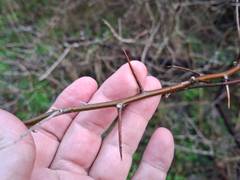
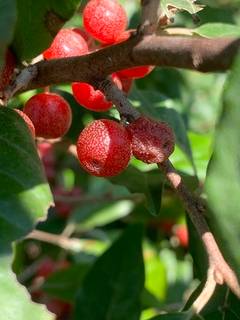
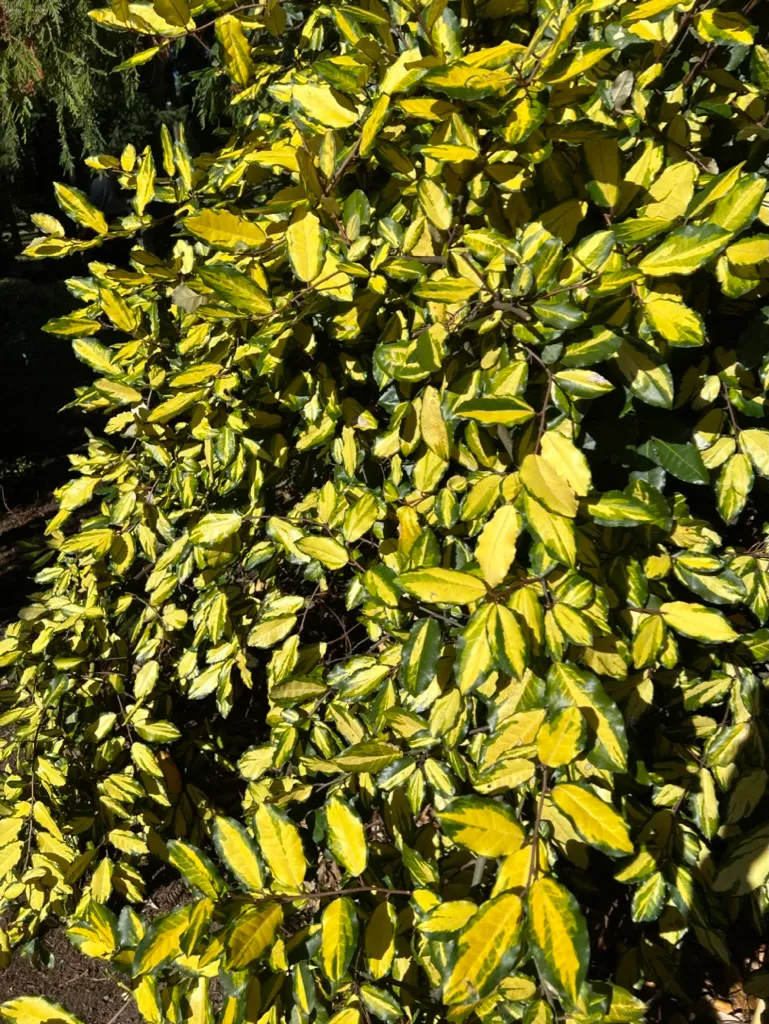
Elaeagnus pungens 'Maculata' is a spreading broadleaf evergreen cultivar in the family Elaeagnaceae growing 6–10 feet (1.8–3 m) tall and 6–10 feet (1.8–3 m) wide from a multi-stemmed base that produces arching branches with scattered axillary thorns — the cultivar is smaller at maturity than the species-type E. pungens (which reaches 8–12 feet / 2.4–3.7 m) because some of the plant's photosynthetic capacity is taken up by the reduced chlorophyll content in the variegated leaf centers. The cultivar name 'Maculata' is Latin for spotted and refers to the central gold to yellow blotch or splash that appears at the middle of each leaf, and the central placement of the gold marking separates 'Maculata' from the related cultivar 'Gilt Edge' (which carries the gold variegation at the leaf margins rather than at the leaf center) — this central-versus-marginal gold distribution is the primary vegetative character for distinguishing the two variegated cultivars of the species. Leaves are dark green at the margins with a central gold to yellow blotch, oval, 2–4 inches (5–10 cm) long, with wavy margins, and densely silvery-scaled on the underside from the peltate scale covering that is the genus character shared with the plain-green species type. White to creamy-white tiny tubular flowers 0.4 inch (10 mm) long open in axillary clusters along the stems in October and November across a 4–5 week bloom period, and the flowers carry the same strong sweet gardenia-like fragrance as the species type and scent the surrounding fall garden air. Limitation: the cultivar has a strong tendency to produce all-green reversion shoots where the variegation has been lost — these reversion shoots are more vigorous than the variegated growth and will overtake and replace the variegated canopy within a few years if allowed to develop, and seasonal inspection for reversion and prompt removal of any all-green shoots cut back to the origin point on the main branch is the primary maintenance operation for this cultivar. The species is one of a small group of non-leguminous plants that form nitrogen-fixing actinorhizal symbiotic associations with Frankia bacteria in root nodules, and this nitrogen-fixing biology is inherited from the species type in the cultivar. The parent species E. pungens is classified as invasive in several southeastern United States states where bird-dispersed fruit colonizes native forest margins and open scrub habitat, and this invasive potential is shared by the cultivar — regional invasive species lists should be consulted before planting in jurisdictions where the species is restricted. Thick leather gloves and long sleeves are warranted during any pruning operation because of the axillary thorns carried at the leaf bases. Drought-tolerant once established. Tolerates salt spray, wind exposure, and poor soils. The fruit is edible but bland. Deer-resistant. Non-toxic.
Native Range
The parent species Elaeagnus pungens is native to China and Japan, growing in mountain scrub and woodland margins at low to middle elevations. The cultivar 'Maculata' is a garden selection of the species and was introduced to western commercial cultivation in the 20th century as a variegated form that combines the tough evergreen habit and the fall fragrance of the species type with year-round gold-centered foliage color.Suggested Uses
Used as a variegated evergreen screen, accent specimen, informal hedge, and container specimen at 6–10 foot (1.8–3 m) spacing between plants in USDA zones 7 through 9. The year-round gold-centered variegated foliage with the silvery leaf undersides and the strongly fragrant fall bloom combine for a variegated large shrub suited to exposed poor-soil positions where the tough biology of E. pungens supports long-term performance. Jurisdictions where the parent species is classified as invasive (several southeastern United States states) are unsuitable because of the bird-dispersed seed spread into native vegetation shared between the cultivar and the species type. Gardeners who are not willing to perform seasonal reversion monitoring and removal will see the variegated canopy replaced by all-green reversion growth within a few years, and the plain-green E. pungens species type is the alternative choice where the variegation maintenance is not wanted.How to Identify
Appearance
Size & Dimensions
Height6' - 10'
Width/Spread6' - 10'
Bloom Information
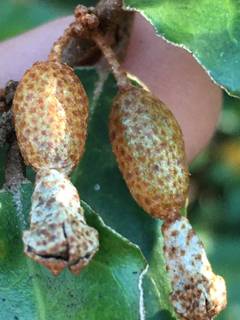
White to creamy-white tiny tubular flowers 0.4 inch (10 mm) long open in axillary clusters along the stems in October and November across a 4–5 week bloom period. The flowers carry the same strong sweet gardenia-like fragrance as the species type, and the fall bloom timing fills a fragrance gap that most other fragrant flowering shrubs do not cover in the autumn months. Honeybees work the flowers during warm fall days.
Detailed Descriptions
Flower Description
white to creamy-white tiny tubular flowers 0.4 inch (10 mm) long carried in axillary clusters along the stems in October and November; inconspicuous in appearance but strongly fragrant with a sweet gardenia-like scent inherited from the species typeFoliage Description
dark green at the leaf margins with a central gold to yellow blotch or splash at the middle of each leaf; silvery-scaled on the underside from a covering of tiny peltate scales; oval leaves 2-4 inches (5-10 cm) long with wavy margins; the gold pattern is in the center of the leaf (not at the margins) which separates 'Maculata' from the related cultivar 'Gilt Edge' (gold at the margins); the cultivar produces all-green reversion shoots that must be removed to preserve the variegated characterGrowing Conditions
Sun Requirements
Requires 4-8 hours of direct sunlight daily
• Full Sun: 6+ hours of direct sunlight
• Partial Shade: 3-6 hours of direct sunlight
• Full Shade: Less than 3 hours of direct sunlight
Care & Maintenance
Care Guide
Site in full sun to partial shade with 4–8 hours of direct sun per day in well-drained soil with a pH of 5.5–7.5. The cultivar adapts to loam, sand, and clay soils and is drought-tolerant once the root system is established, and the nitrogen-fixing actinorhizal symbiosis with Frankia bacteria in the root nodules — inherited from the species type — supports growth in poor and nutrient-depleted soils. The cultivar has a strong tendency to produce all-green reversion shoots where the variegation has been lost, and seasonal inspection for reversion and prompt removal of any all-green shoots cut back to the origin point on the main branch is the primary maintenance operation. The parent species is classified as invasive in several southeastern United States states, and this invasive potential is shared by the cultivar — regional invasive species lists should be consulted before planting in jurisdictions where the species is restricted. Thick leather gloves and long sleeves are warranted during any pruning operation because of the axillary thorns carried at the leaf bases. The fruit is edible but bland. Non-toxic and deer-resistant. Hardy in USDA zones 7–9.Pruning
Seasonal inspection for all-green reversion shoots is the primary pruning operation — any all-green shoots that appear are cut back to the origin point on the main branch whenever they are noticed because the reversion growth is more vigorous than the variegated growth and will overtake and replace the variegated canopy within a few years if allowed to develop. General size-control pruning is done in early spring (March) or in fall (December), and the cultivar tolerates hard renovation pruning back to the woody framework with reliable regrowth from the base. Thick leather gloves and long sleeves are warranted during any pruning operation because of the axillary thorns carried at the leaf bases along the stems.Pruning Schedule
Prune: March & December
early springfall