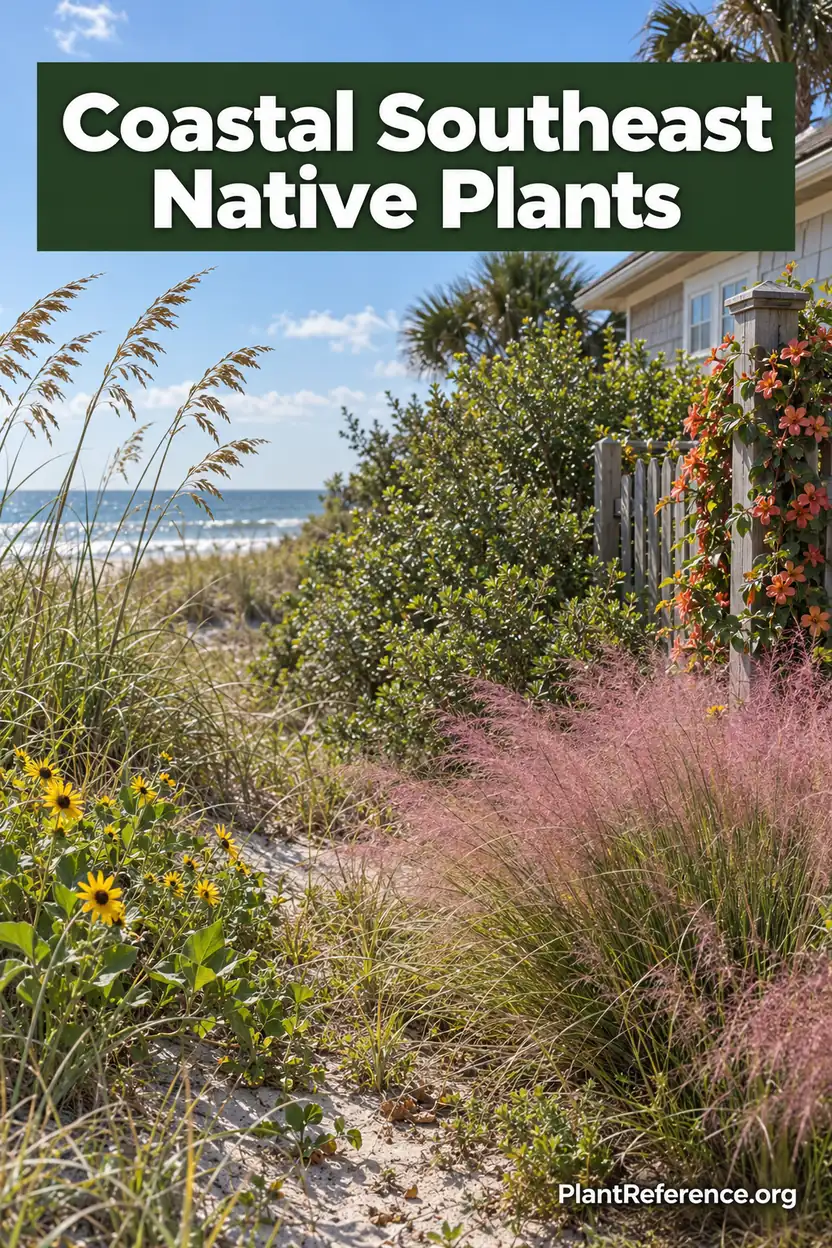
Best Native Plants for Coastal Southeast Gardens
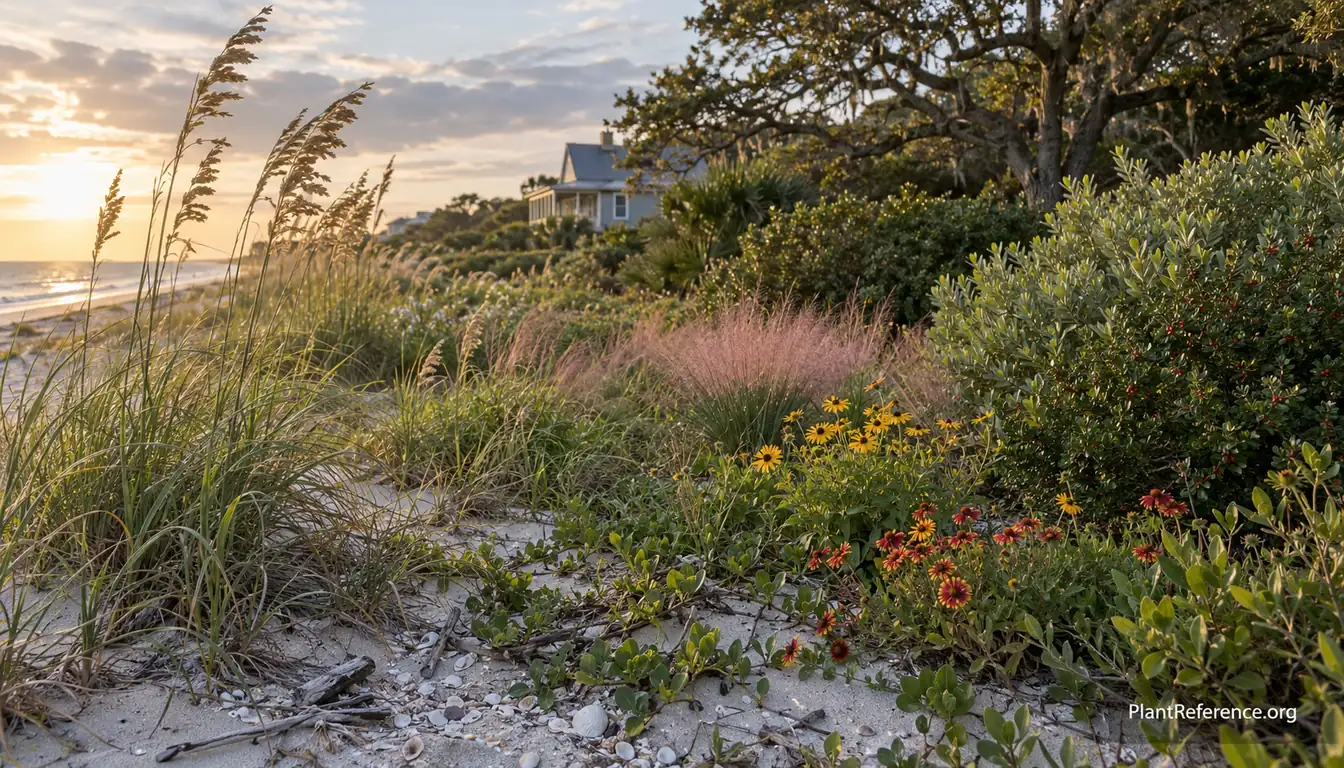
— Image © PlantReference.org 2026
Pets & Toxicity
Recorded toxicity for plants linked in this guide. An unknown status is not a safety assessment.
Toxic to pets: common winterberry, gallberry, southern live oakDetailsHide
Quercus virginiana — Toxicity Warning
Toxic when leaves or acorns are eaten in quantity, especially by horses and grazing livestock; human ingestion toxicity is generally low.View Quercus virginiana plant profileCoastal Southeast native plants survive conditions that defeat ordinary landscape choices: salt spray, abrasive wind, fast-draining sand, humidity, intense rain, and tropical storms. The strongest design follows the shore-to-yard gradient. Put true dune specialists in the most exposed zone, then move through grasses and low shrubs toward sheltered hedges, vines, and canopy plants.
Map Salt, Wind, Sand, and Fresh-Water Pockets
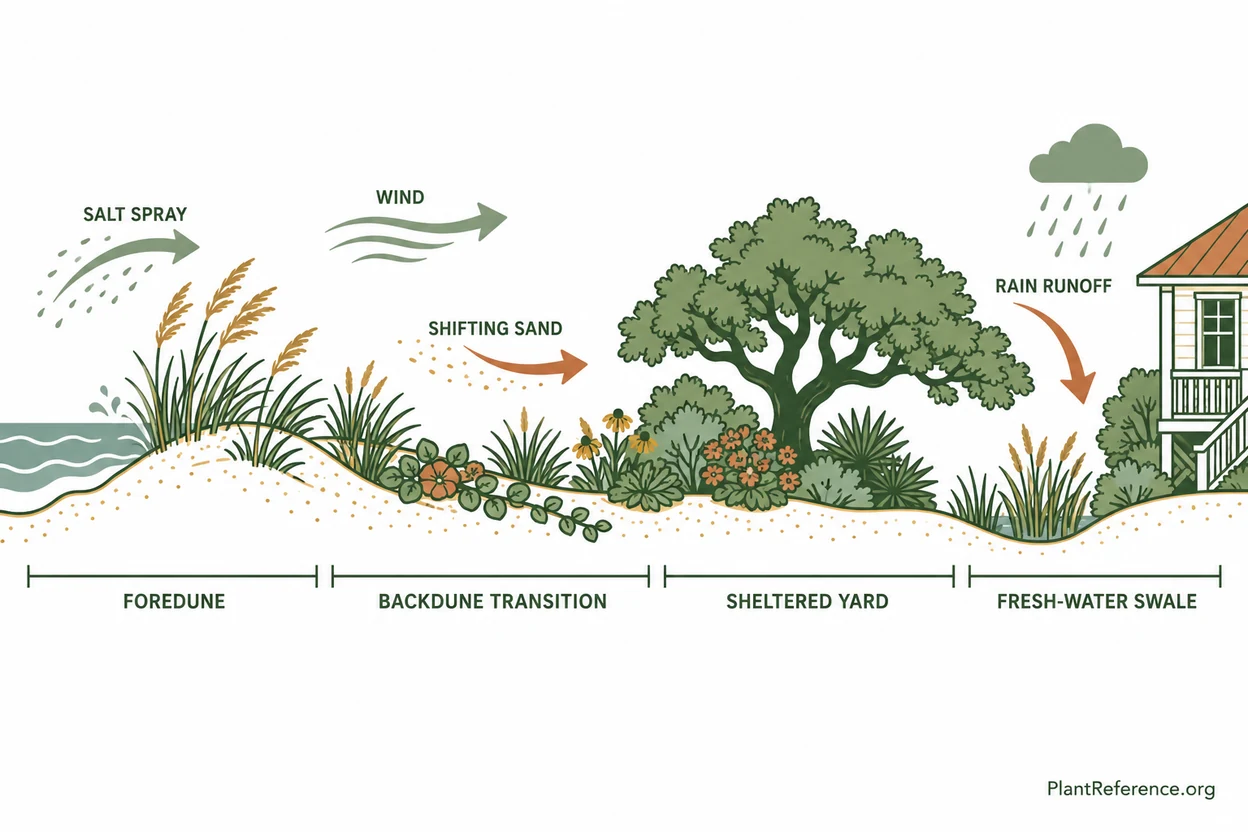
Coastal gardening is not paradise if you ignore exposure. Two beds 100 feet (30 m) apart can behave like different climates. The ocean-facing bed may receive salt crystals, sand blast, and drying wind, while a courtyard behind a wall stays humid and almost still. Walk the property after an onshore storm and note where foliage burns, sand piles, and rainwater stands.
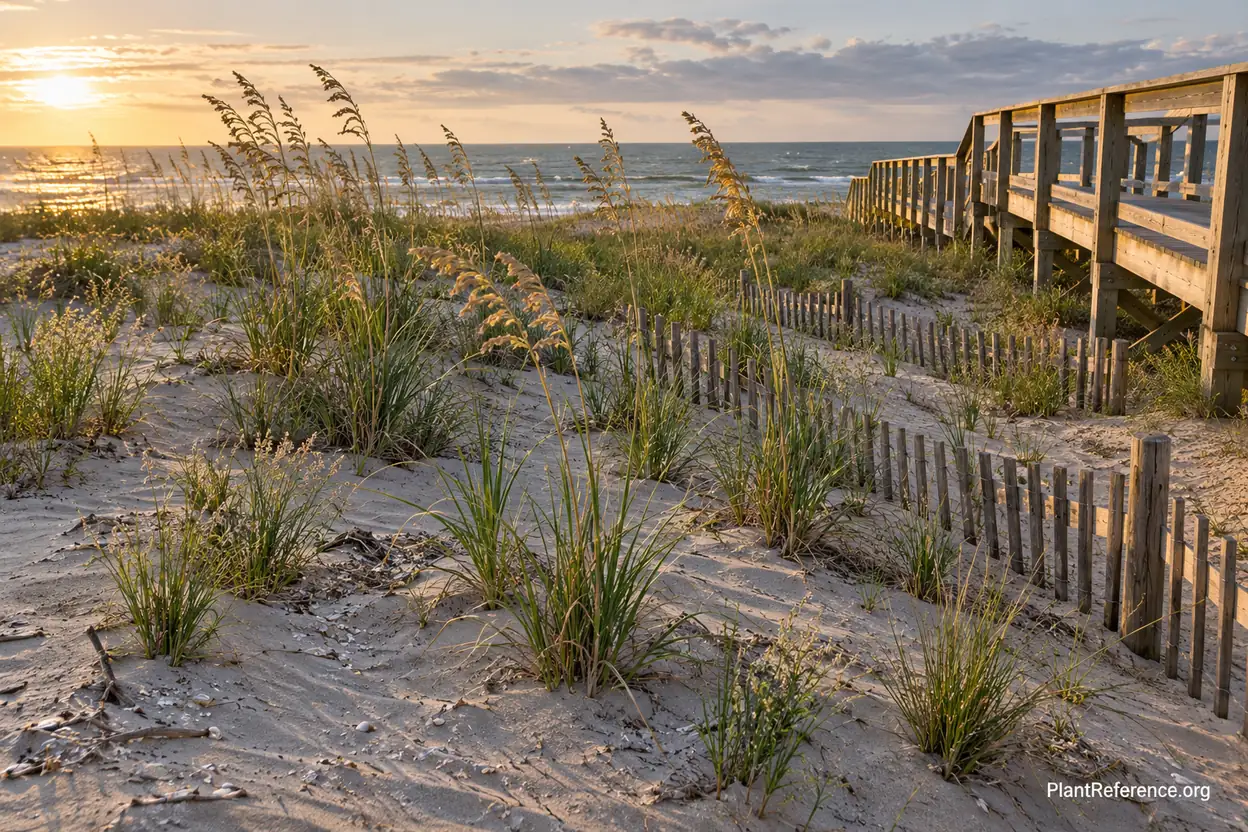
Divide the site into three practical bands. The frontal or foredune band receives the strongest salt and moving sand. The backdune transition has some protection and can support bunchgrasses, low flowers, palms, and tough shrubs. The sheltered yard has reduced salt, deeper organic matter, and more irrigation choices. This is where live oak, evergreen hedges, crossvine, and fresh-water hollies are most comfortable.
Salt arrives in several ways. Direct spray coats leaves and pulls water from tissue. Saline groundwater or storm surge affects roots. Wind dries foliage even when soil is moist. A plant may tolerate one pathway and struggle with another, so "salt-tolerant" is not a universal rating. Use local observations and regional nursery advice to refine placement.
Check drainage after a heavy rain. Coastal sand can drain in minutes, but compacted fill, marl, or a buried hard layer may hold water. Low swales can shift from dry to flooded within hours. The comparison in Poor Drainage in Raised Beds: Causes and Fixes for Waterlogged Soil helps identify perched water, though natural dune soil should not be excavated or amended like a vegetable bed.
Map wind corridors around buildings. A narrow side yard can accelerate air, while a solid wall creates turbulence on its lee side. Permeable native hedges reduce wind more gradually than a solid fence. Place flexible grasses where they can bend, and keep brittle or large trees far enough from structures to receive professional pruning and inspection.
Finally, identify fresh-water pockets. A rain-fed depression behind the dune can support different plants from the salt-exposed ridge. Winterberry 🌿Ilex verticillata belongs in a sheltered moist area, not the foredune. Keep irrigation runoff from crossing dunes, and do not assume that every low spot should become a rain garden if storm surge regularly brings salt.
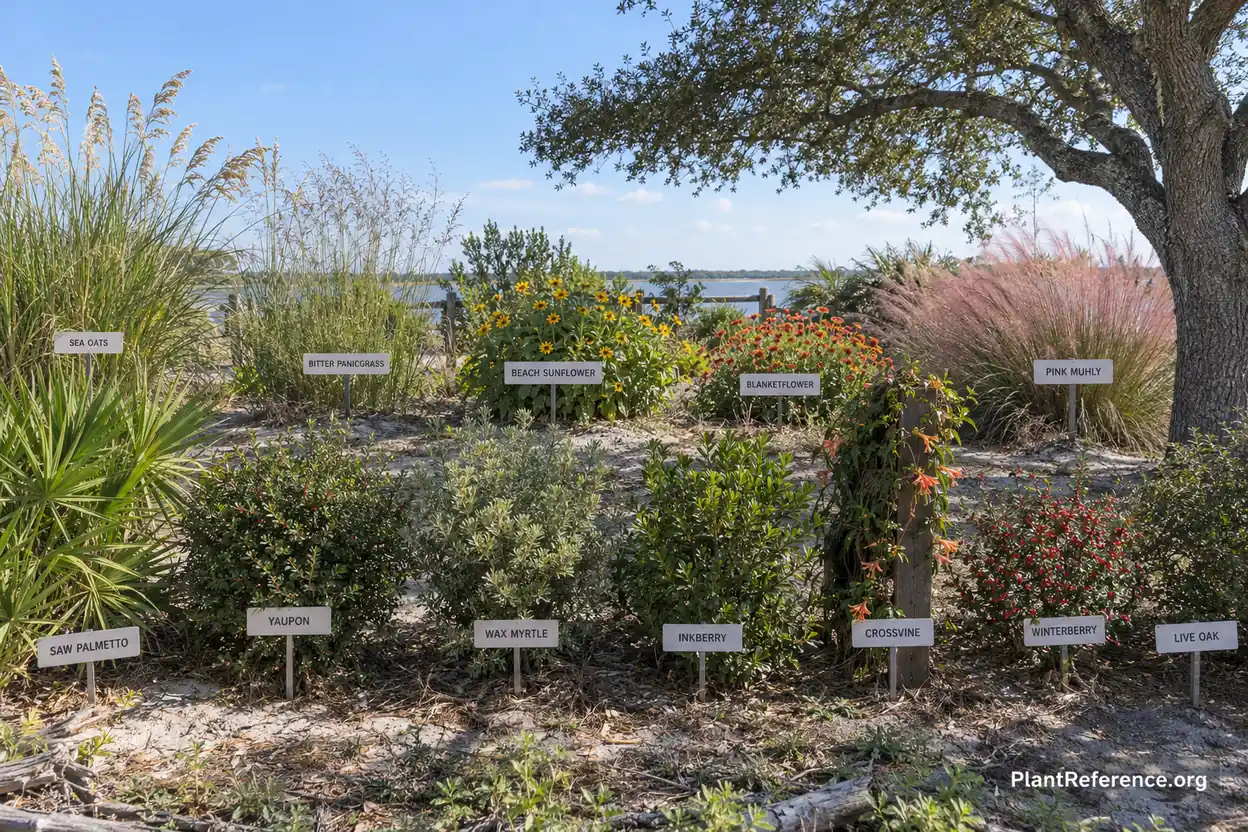
Compare 12 Coastal Southeast Native Plants
These twelve plants create a practical palette across the exposure gradient. Local native status, cold tolerance, and legal planting rules vary from the Carolinas through Georgia, Florida, and the Gulf Coast. Confirm every choice with a regional native nursery, and use local genetic material for dune restoration when required. Do not move plants from wild beaches.
No. | Native plant | Typical size | Best exposure | Main garden role |
|---|---|---|---|---|
1 | Sea oats 🌿Uniola paniculata | 3–6 ft (0.9–1.8 m) | Foredune | Sand capture and dune structure |
2 | Bitter panicgrass 🌿Panicum amarum | 3–6 ft (0.9–1.8 m) | Foredune | Rhizomatous beach stabilization |
3 | Beach sunflower 🌿Helianthus debilis | 1–2 ft (0.3–0.6 m) | Foredune to backdune | Spreading yellow ground layer |
4 | Blanketflower 🌿Gaillardia pulchella | 1–2 ft (0.3–0.6 m) | Backdune | Red-yellow seasonal color |
5 | Pink muhly 🌿Muhlenbergia capillaris | 3–4 ft (0.9–1.2 m) | Backdune | Fall haze and grass structure |
6 | Saw palmetto 🌿Serenoa repens | 3–6 ft (0.9–1.8 m) | Backdune | Evergreen thicket and wildlife cover |
7 | Yaupon holly Ilex vomitoria | 8–20 ft (2.4–6 m) | Backdune to sheltered | Hedge, screen, and bird fruit |
8 | Wax myrtle 🌿Morella cerifera | 10–20 ft (3–6 m) | Sheltered transition | Fast evergreen screen |
9 | Inkberry holly 🌿Ilex glabra | 5–8 ft (1.5–2.4 m) | Sheltered moist | Evergreen mass and pollinator flowers |
10 | Crossvine Bignonia capreolata | 30–50 ft (9–15 m) | Sheltered | Evergreen-to-semi-evergreen vine cover |
11 | Winterberry 🌿Ilex verticillata | 6–12 ft (1.8–3.7 m) | Fresh-water pocket | Deciduous shrub with winter fruit |
12 | Southern live oak 🌿Quercus virginiana | 40–80 ft (12–24 m) | Sheltered | Canopy, wind filtering, and habitat |
Sea oats 🌿Uniola paniculata (yoo-nee-OH-luh pan-ik-yoo-LAY-tuh) has arching seedheads and a deep, spreading root system that traps windblown sand. It is a dune engineer, not a decorative grass to harvest from public beaches. Plant nursery-propagated stock only where permitted. The leaves and stems work because they bend in wind and keep collecting sand around living crowns.
Bitter panicgrass 🌿Panicum amarum also holds exposed sand, spreading by rhizomes and producing blue-green leaves. It can occupy the beach-to-backyard transition where sea oats might be too tall or regulated. Both grasses need moving air, full sun, and sand. Rich garden soil or frequent fertilizer creates weak growth that does not perform the same structural job.
Beach sunflower 🌿Helianthus debilis runs across hot sand and produces yellow flowers that feed insects. Blanketflower 🌿Gaillardia pulchella supplies red-and-yellow blooms in open, disturbed backdune sites. Their exact life span and persistence vary with location and weather, so let some seed mature. They are seasonal connectors around permanent grass and shrub structure.
Pink muhly 🌿Muhlenbergia capillaris provides fine green summer foliage and a cloud of pink-purple flowers in fall. It handles salt, drought, and deer pressure once established, though it looks best with full sun and room for air to pass. For help distinguishing grasses from similar plants, use Grass vs Sedge vs Rush: How to Tell Them Apart.
Saw palmetto 🌿Serenoa repens creates tough evergreen mass but demands space. Its petioles carry sharp teeth, so keep it away from narrow paths. Yaupon holly Ilex vomitoria and wax myrtle 🌿Morella cerifera form taller evergreen screens. Both can be trained as shrubs or small multi-trunk trees, and both feed wildlife when allowed to flower and fruit.
Inkberry holly 🌿Ilex glabra prefers a sheltered site with more moisture than the foredune. Crossvine Bignonia capreolata climbs fences and sturdy arbors by tendrils with adhesive disks; give it a structure that can carry mature weight. Winterberry 🌿Ilex verticillata drops its leaves to reveal bright fruit, while Southern live oak 🌿Quercus virginiana creates the long-term canopy for a protected yard.
Stabilize Dunes Without Damaging Them
A dune is living infrastructure. Plant roots and stems slow wind, trap sand, and help the landform rebuild after ordinary erosion. Foot traffic cuts through that network, and one informal shortcut can become a blowout that widens with every storm. Before planting, fencing, irrigating, or changing grade, check local, state, and federal rules. Protected dunes are not ordinary private flower beds.
Use boardwalks or designated paths to concentrate movement. Low sand fencing may be part of an approved restoration plan, but its placement changes where sand accumulates. Do not improvise a wall that redirects erosion onto a neighbor or blocks wildlife. Work with the coastal authority, conservation district, or qualified restoration professional responsible for the site.
Install nursery-grown sea oats 🌿Uniola paniculata and bitter panicgrass 🌿Panicum amarum on the spacing and pattern specified for the project. A staggered grid often captures sand more evenly than straight ornamental rows. Plant at the same depth as the propagation container, firm sand around the root ball, and water during establishment without carving channels down the slope.
The first season is about roots. Wind can expose a crown or bury a small plug, so inspect after storms and correct minor changes by hand when permitted. Keep irrigation temporary and gentle. Mature dune grasses should not depend on lawn sprinklers, which encourage weeds, wash sand, and waste water through evaporation.
Leave seedheads. They help identify the planting, support wildlife, and maintain natural form. Cutting sea oats 🌿Uniola paniculata for arrangements may be prohibited, even on some private coastal properties. A clean visual edge belongs around access paths, not across the working dune face. The goal is a self-sustaining plant community, not a clipped ornamental grass border.
Beach sunflower 🌿Helianthus debilis can fill openings behind the most exposed ridge, but it does not replace the structural roots of dune grasses. Combine functions: rhizomatous grass to trap sand, sprawling flowers to cover warm gaps, and taller backdune plants to filter wind. That layered approach resembles the plant-community logic in Pacific Northwest Native Plants: 10 Resilient Picks, even though the species and stresses are completely different.
Build the Backdune Shrub and Vine Layers
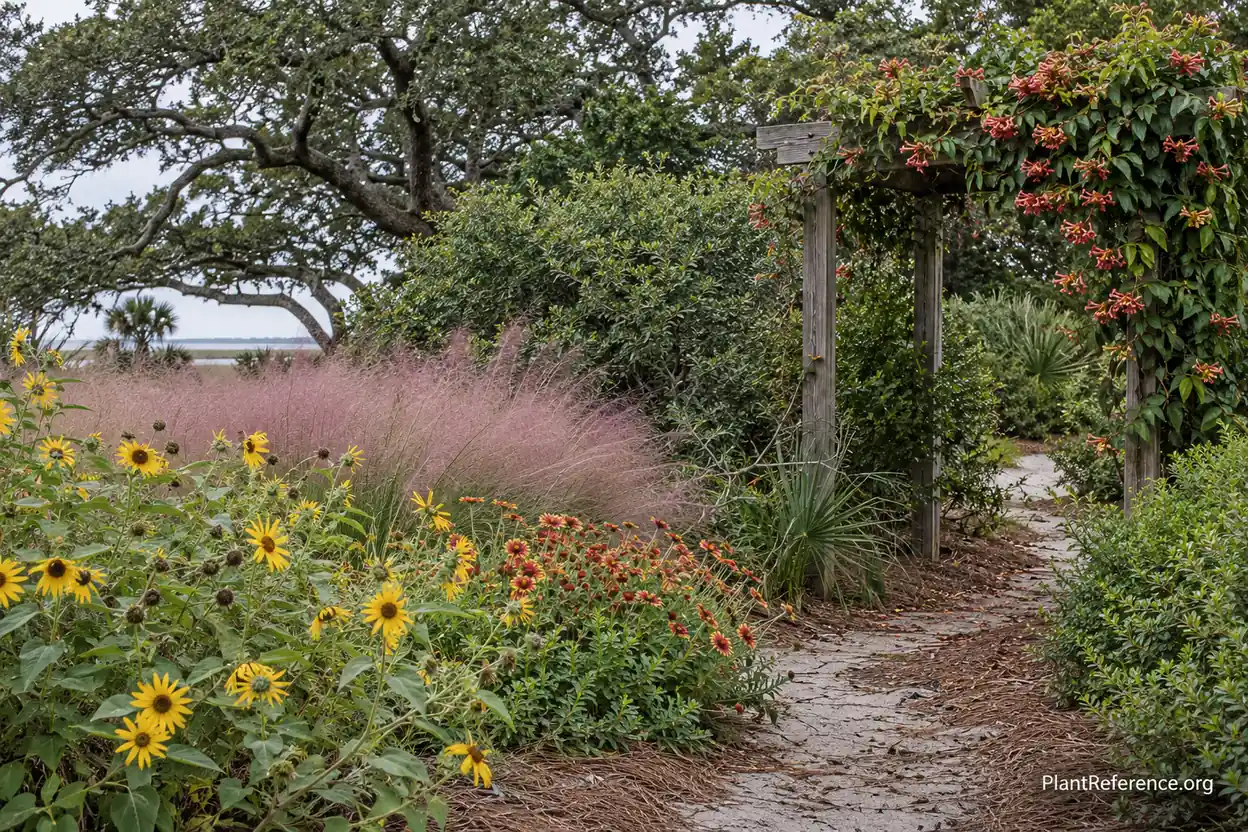
The backdune is where a home landscape can become visibly lush without pretending it is inland. Repeat pink muhly 🌿Muhlenbergia capillaris and beach sunflower 🌿Helianthus debilis through the sunny foreground, then build wind-filtering masses of yaupon holly Ilex vomitoria, wax myrtle 🌿Morella cerifera, and saw palmetto 🌿Serenoa repens. Keep open paths for maintenance and storm cleanup.
Yaupon holly Ilex vomitoria tolerates shearing, but its natural multi-stem form is more resilient and useful than a thin green wall. Female plants produce red fruit when compatible male pollen is available. Wax myrtle 🌿Morella cerifera is also typically dioecious, so fruit depends on male and female plants. Buy from a nursery that can identify sex when fruit is part of the plan.
Winterberry 🌿Ilex verticillata has the same pollination issue and an additional siting limit. A female winterberry needs a compatible male that blooms at the same time, usually one male for several females within pollinating distance. It also needs a moist, sheltered fresh-water soil. Do not place it where salt spray or storm surge regularly reaches the root zone simply because the red berries look coastal.
Inkberry holly 🌿Ilex glabra makes a lower evergreen mass in moist, acidic-to-neutral sheltered soil. It can become bare at the base if crowded or repeatedly sheared. Give it enough light, select appropriate local material, and renew older stems selectively from the base. Check soil results before applying acidifier; Raised Bed Soil pH Problems: Testing, Adjusting, and Maintaining Balance explains why measured correction beats guessing.
Crossvine Bignonia capreolata supplies height where tree roots or space limit a wide shrub. Its orange-red tubular flowers draw hummingbirds, and foliage often persists through mild winters. Train young stems onto a sturdy arbor or fence, then thin congested growth after flowering. Do not let adhesive disks spread across painted siding or roofing where inspection becomes difficult.
Southern live oak 🌿Quercus virginiana belongs in the most protected, spacious part of the yard. It can become broader than many houses and must be placed for its mature crown and root zone. How Much Soil Do Urban Trees Actually Need? The Root Volume Guide makes the scale clear. Preserve existing live oaks by avoiding trenching, fill, paving, and grade changes beneath their canopies.
Pollinator value improves when flowers appear in repeated patches across the season. Beach sunflower 🌿Helianthus debilis, blanketflower 🌿Gaillardia pulchella, pink muhly 🌿Muhlenbergia capillaris, hollies, wax myrtle, and crossvine each serve different visitors. Best Perennials for Pollinators: Bees & Butterflies explains why broad, pesticide-free floral targets work better than isolated specimens.
Plant and Feed Natives in Sandy Coastal Soil
Sandy soil drains fast and holds few nutrients, but that does not mean every planting hole needs a bag of compost. Dune and backdune natives evolved with lean, oxygen-rich soil. A rich pocket can hold water around roots, promote weak top growth, and encourage weeds. Improve a sheltered ornamental bed broadly when a soil test supports it, but leave true dune soil in its functional condition.
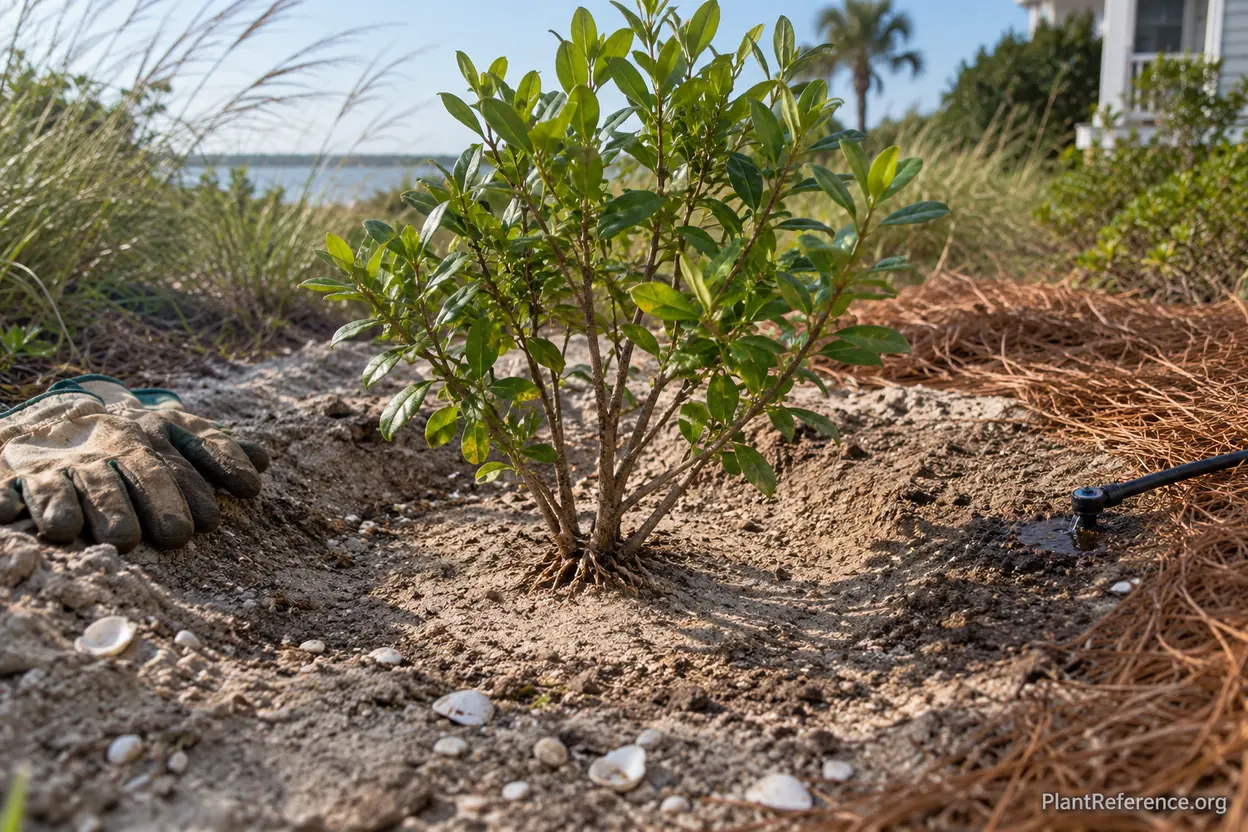
Plant during a mild season when roots can grow before extreme heat or tropical weather. Water the nursery container first, dig no deeper than the root ball, and set the crown level with surrounding soil. In loose sand, make the hole two to three times wider and firm gently so wind cannot rock the plant. Stake only when necessary, using flexible ties and removing support after roots anchor.
New salt-tolerant plants still need fresh water during establishment. Apply a slow soak to the root ball, then let the upper soil begin drying before watering again. Expand the wet area as roots grow. In exposed sites, a temporary wind screen can reduce stress, but remove it gradually so stems acclimate. Never use brackish well water without knowing its salinity.
Nutrients move quickly through sand. Instead of applying a large fertilizer dose, start with a soil test and observe growth. Pale leaves can reflect salt injury, high pH, drought, flooded roots, or a real deficiency. Use a small, slow-release, locally recommended application only when needed. Excess nitrogen makes sea oats 🌿Uniola paniculata, bitter panicgrass 🌿Panicum amarum, and pink muhly 🌿Muhlenbergia capillaris floppy.
Mulch belongs mainly in the sheltered yard. A 2–3 inch (5–8 cm) layer of pine straw can slow evaporation, reduce weeds, and add organic matter around hollies and young trees. Keep it 6 inches (15 cm) away from trunks and crowns. On an exposed dune, loose mulch can blow, bury seedlings, or interfere with sand movement, so follow the restoration plan instead.
Irrigation design should mirror exposure. Use temporary emitters for dune plugs, a widely spaced schedule for established backdune shrubs, and a separate line for the moist fresh-water pocket. A moisture probe helps compare zones, but salt can affect readings and plant response. Check soil by hand and look at the full root zone, not only the dry surface.
Stormwater is not automatically useful irrigation. Roof runoff may scour sand, carry pollutants, or keep a foundation wet. Route clean water into an approved vegetated area away from dunes and buildings. If a sheltered yard has room for infiltration, use the planning principles in Fix PNW Garden Drainage: Glacial Till, Hardpan & Raised Beds only as general diagnostics; coastal sand and surge require local engineering.
Prepare the Garden for Storms and Salt Burn
Storm preparation begins years before a forecast. Correct tree placement, strong branch structure, permeable windbreaks, and healthy root space matter more than last-minute pruning. Have a qualified arborist inspect mature Southern live oak 🌿Quercus virginiana, especially after construction or root disturbance. Topping creates hazardous regrowth and does not make a tree hurricane-resistant.
Before storm season, remove dead or broken branches, secure loose containers, clear drainage routes, and document the landscape with photos. Do not strip healthy foliage from palms or shrubs. Flexible native plants dissipate wind when they have balanced crowns. A dense, repeatedly sheared hedge may catch wind like a wall and split at weak branch unions.
After salt spray, rinse valuable sheltered plants with fresh water as soon as conditions are safe, applying enough to wash foliage without saturating already flooded soil. Wait before pruning brown leaves because green tissue may remain beneath. Salt burn often appears on windward leaf edges. Give the plant time to show living buds, then remove dead growth with clean tools.
Storm surge is different from foliar salt. Once water recedes, drain ponded fresh-water zones if possible and irrigate with fresh water only when local authorities say the supply is safe and the soil can accept it. Do not add fertilizer to a stressed root system. Replace plants that repeatedly fail with species from the more exposed band rather than rebuilding the same vulnerable bed.
Humidity invites fungal leaf spots, but a few marked leaves do not justify preventive broad-spectrum spraying. Improve spacing, prune selectively for air, water soil instead of foliage, and remove heavily diseased debris. Slugs can move into moist sheltered pockets; the low-toxicity practices in Stop Slugs in the Pacific Northwest Garden Safely adapt better than scattering bait across wildlife habitat.
Edit the garden after each storm season. Extend plant groups that held sand, recovered from salt, or kept structure. Move sensitive species inland. Replace washed mulch, reopen paths, and remove volunteers from foundations. A resilient coastal garden is not static; it learns from wind and water while keeping dunes, access, and the house safer.
Frequently Asked Questions
Reading about plants and recognising them are different skills. These three build the second.
- Daily PlantIdentify the day’s mystery plant from a close-up photograph.
- Keyed OutWork a dichotomous key, lead by lead, to name a hidden specimen.
- Name That PlantName a specimen from botanical clues dealt hardest first.
Free to play, no account needed
Tagged with
Maria is a tropical plant grower in Miami who maintains a half-acre property packed with palms, fruit trees, and tropical ornamentals. She grew up in Puerto Rico surrounded by tropical plants and moved to South Florida for college, earning a biology degree. Maria worked at a major tropical botanic garden for several years before transitioning to freelance writing and consulting. She specializes in tropical fruit growing, hurricane-resilient landscaping, and the particular challenges of gardening in South Florida—salt air, limestone soil, intense rain, and the threat of tropical storms. Maria's practical about the realities of tropical gardening: it's not paradise if you don't understand what you're dealing with.