Best Plant Identification App: PictureThis vs iNaturalist & More
Pets & Toxicity
Recorded toxicity for plants linked in this guide. An unknown status is not a safety assessment.
— Image © PlantReference.org 2026
Choosing the best plant identification app comes down to one honest question: do you want a fast answer, or do you want to actually learn the plant? Most of these apps will name a common garden flower in two seconds flat. The differences show up the moment you point them at a sedge, a weedy grass, or a plant that looks like three other plants. I tested the major players the way a real gardener uses them—quick photos, imperfect light, mixed plant groups—and the gap between "polished" and "trustworthy" turned out to be wider than the marketing suggests.
How Plant Identification Apps Actually Work
Every app here uses image recognition trained on large photo databases. You snap a leaf, flower, or whole plant, and the app compares your image to millions of labeled examples, then returns its best matches. That sounds authoritative, but the result is a probability, not a fact—the app is essentially saying "this looks most like X."
That distinction matters enormously. Accuracy swings wildly depending on what you photograph and how. A clear, well-lit flower of a common species gets named correctly almost every time. A blurry grass blade, a juvenile leaf, or a plant outside the app's training region can produce a confident-sounding answer that is simply wrong.
Photograph the most distinctive part: flower first, then leaf arrangement, then whole plant
Get close enough to fill the frame, but keep the subject in focus
Include a second shot of the stem and how leaves attach
Avoid mixed backgrounds where the app might lock onto the wrong plant
The best results come from feeding the app the same evidence a botanist would want. If you want the full rundown on what to capture, our guide on Plant Identification App Accuracy: Why Apps Get It Wrong breaks down the common mistakes that produce bad matches.
PictureThis: Fastest and Most Polished
If speed and a clean interface are your priority, PictureThis is the standout. In testing it returned accurate matches for common ornamentals and houseplants in the high range—roughly 78 to 98 percent on clear photos—and it does it almost instantly. It also bolts on extras most rivals skip: basic disease diagnosis, care reminders, and watering tips.
The trade-offs are real, though. PictureThis usually shows a single confident suggestion rather than a ranked list, which hides its uncertainty from you. And it is aggressive about its subscription, currently around $30 per year after a short trial. For a casual user who mostly wants to know "what is this houseplant," it earns its keep. For anyone identifying wild plants where being wrong has consequences, that single-answer style is a weakness.
PictureThis shines brightest indoors. If you are still learning your collection, pair it with our visual walkthrough on How to Identify Houseplants: A Visual Guide so you understand why it lands on a given family.
PlantNet: Best Free App for Ranked Results
PlantNet is my pick for the best free plant identification app, and the reason is philosophical as much as practical. Instead of one confident guess, it returns several ranked candidates with confidence percentages, so you can see when it is unsure. That transparency is exactly what a learner needs.
Accuracy lands in the moderate range, roughly 68 to 80 percent, which sounds lower than PictureThis but is more honest—you are seeing the spread of possibilities rather than a polished single answer. PlantNet is community-backed and research-oriented, and it lets you contribute observations that improve the model. The interface is less slick than PictureThis, and it asks you to specify which organ you photographed (leaf, flower, fruit, bark), but that small friction produces better results.
Free with no aggressive paywall
Shows multiple ranked candidates with confidence scores
Lets you tag the plant part you photographed for sharper matches
Strong for wild and garden plants across many regions
When PlantNet hands you two or three candidates, that is your cue to look closer at the plant itself. Comparing leaf arrangement using Alternate vs Opposite Leaf Arrangement: The MADCapHorse Mnemonic Explained will often break the tie faster than re-photographing.
iNaturalist and Seek: Best for Community and Learning
iNaturalist is the choice if you care about learning and contributing to real science. Its computer-vision suggestions are deliberately conservative—accuracy reports range widely, from about 40 to 87 percent, because it would rather offer a genus than a wrong species. The real magic is the community: post an observation and human experts often confirm or correct it within days. Your sightings become research-grade data used by scientists.
Seek, made by the same team, is the kid-friendly, privacy-focused version. It identifies plants in real time through the camera without requiring an account or storing your location, and it gamifies the experience with badges. It is gentle and fun, though it struggles with tricky groups like sedges and uncommon weeds.
The downside of iNaturalist is speed. It is not the app to grab when you want an instant answer at the trailhead. It is the app to use when you want to be right and to slowly build genuine skill. That patient, structured approach pairs naturally with learning How to Use a Dichotomous Key: Step-by-Step Guide to Keying Out Any Plant, which teaches the same observe-then-decide habit by hand.
Flora Incognita: Strong on Confidence Levels
Flora Incognita, developed by German research institutions, earns a place for its honesty about uncertainty. It provides explicit confidence levels and supports multiple photos of the same plant, which meaningfully improves its guesses. Independent reviews score it highly, around 8.9 out of 10 on usability and accuracy for the species it covers.
The catch is geographic. Its training is strongest on European flora, though coverage is expanding. North American users will find it excellent on widespread species and shakier on regional natives. If you garden with a lot of European ornamentals, it is a genuinely strong contender; if you are keying out native prairie forbs in the Midwest, lean on PlantNet or iNaturalist instead.
Side-by-Side Comparison
No single app wins every category. Speed, transparency, price, and regional coverage pull in different directions, so the right pick depends on how you actually use it.
App | Accuracy Range | Cost | Best For | Main Drawback |
|---|---|---|---|---|
PictureThis | High (78-98%) | ~$30/year | Fast results, houseplants, care tips | Single guess; pushy subscriptions |
PlantNet | Moderate (68-80%) | Free | Ranked results, wild and garden plants | Less polished interface |
iNaturalist | Moderate (40-87%) | Free | Community verification, citizen science | Slow; conservative IDs |
Seek | Low-Moderate | Free | Kids, privacy, real-time fun | Weak on sedges and weeds |
Flora Incognita | High (~8.9/10) | Free | Confidence levels, multi-photo IDs | European focus |
For most gardeners I recommend a two-app setup: PlantNet or PictureThis for the quick first guess, and iNaturalist to confirm anything important. That combination costs nothing if you skip the PictureThis subscription, and it covers both speed and verification.
Where Apps Still Get It Wrong
The single most important thing to understand about every app on this list: none is reliable enough to trust blindly when safety is on the line. Toxic plants and their edible lookalikes are exactly where apps fail most dangerously.
Consider 🌿Conium maculatum (KOH-nee-um mak-yoo-LAH-tum), poison hemlock, which apps routinely confuse with edible carrot-family plants and with 🌿Daucus carota, Queen Anne's lace. The distinguishing marks—smooth purple-blotched stems versus hairy stems, a musty odor versus a carrot scent—are things you confirm in person, not through a phone. The same caution applies to the Toxicodendron genus that causes poison ivy and poison oak rashes.
Never eat or handle a plant based on an app alone
Cross-check toxic lookalikes with a printed key or expert
Be skeptical of confident single answers on grasses, sedges, and weeds
Re-photograph in better light before trusting a low-confidence match
Apps also stumble on plant groups that need magnification or microscopic detail. If you are working through lawn weeds, our Common Lawn Weeds Identification Guide and the safety-focused Poisonous Plants to Avoid: A Visual Safety Guide are better starting points than any camera scan. For trees, How to Identify Trees by Their Leaves: Shapes, Margins, and Venation Explained will catch errors an app makes on similar-looking species, and confusing groups like conifers reward the hands-on approach in How to Identify Conifers: Pines, Spruces, and Firs Simplified.
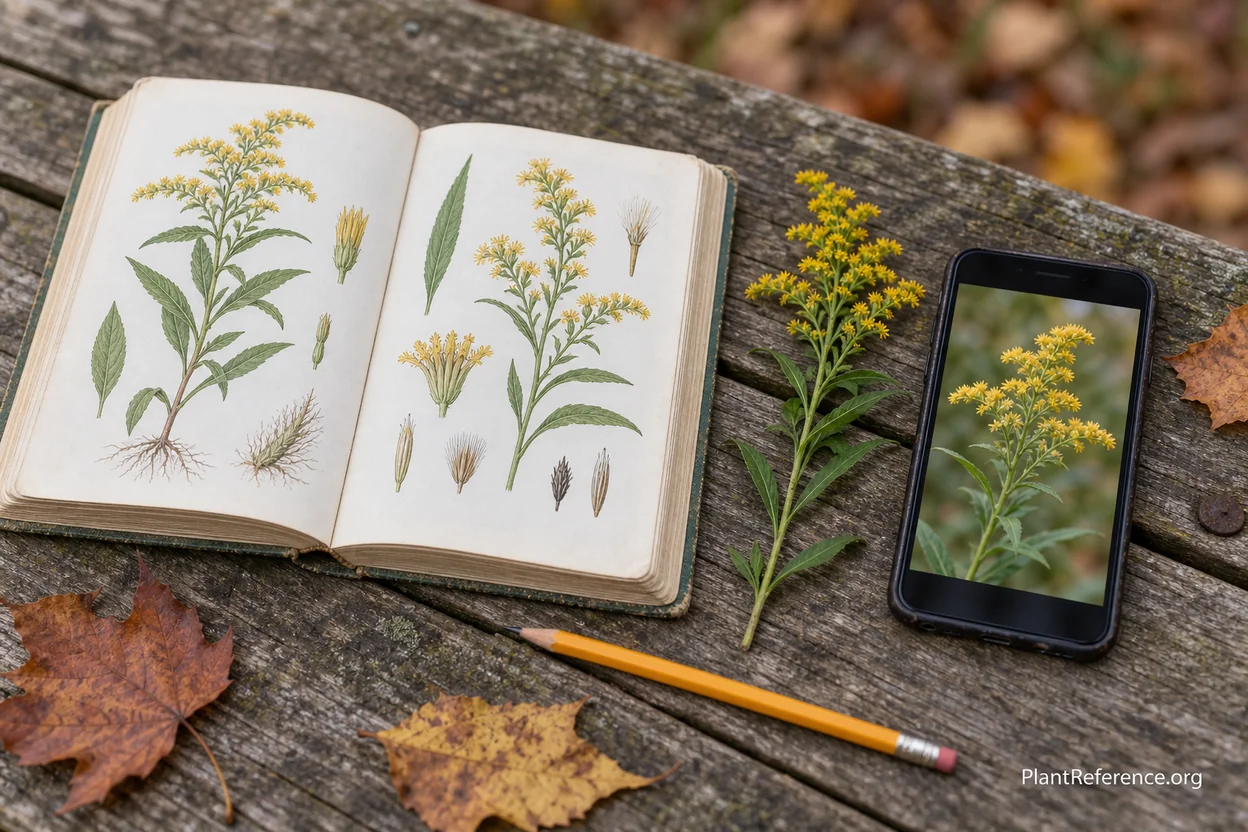
Beyond Apps: Learning to Identify Plants Yourself
Here is the philosophy I keep coming back to: apps identify plants for you, but they do not teach you to identify plants yourself. Lean on them too hard and you stay dependent—unable to confirm whether the app is right or wrong because you never built the underlying skill.
That is the gap PlantReference is designed to fill. Instead of scanning and forgetting, you study each species through multiple images showing how it actually varies across seasons, ages, and regions—so you recognize the plant in real life, not just in one perfect photo. A spaced-repetition flashcard system resurfaces the species you find hard and spaces out the ones you have mastered, and quizzes turn passive looking into active recall. You also learn proper botanical names with pronunciation, which makes every other resource easier to use.
Use the apps for the quick answer when you are out in the field. Use PlantReference to make sure that, six months from now, you do not need the app at all. The strongest plant identifiers I know do both: a phone in one pocket and a real mental library built through deliberate practice. Start with the fundamentals in How to Identify Any Plant: A Beginner's Guide to Leaves, Flowers, and Stems, then drill the families until they become automatic. Once flowers click, Flower Identification Guide: Petals, Shape & Color Explained takes you deeper into the details apps gloss over.
Frequently Asked Questions
Reading about plants and recognising them are different skills. These three build the second.
- Daily PlantIdentify the day’s mystery plant from a close-up photograph.
- Keyed OutWork a dichotomous key, lead by lead, to name a hidden specimen.
- Name That PlantName a specimen from botanical clues dealt hardest first.
Free to play, no account needed
Tagged with
Helen is an interior plant stylist in Los Angeles who works with restaurants, offices, and residential clients to select and maintain indoor plants. She studied design in college and got into plants when a client asked her to "green up" a mid-century modern home. Helen's expertise sits at the intersection of design and plant care—she thinks about light, scale, texture, and color, but she also knows which plants will actually survive in a given space. She's killed enough fiddle leaf figs in dark corners to know better. Helen maintains her own collection of over 80 houseplants in her apartment and writes about indoor plant selection, styling, and the practical side of keeping plants alive in interior environments.