Lonicera, Genus, japonica, Species,
- Genus & species
Japanese honeysuckle
Eastern Asia - Japan, Korea, China, Taiwan
Overview
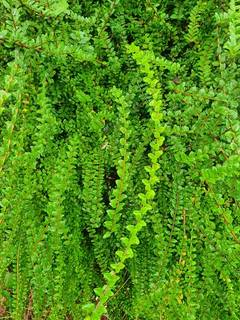
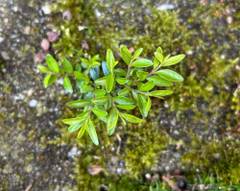
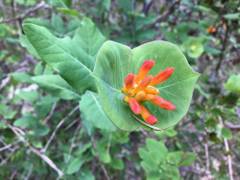
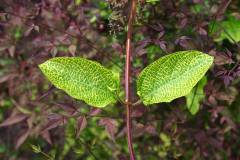
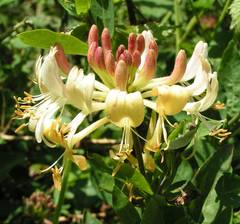
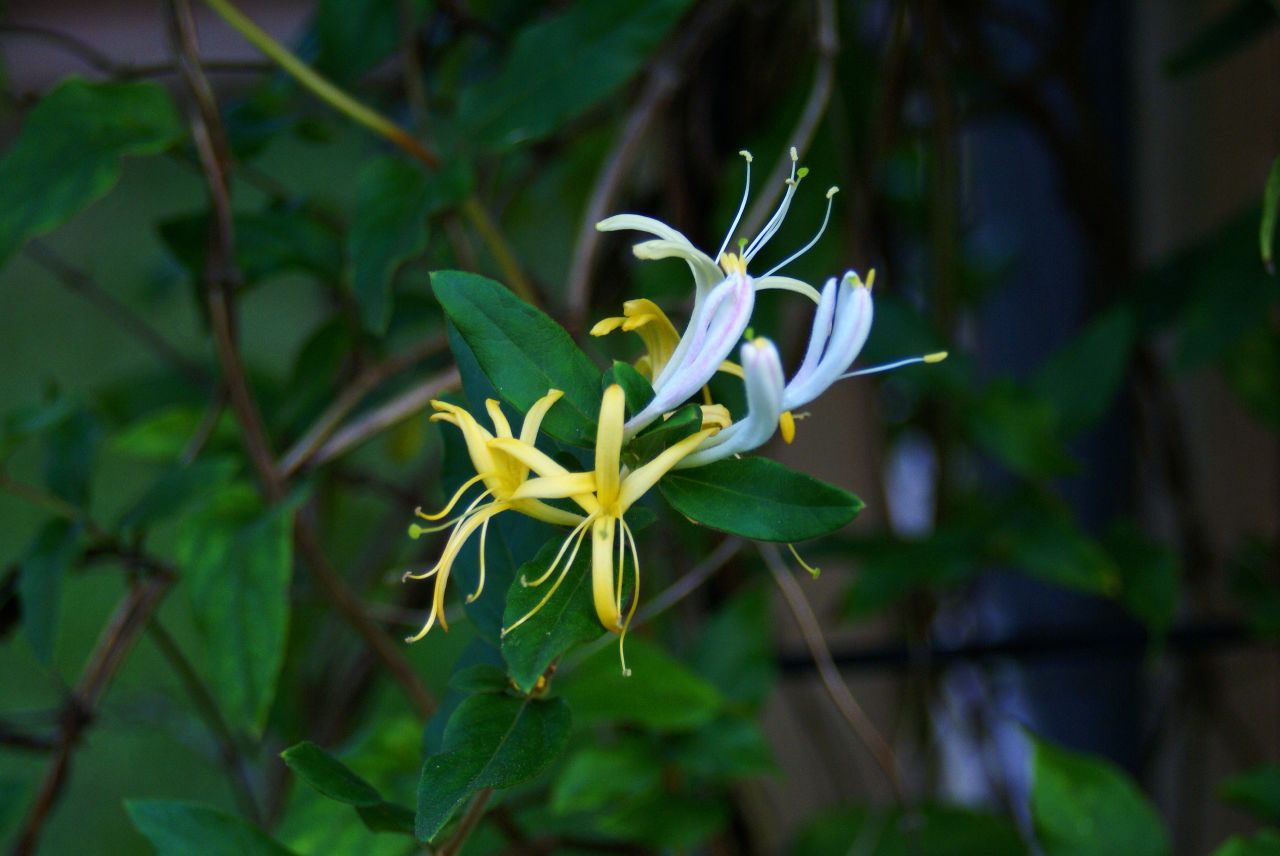
Lonicera japonica is a twining woody vine that extends 15-30 feet (4.5-9 m) of stem in a season and climbs 30-80 feet (9-24 m) into supporting trees. Young stems are hollow, reddish-brown, and hairy, twining around supports up to 2 inches (5 cm) thick; older stems thicken to 1-2 inches (2.5-5 cm) and girdle saplings they wrap. Leaves are opposite, ovate to oblong, 1.5-3 inches (4-8 cm) long, with entire margins on flowering wood and shallow lobes on juvenile shoots. Foliage holds through winter in USDA zones 7-11 and drops in colder zones. Flowers open in pairs from the leaf axils, each tubular and two-lipped, 1.2-2 inches (3-5 cm) long, white on the first day and fading to yellow on the second, so both colors sit on a shoot at once. Scent carries from dusk to midnight. Fruit is a black berry 0.2-0.3 inch (5-8 mm) across holding 2-3 seeds, taken by more than 20 bird species. Stems root at every node that touches soil and resprout from the crown within 4-6 weeks of cutting, so a planting widens 3-6 feet (0.9-1.8 m) per year. The species is listed as a noxious or prohibited invasive plant in Connecticut, Massachusetts, New Hampshire, Vermont, and Illinois.
Native Range
Lonicera japonica is native to eastern Asia, including Japan, the Korean Peninsula, eastern and southern China, and Taiwan, where it grows on forest margins, in thickets, and on disturbed slopes from sea level to about 5,000 feet (1,500 m). It reached Long Island, New York, in 1806 as an ornamental and erosion-control planting and has naturalized through the eastern and central United States from southern New England to Texas. Naturalized populations also occur in Australia, New Zealand, and parts of South America.Suggested Uses
Grown on chain-link fences, arbors, and pergolas where 15-30 feet (4.5-9 m) of annual stem growth is cut back each winter, and used on cut slopes for erosion control in regions without restrictions on the species. Flowers are worked by hawkmoths, bumblebees, and ruby-throated hummingbirds, and the dense stem mass shelters nesting songbirds. In states where the vine is prohibited, Lonicera sempervirens covers the same structures at 8-15 feet (2.4-4.5 m) with red tubular flowers.How to Identify
Appearance
Size & Dimensions
Height15' - 30'
Width/Spread3' - 6'
Bloom Information
Flowering runs April to June across the naturalized range, with scattered repeat bloom from August into October where late-summer rain follows a growth flush. Individual flowers last about two days, white on the first and yellow on the second. Fragrance peaks between dusk and midnight, when hawkmoths work the tubes; ruby-throated hummingbirds and long-tongued bumblebees visit by day. In zones 9-11 light flowering continues through mild winters.
Detailed Descriptions
Flower Description
White aging to yellowFoliage Description
Medium green, paler beneathGrowing Conditions
Sun Requirements
Requires 4-10 hours of direct sunlight daily
• Full Sun: 6+ hours of direct sunlight
• Partial Shade: 3-6 hours of direct sunlight
• Full Shade: Less than 3 hours of direct sunlight
Care & Maintenance
Care Guide
Flowering is heaviest at 6 or more hours of direct sun, and growth continues in shade with bloom reduced to the outer stems. Soils from sand to heavy clay at pH 5.0-8.0 support the vine, and established plants tolerate 4-6 weeks without rain, shedding some leaves under prolonged heat. About 1 inch (25 mm) of water per week through the first season establishes the root system, after which rainfall carries the plant in regions receiving 30 inches (760 mm) or more per year. Nitrogen fertilizer extends stems without raising flower count and is generally omitted. A trellis, fence, or wire support 6-8 feet (1.8-2.4 m) tall carries the twining stems; on open ground the same growth forms a mat 12-18 inches (30-45 cm) deep that layers at the nodes. Powdery mildew appears on shaded interior leaves in humid summers, and aphids cluster on shoot tips in spring.Pruning
Cutting the vine back to 2-3 feet (60-90 cm) in late winter clears the tangle of dead interior stems that accumulates each season. Flower buds form on current-season growth, so hard renewal cuts do not remove the same year's bloom. Stems resprout from the crown in 4-6 weeks, and clippings left in contact with soil root at the nodes, so cut material is bagged and taken off site. Shearing runners after the first flush in July holds the vine within 8-10 feet (2.4-3 m) of its support.Pruning Schedule
Prune: February–March & July
early springsummer
Container Growing
Suitable for container growing
Minimum container size: 5 gallons