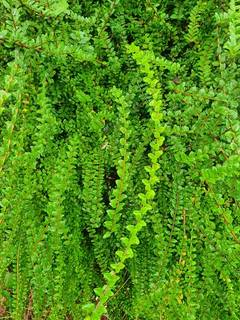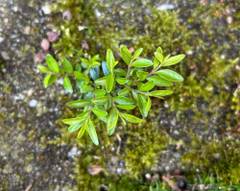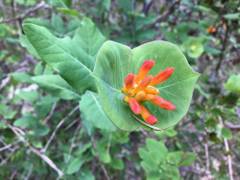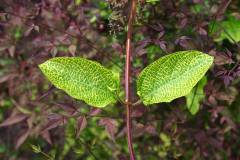
Lonicera, Genus, maackii, Species,
- Genus & species
Amur honeysuckle
Overview
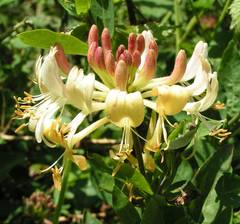
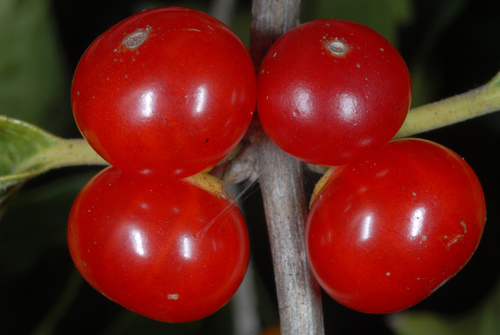
Lonicera maackii is a deciduous shrub in the honeysuckle family, growing 6-20 feet (1.8-6 m) tall with an upright, arching, multi-stemmed form and a spread of 8-15 feet (2.4-4.5 m). The opposite leaves are 1.5-3.5 inches (4-9 cm) long, ovate with a long tapered tip, dark green, and held late into autumn after many native shrubs have dropped their foliage. In late spring it produces paired, tubular two-lipped flowers about 0.8 inch (2 cm) long that open white and age to yellow, lightly fragrant and carried in the leaf axils. Flowers are followed by paired red berries 0.2-0.3 inch (5-8 mm) across that ripen in autumn and are eaten and spread by birds. Older stems have shaggy, furrowed bark and become hollow with age. The species leafs out early and holds its leaves late, casting dense shade that suppresses ground-layer plants. It is listed as invasive across much of the central and eastern United States and forms thickets in woodlands, fence rows, and disturbed ground. Berries are mildly toxic to humans if eaten in quantity.
Native Range
Native to temperate East Asia, including northern and western China, Korea, the Russian Far East, and parts of Japan. It grows there in forest edges, floodplains, and disturbed thickets. It was introduced to North America as an ornamental and for wildlife plantings and has since naturalized widely.Suggested Uses
In its native range and older plantings it was used for informal hedges, screens, and wildlife cover. In North America its planting is now limited by invasive-species regulations across many states. It is most often encountered as a naturalized plant rather than a cultivated one.How to Identify
Appearance
Size & Dimensions
Height6' - 20'
Width/Spread8' - 15'
Bloom Information
Blooms in late spring, typically May into June, after the leaves expand. The paired flowers open white and fade to yellow over a few days, so a shrub often shows both colors at once. They are lightly fragrant and visited by bees, though the nectar is of lower value to pollinators than many native plants.
Detailed Descriptions
Flower Description
white aging to yellowFoliage Description
dark greenGrowing Conditions
Sun Requirements
Requires 2-12 hours of direct sunlight daily
• Full Sun: 6+ hours of direct sunlight
• Partial Shade: 3-6 hours of direct sunlight
• Full Shade: Less than 3 hours of direct sunlight
Care & Maintenance
Care Guide
Grows in full sun to fairly deep shade and tolerates a wide range of soils, from dry to moist and acidic to alkaline. It establishes quickly, resprouts vigorously after cutting, and seeds prolifically through bird-dispersed berries. Because it is invasive across much of eastern North America, planting is restricted or discouraged in many states. Control usually combines cutting with herbicide applied to the stumps, since cut stems regrow. Young seedlings can be pulled when the soil is moist. It needs no care to persist and tends to spread without intervention.Pruning
Cutting stems to the base prompts dense resprouting unless the stumps are treated, so mechanical removal alone rarely kills established plants. Where it is grown, stems can be thinned in winter. Complete removal is more common than ornamental pruning given its invasive status.Pruning Schedule
Prune: December–February
winter