Lonicera, Genus, tatarica, Species,
- Genus & species
tatarian honeysuckle
Overview
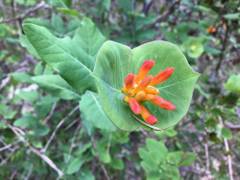
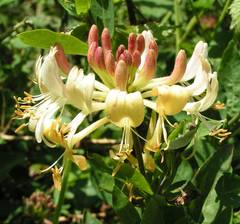
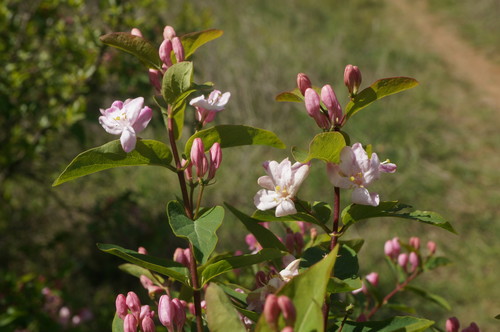
Lonicera tatarica is a deciduous shrub reaching 8-12 feet (2.4-3.7 m) tall and 8-10 feet (2.4-3 m) wide, with an upright, multi-stemmed, arching habit. The oppositely arranged leaves are ovate, 1-2.5 inches (2.5-6 cm) long, blue-green above and paler below, with smooth margins. Paired tubular flowers open in May and June, ranging from pink to white, each 0.5-0.75 inch (1.3-2 cm) long. Stems are hollow between the nodes, separating the species from native honeysuckles with solid pith. Translucent red to orange berries ripen from July to August and are dispersed by birds. L. tatarica is naturalized across much of the northern United States and Canada, where it forms dense thickets in woodland edges, fencerows, and old fields. It is listed as invasive in numerous states because bird-spread seed allows rapid colonization that shades out native understory vegetation. The species tolerates a wide range of soils and exposures, from full sun to partial shade, and withstands cold to USDA zone 3. Its early leaf-out and dense canopy add to its competitive spread in disturbed habitats.
Native Range
Native to southern Russia and Central Asia, extending into Siberia and the Altai region. Introduced to North America in the 1750s as an ornamental and now naturalized across the northern United States and southern Canada.Suggested Uses
Historically planted as an informal hedge, screen, or windbreak and for wildlife cover. Because of its invasive spread, current plantings are largely confined to regions where the species is not regulated. Spaced 6-8 feet (1.8-2.4 m) apart, it forms a continuous thicket.How to Identify
Appearance
Size & Dimensions
Height8' - 12'
Width/Spread8' - 10'
Colors
Bloom Information
Flowers open in May and June, with paired blossoms in the leaf axils along the previous season's growth. Color ranges from pale pink to white depending on the plant. Flowering lasts roughly two to three weeks, followed by red berries that persist into late summer.
Detailed Descriptions
Flower Description
Pink to whiteFoliage Description
Blue-greenGrowing Conditions
Sun Requirements
Requires 4-8 hours of direct sunlight daily
• Full Sun: 6+ hours of direct sunlight
• Partial Shade: 3-6 hours of direct sunlight
• Full Shade: Less than 3 hours of direct sunlight
Care & Maintenance
Care Guide
Lonicera tatarica grows in full sun to partial shade and tolerates clay, loam, and sandy soils across a pH of 5.5 to 7.5. Established plants withstand drought and need no supplemental watering in most climates. The species is hardy to USDA zone 3 and needs no winter protection. Because it self-seeds heavily and is regulated as invasive in many areas, removing volunteer seedlings is the main ongoing task. Aphids can distort new growth. No fertilization is needed on average soils.Pruning
Prune after flowering in late spring to remove crossing or dead stems and to limit size. Older shrubs can be renewed by cutting up to one-third of the oldest stems to the ground each year. Plants tolerate hard rejuvenation pruning to 12 inches (30 cm) and resprout quickly.Pruning Schedule
Prune: June–July
late springsummer