Lonicera, Genus, morrowii, Species,
- Genus & species
Morrow's honeysuckle
Overview
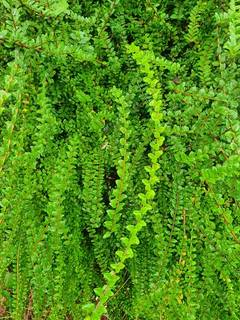
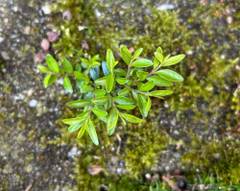
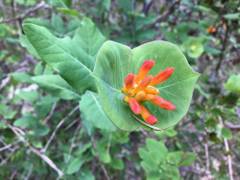
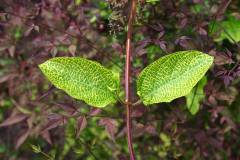
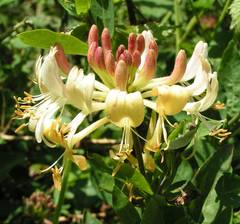
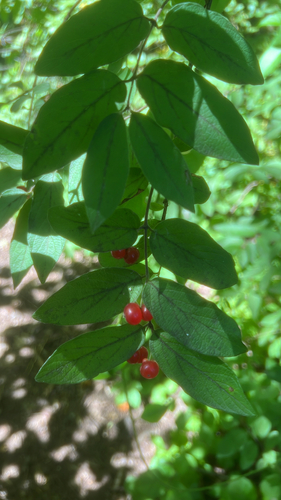
Lonicera morrowii is a deciduous shrub in the honeysuckle family, growing 6-8 feet (1.8-2.4 m) tall and as wide, with arching branches and a dense, rounded form. The oval to oblong leaves are 1-2.5 inches (2.5-6 cm) long, gray-green, and softly hairy beneath, and the older stems are hollow in the center. In late spring it bears pairs of tubular, two-lipped flowers about 0.5-0.75 inch (12-20 mm) long that open white and fade to pale yellow, scented and held on short stalks from the leaf axils. By midsummer these ripen into pairs of round, glossy red berries 0.2-0.3 inch (5-8 mm) wide. Lonicera morrowii leafs out early and holds its leaves late, shading out native plants beneath it, and birds spread the abundant seed widely. It grows in sun or shade and tolerates a wide range of soils, which has helped it become an invasive weed of woodlands, fields, and roadsides across the northeastern and midwestern United States, where it is regulated in several states. Its early leaf-out and heavy fruiting crowd out native shrubs and lower the food value of the habitat for wildlife.
Native Range
Lonicera morrowii is native to Japan, Korea, and northeastern China, where it grows in scrub, woodland edges, and wetlands. It was introduced to North America as an ornamental and for wildlife plantings and has since naturalized widely.Suggested Uses
Once planted as an ornamental hedge and for wildlife cover and fruit, it is now discouraged or banned across much of North America because of its invasive spread. Removal projects in natural areas focus on clearing it to restore native plant communities. Native shrubs such as winterberry or arrowwood viburnum are used in its place for similar size and bird value.How to Identify
Appearance
Size & Dimensions
Height6' - 8'
Width/Spread6' - 8'
Bloom Information
Flowering occurs in late spring, usually May into June, with the paired flowers opening white and aging to yellow over a week or two. The flowers are fragrant and draw bees and other insects. Red berries follow in summer and persist into fall, eaten and spread by birds.
Detailed Descriptions
Flower Description
white aging to yellowFoliage Description
gray-greenGrowing Conditions
Sun Requirements
Requires 2-10 hours of direct sunlight daily
• Full Sun: 6+ hours of direct sunlight
• Partial Shade: 3-6 hours of direct sunlight
• Full Shade: Less than 3 hours of direct sunlight