When to Plant Onions in Phoenix: Complete Guide + Best Varieties for Zone 9b
Pets & Toxicity
Recorded toxicity for plants linked in this guide. An unknown status is not a safety assessment.
Toxic to pets: evergreen hardy white bunching onion, California early softneck garlic, Welsh onion (scallions) and 7 moreDetailsHide
Allium cepa 'Evergreen Hardy White' — Toxicity Warning
Toxic to cats and dogs if eaten; cats are especially susceptible, and raw, cooked or concentrated plant material can damage red blood cells and cause anaemia.View Allium cepa 'Evergreen Hardy White' plant profileAllium sativum 'California Early' — Toxicity Warning
Toxic to cats and dogs if eaten; cats are especially susceptible, and raw, cooked or concentrated plant material can damage red blood cells and cause anaemia.View Allium sativum 'California Early' plant profileAllium fistulosum — Toxicity Warning
Toxic to cats and dogs if eaten; cats are especially susceptible, and raw, cooked or concentrated plant material can damage red blood cells and cause anaemia.View Allium fistulosum plant profileAllium cepa 'Copra' — Toxicity Warning
Toxic to cats and dogs if eaten; cats are especially susceptible, and raw, cooked or concentrated plant material can damage red blood cells and cause anaemia.View Allium cepa 'Copra' plant profileAllium cepa 'Texas Super Sweet' — Toxicity Warning
Toxic to cats and dogs if eaten; cats are especially susceptible, and raw, cooked or concentrated plant material can damage red blood cells and cause anaemia.View Allium cepa 'Texas Super Sweet' plant profileAllium cepa 'Red Creole' — Toxicity Warning
Toxic to cats and dogs if eaten; cats are especially susceptible, and raw, cooked or concentrated plant material can damage red blood cells and cause anaemia.View Allium cepa 'Red Creole' plant profileAllium cepa 'Granex' — Toxicity Warning
Toxic to cats and dogs if eaten; cats are especially susceptible, and raw, cooked or concentrated plant material can damage red blood cells and cause anaemia.View Allium cepa 'Granex' plant profileAllium cepa 'Yellow Granex' — Toxicity Warning
Toxic to cats and dogs if eaten; cats are especially susceptible, and raw, cooked or concentrated plant material can damage red blood cells and cause anaemia.View Allium cepa 'Yellow Granex' plant profileAllium sativum 'Inchelium Red' — Toxicity Warning
Toxic to cats and dogs if eaten; cats are especially susceptible, and raw, cooked or concentrated plant material can damage red blood cells and cause anaemia.View Allium sativum 'Inchelium Red' plant profileAllium cepa 'Walla Walla' — Toxicity Warning
Toxic to cats and dogs if eaten; cats are especially susceptible, and raw, cooked or concentrated plant material can damage red blood cells and cause anaemia.View Allium cepa 'Walla Walla' plant profile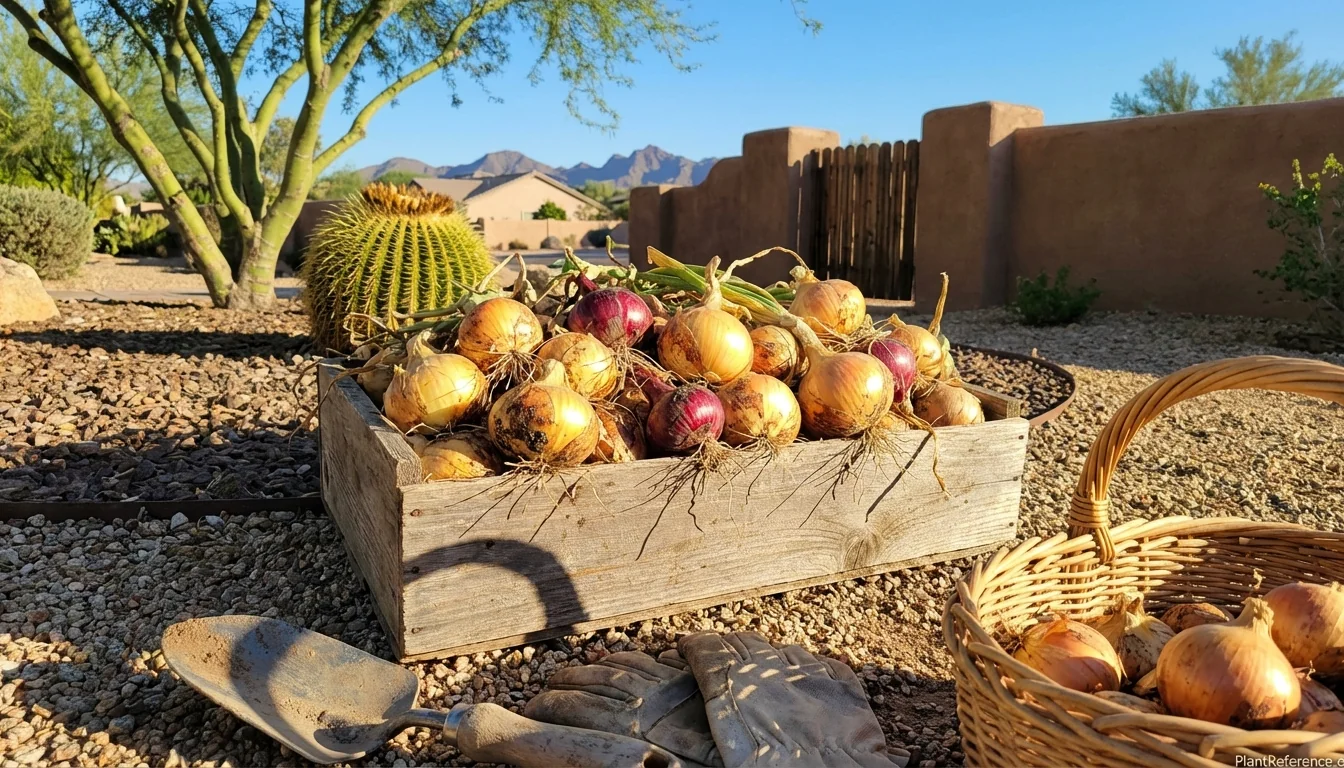
— Image © Plant Reference 2026
Growing onions in Phoenix requires understanding one critical fact: you must plant short-day varieties in fall, not spring. After forty years of desert gardening, I'll tell you exactly when to plant onions in Phoenix and which varieties actually work in Arizona's Zone 9b climate.
Best Onion Varieties for Phoenix's Desert Climate
Phoenix sits at 33° North latitude, which means you need short-day onion varieties that trigger bulbing with only 10-12 hours of daylight. This is fundamental—plant long-day varieties here and you'll get massive green tops but no bulbs.
The day-length requirement determines everything in onion growing. Short-day onions 🌿Allium cepa 'Tokyo Long White' start forming bulbs when days reach 10-12 hours in late winter. Phoenix's peak summer daylight only reaches 14 hours, so long-day varieties (needing 14-16 hours) never get the signal to bulb.
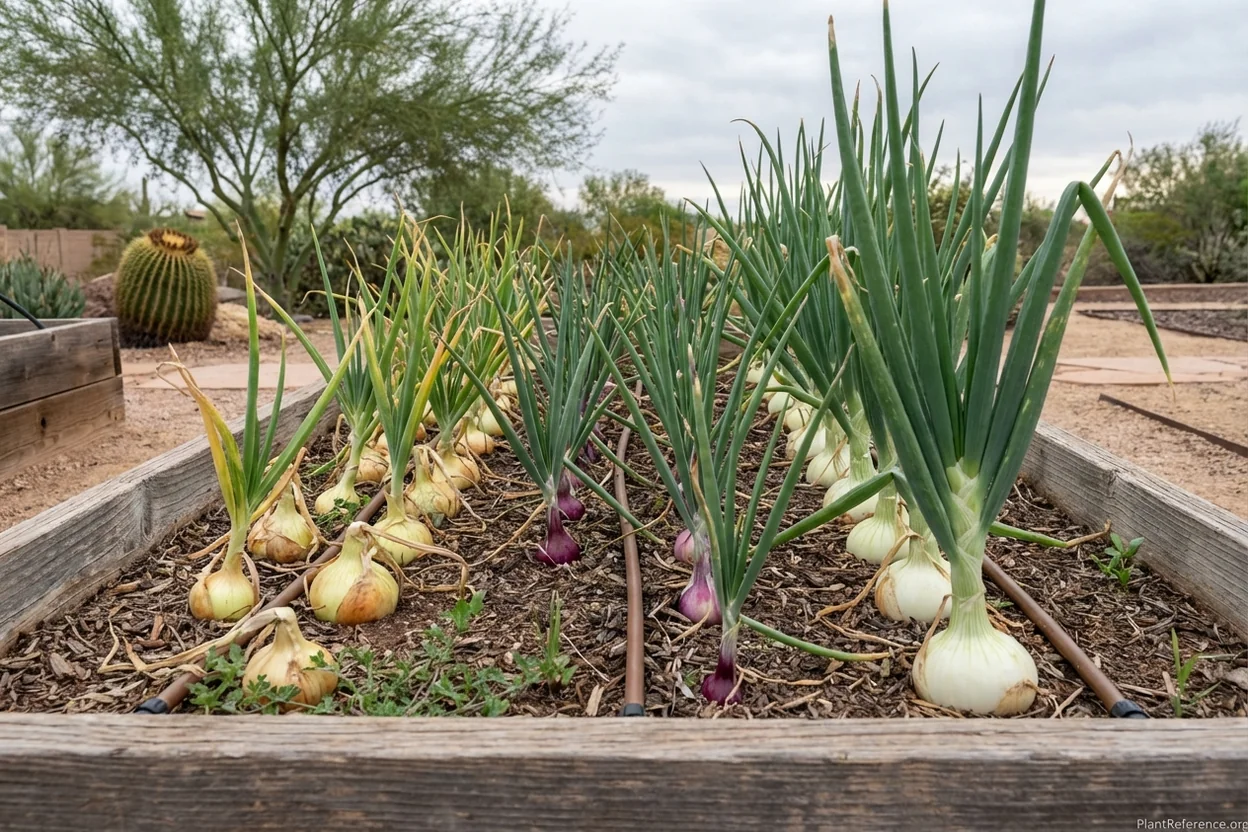
Here are the onion varieties that consistently succeed in Phoenix:
Variety | Days to Maturity | Best For | Notes for Phoenix |
|---|---|---|---|
110-120 days | Fresh eating | Heat-tolerant, large bulbs, plant Nov-Dec | |
95-110 days | Storage/cooking | Best red for desert, excellent disease resistance | |
Allium cepa '1015Y' | 110-125 days | Sweet onions | Mild flavor, harvest before heat |
100-115 days | Early harvest | Vidalia-type, good for March harvest | |
Allium cepa 'Southern Belle' | 105-120 days | Versatile use | Adapted specifically for Southwest |
100-110 days | Storage | Most reliable yellow for Phoenix |
I've grown all these varieties in Phoenix, and 🌿Allium cepa 'Texas Super Sweet' consistently produces the largest bulbs. The key is understanding that these are bred for southern latitudes and mild winters—they grow vegetatively through Phoenix's pleasant winter months, then bulb rapidly as spring days lengthen.
For garlic in Phoenix, stick with softneck varieties like 🌿Allium sativum 'California Early' planted in November. Hardneck varieties need more vernalization than Phoenix winters provide naturally.
Don't waste time with bunching onions 🌿Allium fistulosum in summer—they bolt immediately in heat. Plant them October through March for continuous scallion harvests.
Specific Planting Dates for Phoenix
Phoenix's Zone 9b climate with a February 14 last frost date creates a unique growing window. Here's your exact planting schedule:
Fall Planting Window: October 15 - December 15
This timing is critical. Plant too early and seedlings struggle in residual summer heat. Plant too late and you won't get sufficient bulb development before May heat arrives.
Optimal Planting Dates by Method:
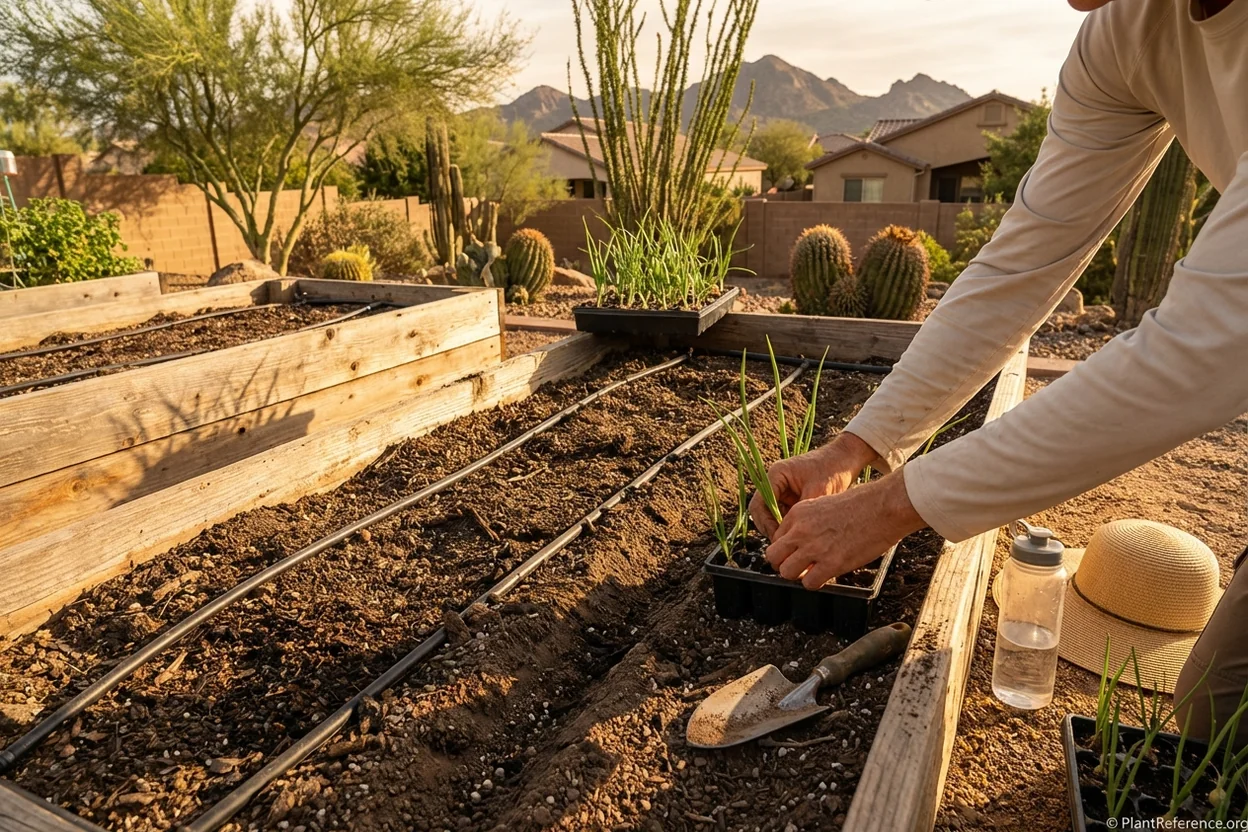
Transplants (Recommended): October 15 - November 30
Start: October 15 when temperatures drop below 90°F consistently
Peak window: October 30 - November 15 for best establishment
Latest: November 30 for adequate growing time
Seeds (Advanced Growers): September 15 - October 15
Indoor start: September 15 for transplanting in November
Direct sow: October 1-15 when soil temperatures moderate
Germination: Requires soil temps below 85°F (27°C)
Sets (Limited Availability): October 20 - November 20
Short-day sets are harder to find than transplants
Plant when nighttime temperatures stay below 70°F (21°C)
Garlic Planting Dates:
Plant garlic cloves November 15 - December 31
Earlier planting allows better root establishment
Softneck varieties only:
🌿Allium sativum 'California Early', 🌿Allium sativum 'Inchelium Red'
Why These Dates Work:
Phoenix's growing season runs backwards from northern climates. Your onions grow through the pleasant 60-80°F (15-27°C) winter months, then mature as temperatures rise in spring. Harvest must occur before sustained 95°F+ (35°C) temperatures begin in May.
The 289-day growing season from February 14 to November 30 seems long, but remember—summer months are unusable for most vegetables due to extreme heat.
Complete Growing Guide for Phoenix
Desert onion growing requires different strategies than temperate climates. Here's what actually works in Phoenix:
Soil Preparation:
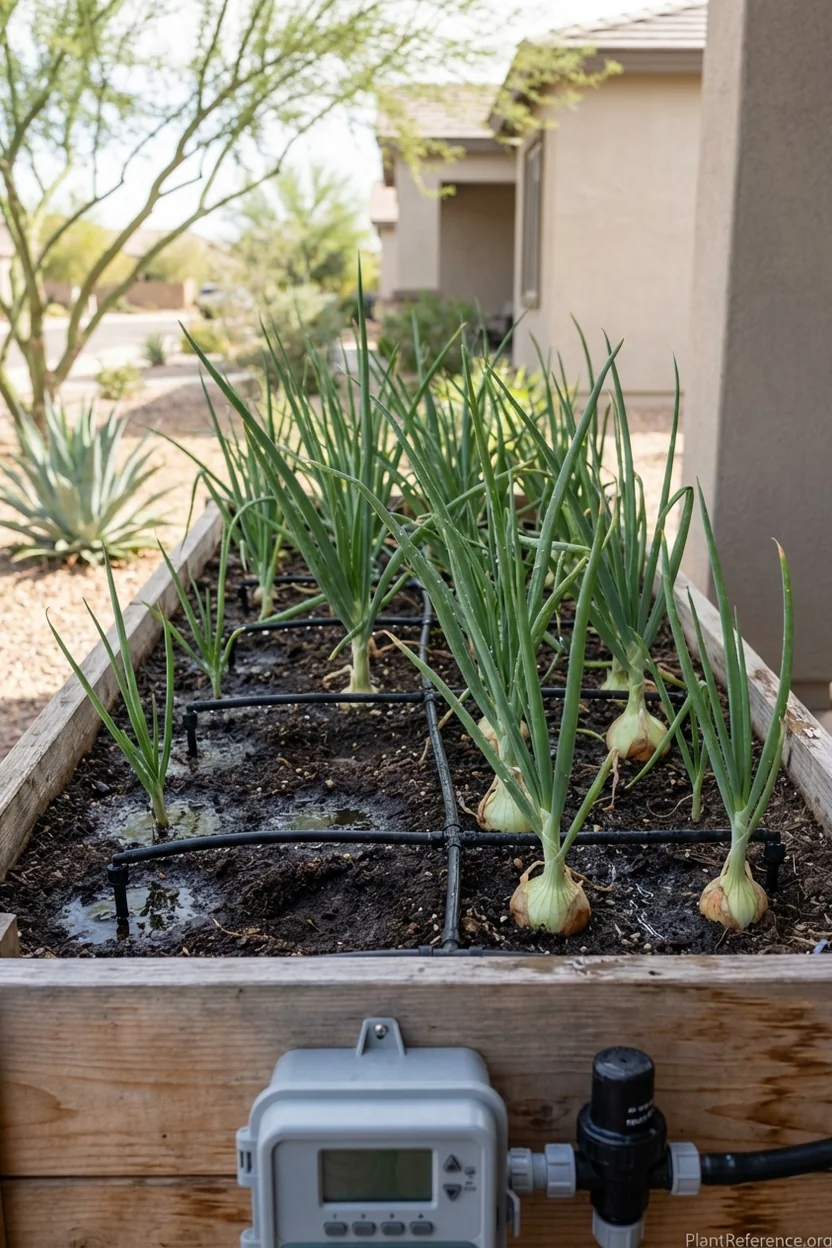
Phoenix's desert soil needs major amendment. I add 4 inches (10 cm) of compost and 2 inches (5 cm) of aged steer manure to each bed annually.
Test pH: Aim for 6.0-6.8 (Phoenix soils often run alkaline)
Add sulfur if pH exceeds 7.0
Incorporate compost to 12 inches (30 cm) deep
Install drip irrigation before planting
Mulch heavily with wood chips after planting
The desert sun bakes organic matter out of soil rapidly. I refresh beds with compost every fall, and the onions love the rich, moisture-retentive soil.
Water Management:
This is where most Phoenix gardeners fail with onions. Desert air pulls moisture from leaves faster than anywhere else in the country.
Irrigation Schedule:
October-December: Every 2-3 days, 1 inch (2.5 cm) per week
January-February: Every 3-4 days, maintaining consistent moisture
March-April: Daily light watering as temperatures rise
May (pre-harvest): Reduce to encourage curing
Never let onions completely dry out in Phoenix. The low humidity and intense sun will stunt bulb development immediately.
Fertilization Strategy:
Desert soils are typically low in nitrogen and organic matter. Feed onions aggressively during vegetative growth, then stop completely when bulbing begins.
Monthly Schedule:
November: 10-10-10 fertilizer at planting
December-January: High-nitrogen feed every 2 weeks
February-March: Continue nitrogen until bulb swelling visible
April-May: Stop all fertilizer to encourage curing
The key is recognizing when bulbing starts—usually mid-March in Phoenix. You'll see the soil crack around the base as bulbs expand. That's your signal to stop feeding.
Temperature Protection:
Phoenix rarely freezes, but winter lows in the upper 30s°F (3-4°C) can slow growth. I use row covers when temperatures drop below 40°F (4°C).
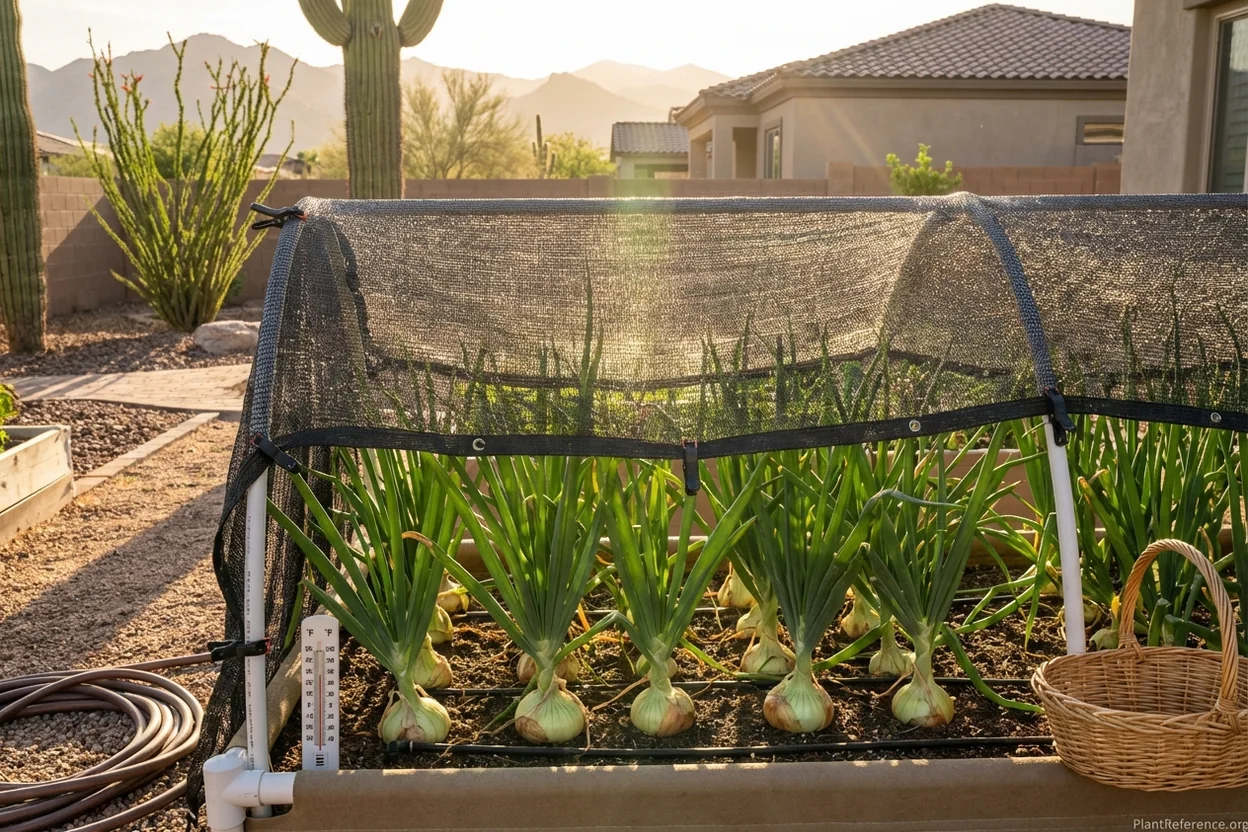
More critical is spring heat protection. Once daytime temperatures exceed 90°F (32°C) consistently—usually early May—shade cloth extends the growing season by 2-3 weeks.
Troubleshooting Phoenix-Specific Problems
Desert conditions create unique challenges. Here are the problems I see most often and their solutions:
Problem: Small bulbs despite healthy tops This usually means you planted long-day varieties that won't bulb at Phoenix's latitude. 🌿Allium cepa 'Walla Walla' and 🌿Allium cepa 'Copra' simply don't work here—the day length never reaches their 14-16 hour requirement.
Solution: Only plant varieties labeled "short-day" or bred for southern regions.
Problem: Premature bolting (flowering) Spring-planted onions often bolt when temperatures fluctuate wildly between winter and summer.
Solution: Stick to fall planting only. Spring onions get confused by Phoenix's rapid temperature swings from 40°F (4°C) nights to 85°F (29°C) days.
Problem: Bulbs rotting in storage Phoenix's dry air seems like it would help curing, but intense UV degrades onion skins rapidly.
Solution: Cure in shade with excellent air circulation. I use a covered patio with box fans for the first week after harvest.
Problem: Leaf tip burn Desert sun and low humidity cause leaf tips to brown and crisp, reducing photosynthesis and bulb size.
Solution: 30% shade cloth from March through harvest. Light shade actually increases yields in desert conditions.
Problem: Poor germination from seed Desert soil temperatures stay too hot too long for good germination, even in fall.
Solution: Start seeds indoors in September with air conditioning, then transplant in October. Or purchase transplants from nurseries.
Problem: Thrips damage These tiny insects thrive in Phoenix's heat and low humidity, causing silvery streaks on leaves.
Solution: Weekly sprays with insecticidal soap during March-April. Row covers work but reduce air circulation when you need it most.
Harvest & Storage
Phoenix harvest timing is critical—too late and the bulbs suffer heat damage that prevents storage.
Harvest Timing:
Early varieties: Late March to early April
Main season: April 15 - May 15
Absolute deadline: May 20 before summer heat
Harvest when 50% of tops have fallen over naturally. Don't bend them manually—this stops carbohydrate flow to the bulb and reduces storage life.
Harvesting Process:
Choose a dry morning after 2-3 days without irrigation
Loosen soil with fork, then lift bulbs gently
Leave roots attached initially
Lay in shade immediately—never in direct desert sun
Begin curing process within 2 hours
Curing for Phoenix Storage:
Desert curing is faster than humid climates but requires careful shade management:
Week 1: Covered patio with fans for air circulation. Temperature 80-90°F (27-32°C) ideal.
Week 2-3: Move to cooler location like garage or shed. Onions are cured when necks feel completely dry and papery.
Storage: Phoenix's dry air is excellent for long-term storage. I keep cured onions in mesh bags in an unheated garage, and storage varieties last 6-8 months easily.
Storage Varieties for Phoenix: - 🌿Allium cepa 'Red Creole': 6-8 months - 🌿Allium cepa 'Yellow Granex': 4-6 months - 🌿Allium cepa 'Texas Super Sweet': 2-3 months (eat fresh)
Sweet onions store poorly everywhere, but storage varieties do exceptionally well in Phoenix's low humidity.
Frequently Asked Questions
Reading about plants and recognising them are different skills. These three build the second.
- Daily PlantIdentify the day’s mystery plant from a close-up photograph.
- Keyed OutWork a dichotomous key, lead by lead, to name a hidden specimen.
- Name That PlantName a specimen from botanical clues dealt hardest first.
Free to play, no account needed
Alejandro is a landscape designer in Phoenix who focuses on low-water, desert-adapted plantings. He grew up in Tucson surrounded by Sonoran Desert plants and got frustrated watching neighbors install water-hungry lawns in a city that gets eight inches of rain a year. After earning his landscape architecture degree, he started designing residential gardens using native and desert-adapted species. Alejandro's approach is practical—he works with the climate rather than against it, using microclimates, shade structures, and efficient irrigation to create gardens that look good without draining the aquifer. He's a regular speaker at local xeriscaping workshops.