Overview
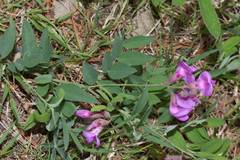
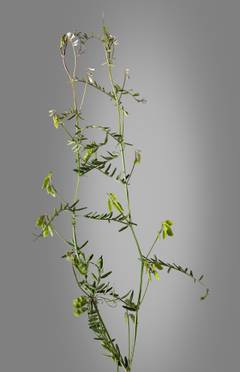
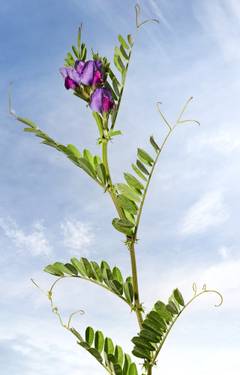
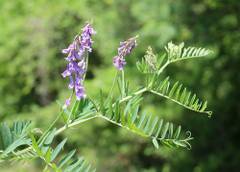
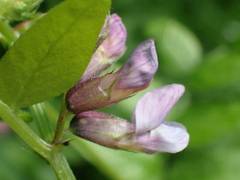
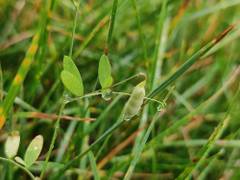
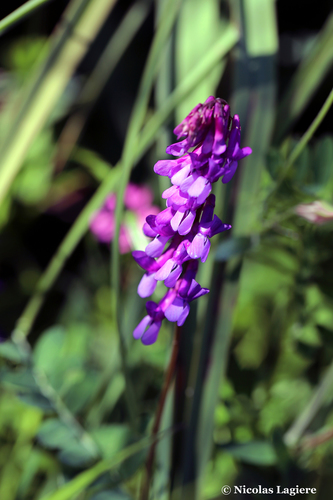
Vicia villosa is a vigorous densely hairy scrambling annual or winter annual vine in the family Fabaceae reaching 24-60 inches (60-150 cm) tall and 24-48 inches (60-120 cm) wide, climbing by branched terminal tendrils and often forming dense tangled masses over supporting vegetation. The entire plant is covered in soft woolly spreading hairs, which is the main identification feature and the source of both common names. Stems are angular and densely villous (woolly). Leaves are pinnately compound with 12-20 oblong leaflets 0.4-0.8 inch (10-20 mm) long. Flowers are violet-purple to blue, 0.5-0.8 inch (12-20 mm) long, papilionaceous, bicolored (the banner is darker violet-purple, the wings are lighter with white tips), in dense one-sided drooping racemes of 10-30 flowers on long axillary peduncles. The dense one-sided raceme is diagnostic. Fruit is a flattened legume pod 0.8-1.2 inches (20-30 mm) long, smooth, turning brown to black, and carrying 2-8 seeds. Nitrogen-fixing via Rhizobium root nodules. A single plant produces 500-2,000 seeds. The species is the dominant legume cover crop by planted acreage in the United States and also occurs as a roadside and field edge weed.
Native Range
Vicia villosa is native to Europe and western Asia, on roadsides, field edges, waste ground, and cultivated fields from sea level to approximately 6,000 feet (1,800 m). Widely planted as a winter cover crop across North America. Naturalized throughout the Pacific Northwest both from intentional plantings and as an escaped weed.Suggested Uses
Used as the woolly dense-racemed member of the four-species Vicia identification exercise. The densely hairy stems support a tactile identification exercise. The one-sided raceme architecture contrasts with the symmetric racemes of V. americana. The species is the dominant legume cover crop by planted acreage in the United States; nitrogen fixation rates (60-200 lb N/acre) are studied in sustainable agriculture. The roll-crimp termination method is a primary teaching example in no-till cover-crop management.How to Identify
Appearance
Size & Dimensions
Height2' - 5'
Width/Spread2' - 4'
Bloom Information
Dense one-sided drooping racemes of 10-30 violet-purple bicolored flowers 0.5-0.8 inch (12-20 mm) long on long axillary peduncles, borne May through July over 3-4 weeks. Pollinated by bees. Pods mature 4-6 weeks after flowering. In the Pacific Northwest the dense purple racemes are conspicuous along roadsides and in cover-crop fields in June.
Detailed Descriptions
Flower Description
Violet-purple to blue; bicolored with white wing tips; papilionaceous; in dense one-sided drooping racemes of 10-30 flowers; May-JulyFoliage Description
Medium green; pinnately compound with 12-20 oblong leaflets; entire plant covered in soft woolly spreading hairs; deciduousGrowing Conditions
Sun Requirements
Requires 4-10 hours of direct sunlight daily
• Full Sun: 6+ hours of direct sunlight
• Partial Shade: 3-6 hours of direct sunlight
• Full Shade: Less than 3 hours of direct sunlight