Vicia, Genus, cracca, Species,
- Genus & species
tufted vetch
Overview
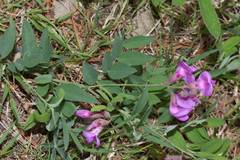
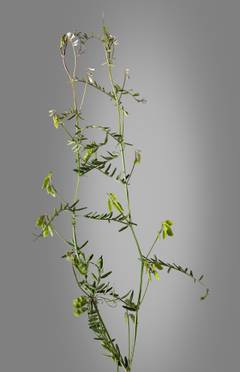
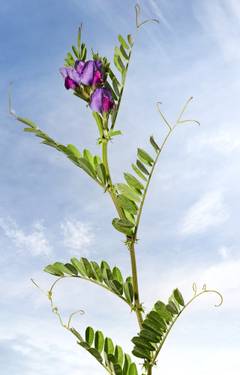
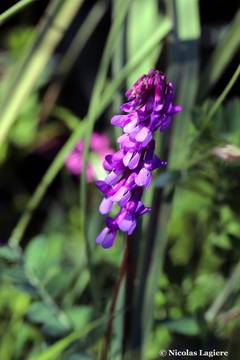
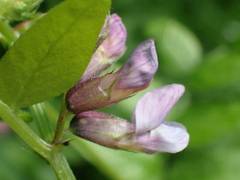
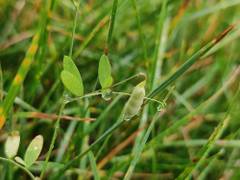
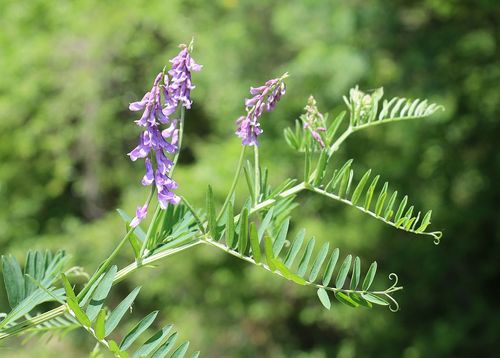
Vicia cracca is a herbaceous perennial in the legume family, climbing by branched tendrils to 2-6 feet (60-180 cm) where it scrambles over supporting vegetation. Stems are slender, ridged, and weak, relying on surrounding plants for support. The compound leaves are pinnate, with 8-12 pairs of narrow leaflets each 0.4-1.2 inches (10-30 mm) long, terminating in a branched tendril. From late spring through summer it carries dense, one-sided racemes of 10-40 blue-violet to purple pea-flowers, each 0.4-0.5 inch (8-12 mm) long, on stalks held above the foliage. Flowers are followed by flattened pods 0.6-1 inch (15-25 mm) long, each holding several seeds that are forcibly ejected when the pod splits. The species spreads by both seed and creeping rhizomes, forming tangled colonies in grasslands, roadsides, and field margins. As a nitrogen-fixing legume it grows in low-fertility soils, though its scrambling habit can smother shorter neighbours and it is considered weedy in parts of North America. Roots and foliage contain compounds that can be toxic to livestock in quantity.
Native Range
Native to Europe and temperate Asia, where it grows in meadows, hedgerows, and woodland margins. It has naturalized widely across North America and is present in most of Canada and the northern United States.Suggested Uses
Used in wildflower meadows, naturalistic borders, and pollinator plantings where its tendrils climb through grasses and taller perennials. As a nitrogen-fixing legume it is sometimes included in green-manure and cover-crop mixes. Its spreading habit suits informal rather than formal settings.How to Identify
Appearance
Size & Dimensions
Height2' - 6'
Width/Spread1' - 3'
Bloom Information
Flowers from late spring into late summer, typically June through August in temperate zones. Each raceme opens from the base upward over one to two weeks, and a colony can carry blooms over a long season. Pollination is mainly by bumblebees and other long-tongued bees.
Detailed Descriptions
Flower Description
blue-violet to purpleFoliage Description
greenGrowing Conditions
Sun Requirements
Requires 4-10 hours of direct sunlight daily
• Full Sun: 6+ hours of direct sunlight
• Partial Shade: 3-6 hours of direct sunlight
• Full Shade: Less than 3 hours of direct sunlight
Care & Maintenance
Care Guide
Grows in full sun to part shade in a wide range of soils, from sandy to clay, tolerating low fertility through nitrogen fixation. Moderate moisture is suitable, though established plants withstand short dry spells. It self-seeds readily and spreads by rhizome, so it can colonize beyond its planted area. Plants need no supplemental feeding in average soil. In gardens it is usually grown in wildflower meadows or naturalistic plantings where its scrambling stems climb neighbouring vegetation. Shearing after flowering reduces self-seeding.Pruning
Stems can be cut back to ground level in late autumn or early spring to clear spent growth. Shearing after the main bloom reduces seed set and limits spread. No structural pruning is needed.Pruning Schedule
Prune: March & November
fallearly spring