Sedum, Genus, sieboldii, Species,
- Genus & species
october daphne
Overview
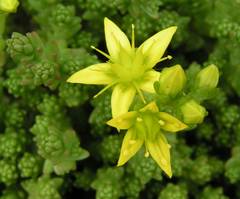
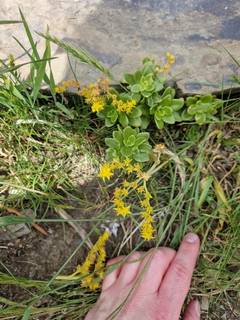
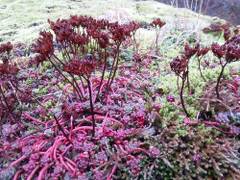
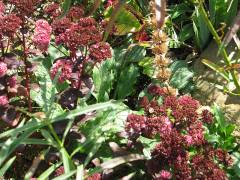
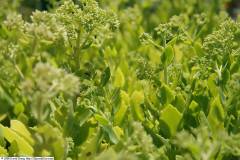
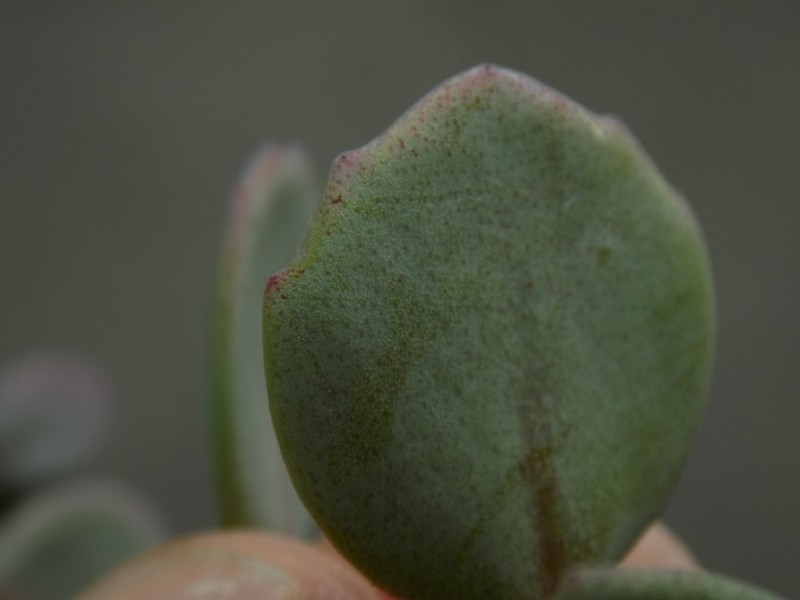
Sedum sieboldii (reclassified by some authorities as Hylotelephium sieboldii) is a herbaceous perennial succulent reaching 6–8 inches (15–20 cm) tall with a spread of 12–18 inches (30–45 cm). Stems arch and cascade from a central crown, giving a trailing habit that spills over edges. Leaves are carried in whorls of three along each stem, rounded, fleshy, blue-grey, 0.75–1 inch (2–2.5 cm) across, with scalloped margins and a thin pink edge. The three-leaved whorls sit at even spacings along the stems, producing a geometric pattern not seen on other sedums in the mat- or upright-forming groups. Dense rounded flower clusters 2–3 inches (5–8 cm) across of small star-shaped bright pink flowers open in October, later than most hardy sedums. Growth rate is slow. Hardy to zone 6, with less cold tolerance than the temperate European and Asian hardy sedums. Foliage dies back completely in winter and emerges late in spring; a location marker helps avoid disturbing the crown during spring cleanup. Sharp drainage is required — wet winter soils cause root rot.
Native Range
Sedum sieboldii is native to Japan, where it occurs on rocky outcrops and cliff faces. The species was named for Philipp Franz von Siebold, the German naturalist who documented Japanese flora in the 1820s–1840s.Suggested Uses
Used in containers where stems can trail over edges, on wall plantings, in rock gardens, and in raised beds at 12–15 inch (30–38 cm) spacing. Grows in containers of at least 2 gallons (8 L) with gritty mix and sharp drainage. Not used on wet sites, in shade, or in zones 5 and colder.How to Identify
Appearance
Size & Dimensions
Height6" - 8"
Width/Spread1' - 1'6"
Bloom Information
Dense rounded flower clusters 2–3 inches (5–8 cm) across of small star-shaped bright pink flowers open in October. Bloom duration is 3 weeks, running from early October into early November in many climates. Flowers are visited by late-season bees and butterflies. The trailing blue-grey whorled foliage carries the primary visual weight spring through autumn.
Detailed Descriptions
Foliage Description
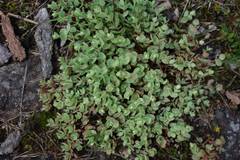
Blue-grey with pink edge; rounded fleshy 0.75-1 inch (2-2.5 cm), scalloped margins, in whorls of threeGrowing Conditions
Sun Requirements
Requires 6-10 hours of direct sunlight daily
• Full Sun: 6+ hours of direct sunlight
• Partial Shade: 3-6 hours of direct sunlight
• Full Shade: Less than 3 hours of direct sunlight
Care & Maintenance
Care Guide
Plant in full sun in lean, gritty, sharply drained soil (pH 6.0–7.5). Sharp drainage is essential; wet winter soils cause root rot. Hardy to zone 6; the species declines in zones 5 and colder. Drought-tolerant once established. The trailing habit is shown to advantage in containers, over walls, or raised beds where stems can cascade. Foliage dies back completely in winter and emerges late in spring. No serious pest or disease problems in well-drained sites.Pruning
Dead stems are removed in spring as new shoots emerge from the central crown. No other pruning is required; the trailing whorled stems develop without intervention. Handling of living stems is limited to avoid breaking the characteristic whorled structure.Pruning Schedule
Prune: March–April
early spring
Container Growing
Suitable for container growing
Minimum container size: 2 gallons