Picea, Genus, meyeri, Species,
- Genus & species
Meyer spruce
Overview
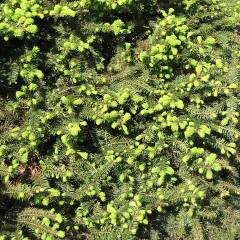
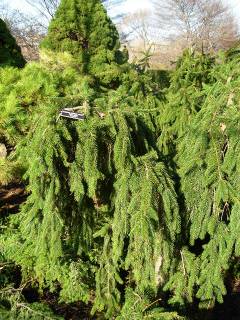
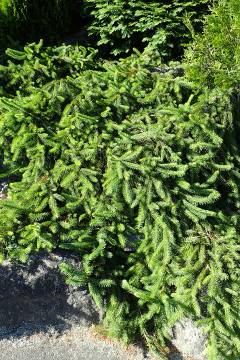
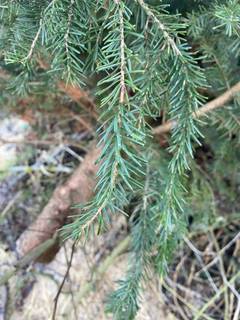
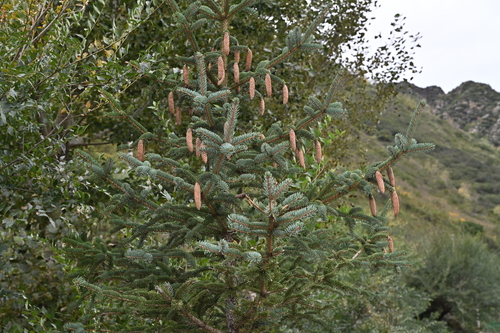
Picea meyeri is an evergreen conifer reaching 35-50 feet (10-15 m) tall and 15-20 feet (4.5-6 m) wide at maturity in cultivation, with a narrow pyramidal to conical form. Growth rate is 6-12 inches (15-30 cm) per year once established. Needles four-sided, stiff, sharply pointed, 0.5-0.9 inch (12-22 mm) long, blue-green to silvery-blue with whitish stomatal lines on all four sides, persisting 4-6 years. New growth emerges blue-grey in May-June. Branches arranged in regular whorls, dense at the base on young trees and opening with age. Bark grey-brown, scaly, becoming furrowed on mature trunks. Pollen cones reddish in May; female cones cylindrical, 2.5-4 inches (6-10 cm) long, green ripening to light brown in the same season, with thin, slightly reflexed scales. Tolerates urban pollution, drought, and humid summers more readily than P. pungens. Susceptible to spruce spider mite and Cytospora canker on stressed trees in regions with hot, dry summers.
Native Range
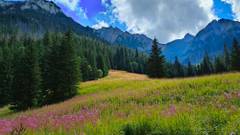
Picea meyeri is native to northern China, including Hebei, Shanxi, Inner Mongolia, and Shaanxi provinces, where it grows in mountain forests at 4,500-9,200 feet (1,400-2,800 m) elevation. Populations are concentrated in the Yan Shan and Helan mountain ranges. The species is widely planted in cultivation across temperate North America and Europe.Suggested Uses
Used as a specimen tree, in screens, and in mixed-conifer plantings, with mature spread of 15-20 feet (4.5-6 m). Spaced 18-25 feet (5.5-7.5 m) apart for screen plantings. Tolerates urban conditions and drought more reliably than other commonly planted spruces.How to Identify
Appearance
Size & Dimensions
Height35' - 50'
Width/Spread15' - 20'
Colors
Foliage Colors
Fall Foliage Colors
Bloom Information
Spruces produce wind-pollinated cones rather than flowers. Male pollen cones reddish, develop at branch tips in May, releasing yellow pollen for 1-2 weeks. Female cones develop in the same season, mature within a single growing year, and reach 2.5-4 inches (6-10 cm) long before opening to release winged seeds in autumn. Cones drop in their first winter rather than persisting on branches.
Detailed Descriptions
Foliage Description
blue-green to silvery-blueGrowing Conditions
Sun Requirements
Requires 6-12 hours of direct sunlight daily
• Full Sun: 6+ hours of direct sunlight
• Partial Shade: 3-6 hours of direct sunlight
• Full Shade: Less than 3 hours of direct sunlight
Care & Maintenance
Care Guide
Establish in well-drained acidic to slightly alkaline soil (pH 5.5-7.5) with full sun exposure of at least 6 hours daily. Water deeply once per week during the first two growing seasons; established plants tolerate drought and rocky soils. Spruce spider mite (Oligonychus ununguis) feeds on needles in hot, dry summers, causing bronzing and premature needle drop, with populations rising under drought stress. Cytospora canker (Leucostoma kunzei) infects branches and produces resin flow with branch dieback in stressed plantings; the disease is more common in zones 6-7 than in cooler zones. Tolerates urban air pollution and salt spray more readily than P. pungens. Foliage may show needle burn at temperatures above 95°F (35°C) in low humidity.Pruning
Spruces do not regenerate new shoots from old wood; pruning is limited to removal of dead, broken, or diseased branches at any time of year. Lower limbs may be removed to expose the trunk on mature specimens; cuts must be flush with the branch collar. New leaders can be selected from upper lateral branches if the central leader is broken, but recovery to a true central form takes 3-5 years.Pruning Schedule
Prune: June–July
summer