Lonicera, Genus, subspicata, Species,
- Genus & species
southern honeysuckle
California and northern Baja California
Overview
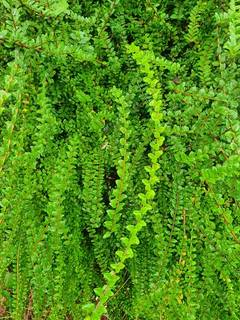
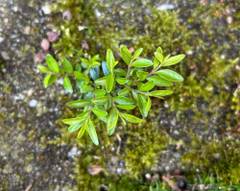
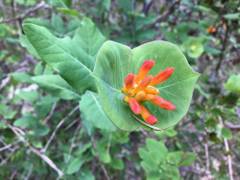
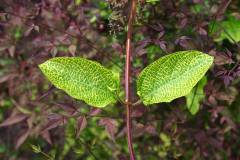
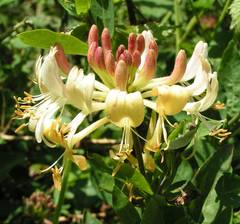
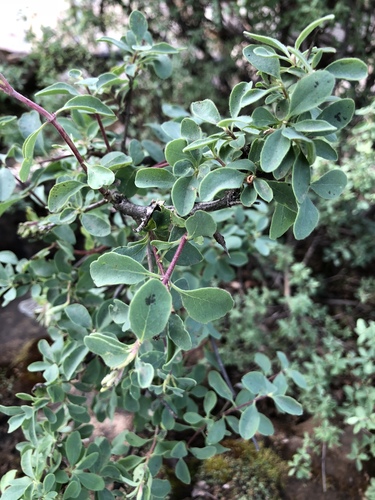
Lonicera subspicata is an evergreen to semi-evergreen woody vine or sprawling shrub of California chaparral and woodland, with slender twining or arching stems reaching 3-8 feet (0.9-2.4 m). The opposite leaves are oval to oblong, 0.5-1.5 inches (1.5-4 cm) long, gray-green, leathery, and often hairy, with the upper pairs sometimes joined around the stem. From late spring into summer it bears narrow spikes of small two-lipped pale yellow flowers about 0.4-0.5 inch (10-13 mm) long, held in narrow spikes rather than the dense clusters of cultivated honeysuckles. The flowers give way to translucent red berries 0.2-0.3 inch (5-8 mm) across that draw birds. L. subspicata grows on dry slopes, in chaparral, oak woodland, and coastal scrub, scrambling over shrubs or forming low mounds where no support is near. It tolerates summer drought, lean soils, and heat once established. The small flowers are less conspicuous than those of cultivated honeysuckles, and the sprawling stems can clamber into neighboring shrubs. It dies back little in mild winters, holding much of its foliage.
Native Range
Lonicera subspicata is native to California and northern Baja California, where it grows in chaparral, oak woodland, coastal sage scrub, and dry foothill slopes.Suggested Uses
L. subspicata is used in California native and habitat gardens, dry slopes, and informal screens where its evergreen stems and red berries support birds and pollinators. It scrambles over fences and shrubs or mounds as a low cover. Its drought tolerance suits it to unirrigated chaparral-style plantings.How to Identify
Appearance
Size & Dimensions
Height3' - 8'
Width/Spread3' - 6'
Bloom Information
L. subspicata flowers from late spring into summer, roughly May through July, with narrow spikes of small pale yellow blooms. The flowers draw bees and other insects and, where present, hummingbirds. Translucent red berries ripen through late summer and are taken by birds.
Detailed Descriptions
Foliage Description
Gray-greenGrowing Conditions
Sun Requirements
Requires 6-10 hours of direct sunlight daily
• Full Sun: 6+ hours of direct sunlight
• Partial Shade: 3-6 hours of direct sunlight
• Full Shade: Less than 3 hours of direct sunlight