Image 1 of 3
1 / 3
Plant Reference
Lonicera, Genus, ligustrina, Species, var., Variety, yunnanensis, Variety, 'Baggesen's Gold', Cultivar,
- Genus & species
- Variety
- Cultivar
golden box honeysuckle
Species native to southwestern China — Yunnan and Sichuan provinces; the cultivar 'Baggesen's Gold' was selected by Niels Baggesen at his nursery in Kent, England in the 1960s
Overview
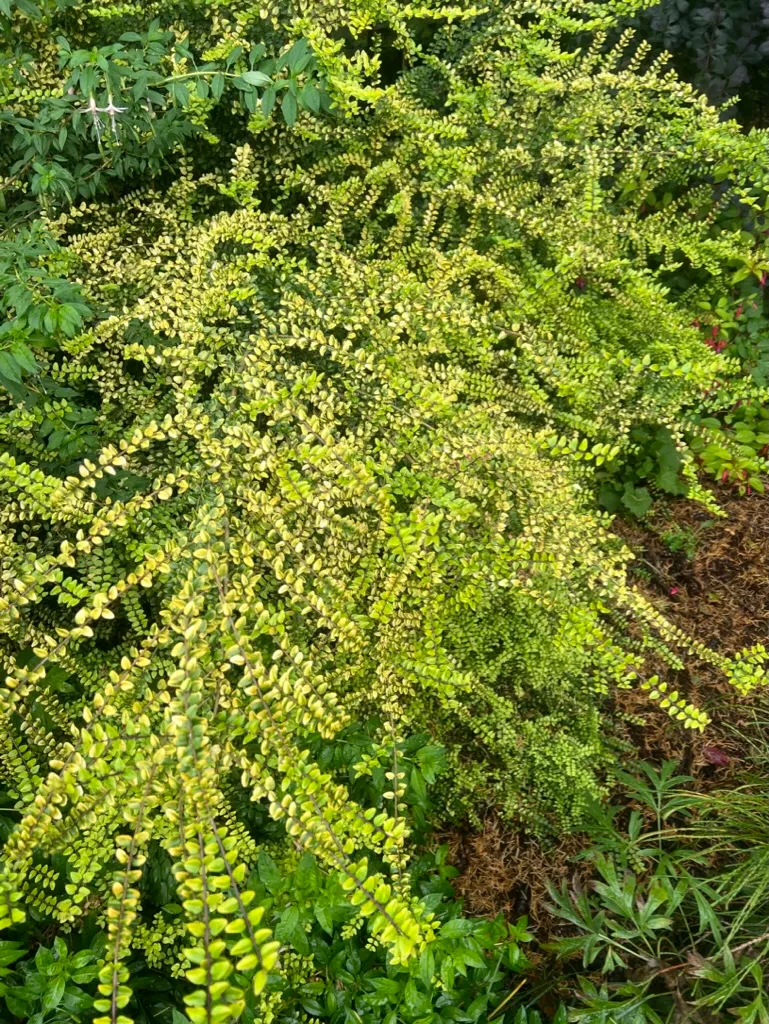
Lonicera ligustrina var. yunnanensis 'Baggesen's Gold' is a mounding broadleaf evergreen shrub in the family Caprifoliaceae growing 4–6 feet (1.2–1.8 m) tall and 4–6 feet (1.2–1.8 m) wide from a multi-stemmed base that produces a dense rounded canopy of small twiggy branches densely clothed in small golden-yellow leaves. The cultivar was selected by Niels Baggesen at his nursery in Kent, England in the 1960s as a chance gold-foliaged seedling within a population of the green-leaved type variety, and the cultivar bears Baggesen's name in commercial recognition of the selection. The cultivar has subsequently become the standard gold-foliaged shrub in British and European garden centers and is widely planted across the cool-summer regions of northern Europe and the Pacific Northwest of North America where the gold foliage holds its color through the growing season. Leaves are golden-yellow to chartreuse in full sun positions and shift to lime-green to yellow-green in shaded positions — the gold leaf color is site-dependent and develops most strongly in full sun where the photosynthetic compensation pathway upregulates the gold pigment expression in response to high light. Small oval leaves 0.5–1 inch (1.3–2.5 cm) long are densely arranged on small-leaved twiggy branches, and the boxwood-like foliage texture combined with the gold leaf color makes the cultivar the standard gold accent shrub for clipped formal hedge applications in cool-summer regions. Through cold winter weather the leaf color shifts to yellow-green or olive tones, and the gold coloration is recovered with the spring flush of new growth. Creamy-white tiny tubular flowers 0.3 inch (8 mm) long open in pairs at the leaf axils along the twigs in May and June across a 3-week bloom period and carry a light sweet honey-scented fragrance at close range; flower production is sparser than on the green-leaved type variety because the reduced chlorophyll of the gold-foliaged cultivar limits the photosynthetic capacity that supports heavy bloom. Limitation: all-green reversion shoots emerge sporadically on the cultivar and call for prompt removal because the green reversion growth is more vigorous than the gold-foliaged growth and will overtake the gold canopy within a few years if allowed to develop. The gold-to-olive winter color shift is the secondary aesthetic limitation in zones with cold winter weather, and gardeners who want the gold color through all four seasons should consider container culture with winter shelter or selection of a different evergreen golden-foliaged species. Native species range is southwestern China (Yunnan and Sichuan provinces) at 3,000–8,000 feet (900–2,400 m) elevation. Drought-tolerant once established. Non-toxic. Deer browse the foliage in regions with active deer populations.
Native Range
The species type Lonicera ligustrina is native to southwestern China — primarily Yunnan and Sichuan provinces — growing in mountain forests and scrubland at 3,000–8,000 feet (900–2,400 m) elevation. The cultivar 'Baggesen's Gold' was selected by Niels Baggesen at his nursery in Kent, England in the 1960s as a chance gold-foliaged seedling within a population of the green-leaved type variety, and the cultivar bears Baggesen's name in commercial recognition of the selection.Suggested Uses
Used as a gold-foliaged formal hedge, gold accent shrub in mixed borders, topiary specimen, and container specimen in containers of at least 5 gallons (19 L) at 18–48 inch (45–120 cm) spacing depending on the designed hedge or topiary scale in USDA zones 6 through 9. The small-leaved boxwood-like glossy gold evergreen foliage and the tolerance of repeated shearing combine to make the cultivar the standard gold accent shrub for clipped formal hedge applications in cool-summer regions where the gold color holds through the growing season. Cool-summer regions (the British Isles, northern Europe, the Pacific Northwest of North America) are the cultivar's strongest performance climates. Hot-summer southern gardens may scorch the gold foliage in afternoon sun and call for partial-shade siting at the cost of some gold color intensity. The gold-to-olive winter color shift in cold-winter zones is a seasonal aesthetic consideration for gardeners who want continuous gold color through all four seasons. Active deer-pressure landscapes are unsuitable without browse protection because deer browse the foliage.How to Identify
Appearance
Size & Dimensions
Height4' - 6'
Width/Spread4' - 6'
Colors
Bloom Information
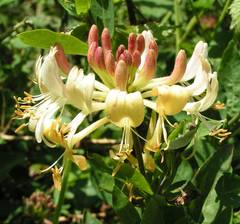
Creamy-white tiny tubular flowers 0.3 inch (8 mm) long open in pairs at the leaf axils along the twigs in May and June across a 3-week bloom period and carry a light sweet honey-scented fragrance at close range. Flower production is sparser than on the green-leaved type variety because the reduced chlorophyll of the gold-foliaged cultivar limits the photosynthetic capacity that supports heavy bloom, and the cultivar is grown for the gold foliage rather than for the bloom display. Honeybees and other pollinators work the flowers for nectar across the spring bloom.
Detailed Descriptions
Flower Description
creamy-white tiny tubular flowers 0.3 inch (8 mm) long carried in pairs at the leaf axils along the twigs in May and June; lightly fragrant with a sweet honey scent at close range; flower production is sparser than on the green-leaved type variety because the reduced chlorophyll of the gold-foliaged cultivar limits the photosynthetic capacity that supports heavy bloomFoliage Description
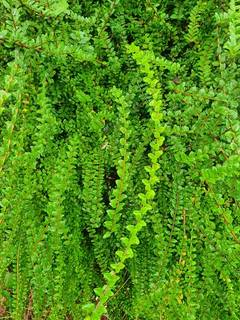
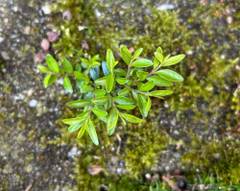
golden-yellow to chartreuse in full sun, lime-green to yellow-green in shaded positions; small oval leaves 0.5-1 inch (1.3-2.5 cm) long densely arranged on small-leaved twiggy branches; the leaf color shifts to yellow-green or olive tones through cold winter weather and recovers gold coloration with the spring flush; evergreen year-roundGrowing Conditions
Sun Requirements
Requires 4-8 hours of direct sunlight daily
• Full Sun: 6+ hours of direct sunlight
• Partial Shade: 3-6 hours of direct sunlight
• Full Shade: Less than 3 hours of direct sunlight
Care & Maintenance
Care Guide
Site in full sun for vivid gold leaf coloration with 4–8 hours of direct sun per day, in well-drained loam, clay, or sand soil with a pH of 5.5–7.5. Drought tolerance develops once the root system is established. The gold leaf color is site-dependent — full sun produces the most vivid gold coloration while shaded positions produce lime-green to yellow-green foliage that is still serviceable but lacks the gold intensity. All-green reversion shoots emerge sporadically and call for prompt removal because the reversion growth is more vigorous than the gold-foliaged growth and will overtake the gold canopy within a few years if not addressed. The cultivar tolerates repeated shearing for formal hedging applications, and 2–3 light shearings per growing season (typically May, June, and July) maintain a tight formal hedge surface. Through cold winter weather the leaf color shifts to yellow-green or olive tones, and the gold coloration is recovered with the spring flush of new growth. Non-toxic. Deer browse the foliage in regions with active deer populations. Hardy in USDA zones 6–9.Pruning
Light shearing 2–3 times per growing season (typically May, June, and July) maintains a tight formal hedge surface and supports dense branching from the cut points. All-green reversion shoots are removed promptly as they appear and are cut back to the parent stem below the point of reversion to remove the latent reversion buds — leaving any reverted shoots in place will produce dominance of the green reversion growth within a few years. Older stems are thinned at the base every 2–3 years on informal plantings to renew the multi-stemmed framework and to support vigorous gold-foliaged young growth at the canopy.Pruning Schedule
Prune: May–July
late springsummer
Container Growing
Suitable for container growing
Minimum container size: 5 gallons