Lolium, Genus, perenne, Species,
- Genus & species
perennial ryegrass
Native to Europe, temperate Asia, and North Africa where the species grows in moist meadows, pastures, and roadsides; naturalized throughout temperate regions worldwide following European colonial-era introduction; the cool-season life cycle, fast 5-7 day germination, and bunchgrass habit together make {Lolium perenne} the fastest-establishing lawn grass for cool-season turf in USDA zones 3-7 — the species is commonly mixed with Kentucky bluegrass in seed mixes, where the ryegrass establishes quickly while the slower bluegrass fills in over the following 1-2 years
Overview
Lolium perenne is a cool-season perennial bunchgrass in the grass family (Poaceae) reaching 6-24 inches (15-60 cm) tall (unmowed) with a 8-12 inch (20-30 cm) spread per plant and an upright clumping habit that tillering develops into a dense turf over time. Native to Europe, temperate Asia, and North Africa, the species germinates in 5-7 days — the fastest of any common lawn grass — and establishes a usable turf in 3-4 weeks. Foliage is narrow-textured with glossy dark green blades 2-4 mm wide, prominent veins on the upper surface, and folded vernation (leaves folded in the bud) — the folded vernation is a diagnostic identification feature for the species. Maintained at mowing heights of 1.5-3 inches (4-8 cm). Not rhizomatous: the species spreads only by tillering, so it does not fill bare spots on its own. Lifespan 3-5 years per plant — shorter-lived than Kentucky bluegrass. Wear-tolerant. Widely used in seed mixes with Kentucky bluegrass for quick establishment while the slower bluegrass fills in over 1-2 years.
Native Range
Lolium perenne is native to Europe, temperate Asia, and North Africa. Naturalized throughout temperate regions worldwide.Suggested Uses
Used in home lawns, sports fields, parks, and erosion-control plantings. Fastest-establishing lawn grass with 5-7 day germination. Wear-tolerant for sports turf positions. Often mixed with Kentucky bluegrass in cool-season seed mixes. Cool-season grass for USDA zones 3-7. Glossy dark green color. Not suited to hot-summer climates (zones 8 and warmer) as a permanent lawn since the species suffers in sustained heat above 90°F. Short-lived 3-5 years per plant — the lawn requires annual overseeding to maintain density. No self-repair from the bunchgrass habit.How to Identify
Appearance
Size & Dimensions
Height2" - 2'
Width/Spread8" - 1'
Bloom Information
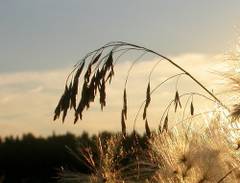
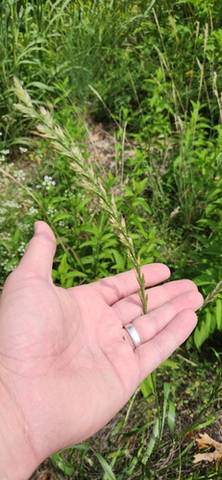
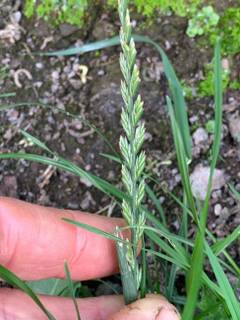
Spike-like inflorescences with alternating spikelets along the stem axis, opening in late spring through early summer if plants are unmowed. Cross-pollinating by wind. Mowing prevents flowering in lawn settings, so seed-head production is rare in maintained turf.
Detailed Descriptions
Flower Description
Green spike-like inflorescences with alternating spikelets along the stem axis, opening in late spring through early summer if plants are unmowed; mowing prevents flowering in lawn settingsFoliage Description
Glossy dark green narrow blades 2-4 mm wide with prominent veins on the upper surface and a folded vernation (leaves folded in the bud — a diagnostic feature for the genus)Growing Conditions
Sun Requirements
Requires 4-10 hours of direct sunlight daily
• Full Sun: 6+ hours of direct sunlight
• Partial Shade: 3-6 hours of direct sunlight
• Full Shade: Less than 3 hours of direct sunlight
Care & Maintenance
Care Guide
Seed in early fall or early spring at 6-8 lb per 1,000 sq ft (270-360 g per 93 sq m). Germinates in 5-7 days at soil temperatures above 50°F (10°C). Full sun to light shade. Grows in fertile well-drained soil at pH 6.0-7.0. Mow at 1.5-3 inches. Water 1-1.5 inches (2.5-4 cm) per week. Fertilize 2-4 lb nitrogen per 1,000 sq ft per year. Cool-season grass that grows actively in spring and fall and goes semi-dormant in summer heat. Does not tolerate sustained heat above 90°F (32°C) — the species suffers in hot summers. Overseed annually to maintain density since plants are short-lived (3-5 years).Pruning
Mow at 1.5-3 inches (4-8 cm). Never remove more than one-third of blade height per mowing. Mow higher during summer stress. Overseed thin areas annually since the bunchgrass habit means the species does not fill bare spots on its own.Pruning Schedule
Prune: March–October
early springlate springsummerfall