Euphorbia, Genus, lactea, Species,
- Genus & species
dragon bones
Tropical Asia — India and Sri Lanka; naturalized in parts of Southeast Asia, the Caribbean, and Florida
Overview
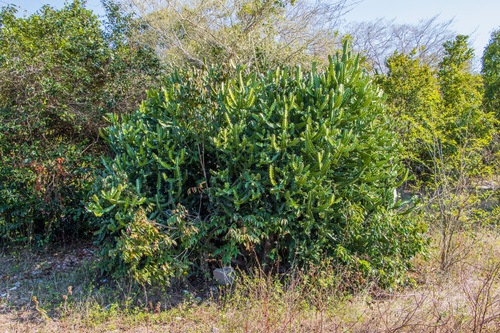
Euphorbia lactea is a candelabra-form succulent native to tropical Asia, grown almost exclusively as an indoor specimen, reaching 36–96 inches (90–240 cm) tall and 12–24 inches (30–60 cm) wide in container culture. The species epithet 'lactea' translates as 'milky' and refers to the white latex sap that flows freely from any cut or broken stem; the genus name Euphorbia honors Euphorbus, the 1st-century BCE Greek physician to King Juba II of Numidia. Stems are triangular to four-angled in cross-section, gray-green to blue-green, and grow as branching candelabra with paired short spines 0.1–0.25 inch (2–6 mm) long arising from the stem ridges. The plant is most often sold as the cultivar 'Cristata' (the crested form), grafted onto a straight E. neriifolia or E. trigona rootstock; the species form with normal candelabra branching is also available but less common in retail. The white latex sap is caustic to skin and mucous membranes and causes contact dermatitis with redness, blistering, and prolonged itching that lasts 5–10 days; sap in the eye causes severe conjunctival irritation that requires immediate flushing with water and may need medical attention. Cultural failure modes are over-watering (root rot from soil that stays wet, the leading cause of decline), insufficient light (etiolation produces thin pale new growth), and cold damage below 50°F (10°C). All parts contain phorbol esters and other diterpenoid compounds that are toxic to dogs, cats, and humans on ingestion; sap contact alone causes the more common dermatitis injury. Hardy outdoors only in USDA zones 10–12.
Native Range
Euphorbia lactea is native to tropical Asia, with a wild range in India and Sri Lanka, where it grows in dry rocky scrubland and on disturbed sites. The species has naturalized across many tropical regions including parts of Southeast Asia, the Caribbean, and Florida.Suggested Uses
Used as a sculptural indoor specimen for sunny windows, sunrooms, and conservatories in containers of 3–7 gallons (11–26 liters) with bright indirect light or partial direct sun. The angular candelabra form suits modern desert-style interior plantings and sculptural arrangements. Combines with smaller succulents such as Echeveria cultivars, Haworthia species, and Sedum for layered desert-style plantings. Less suited to households with cats and dogs that browse foliage due to phorbol ester toxicity, and the latex sap risk applies to all gardeners who handle the plant during pruning or repotting.How to Identify
Appearance
Size & Dimensions
Height3' - 8'
Width/Spread1' - 2'
Colors
Bloom Information
Flowers rarely in container culture; outdoor specimens in tropical climates produce small inconspicuous yellow-green cyathia (the specialized inflorescence of the genus) at stem tips. Indoor plants are grown for the sculptural stem form, which is the year-round display.
Detailed Descriptions
Flower Description
Small inconspicuous yellow-green cyathia (rare in container culture)Foliage Description
Gray-green to blue-green triangular to four-angled succulent stems with paired short spines 0.1-0.25 inch (2-6 mm) long arising from the stem ridgesGrowing Conditions
Sun Requirements
Requires 4-8 hours of direct sunlight daily
• Full Sun: 6+ hours of direct sunlight
• Partial Shade: 3-6 hours of direct sunlight
• Full Shade: Less than 3 hours of direct sunlight
Care & Maintenance
Care Guide
Place in bright indirect light at 200–500 foot-candles or partial direct sun for 4 or more hours; insufficient light causes etiolation (thin pale new growth) at the stem tip. Water deeply when the soil is fully dry, typically every 3–6 weeks in summer and every 6–10 weeks in winter; over-watering is the leading cause of decline. Soil mix should be a free-draining cactus-and-succulent mix or a custom blend of 50–60 percent potting mix and 40–50 percent coarse sand, perlite, or pumice. Maintain temperatures above 50°F (10°C) at all times; the plant tolerates brief cold dips but suffers tissue damage below 50°F that shows as black or brown soft spots. White latex sap stains skin, fabric, and surfaces and causes contact dermatitis on bare skin; cuttings should be handled with skin and eye coverage to prevent splash injury.Pruning
Cut stem branches at the desired length with clean pruners; the cut surface bleeds white latex sap freely and seals over within 1–3 days. Stem cuttings root in dry potting mix in 4–8 weeks for new plants; let the cut surface dry and callus for 2–3 weeks before placing in soil to prevent rot. The latex sap that flows from any cut requires skin and eye coverage during pruning.Container Growing
Suitable for container growing
Minimum container size: 3 gallons