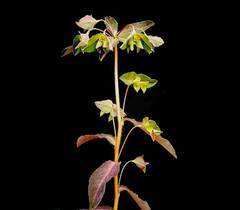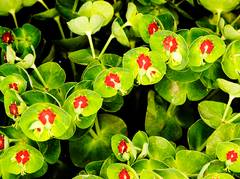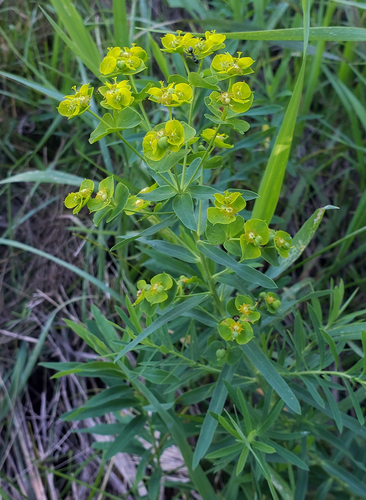
Euphorbia, Genus, virgata, Species,
- Genus & species
leafy spurge
Overview
Euphorbia virgata (often cited as E. esula, though E. virgata is the accepted name for the invasive North American biotype) is a deep-rooted, colony-forming herbaceous perennial in the spurge family (Euphorbiaceae) reaching 24-36 inches (60-90 cm) tall with a 12-24 inch (30-60 cm) spread, expanding indefinitely via lateral root buds. Stems are erect, smooth, densely leafy, and exude copious milky white latex when broken. Leaves are alternate, linear to lance-shaped, 1-3 inches (2.5-8 cm) long, blue-green, with entire margins. The inflorescence is a terminal, umbel-like cluster of cyathia subtended by paired, heart-shaped, yellow-green bracts that provide the visible color display. Fruit is a three-lobed capsule that dehisces explosively, projecting seeds up to 15 feet (4.5 m). A single plant produces 100-250 seeds annually. The lateral root system extends horizontally 15 feet (4.5 m) or more, with adventitious buds producing new shoots every 4-12 inches (10-30 cm). Roots penetrate 15-20 feet (4.5-6 m) deep. Root fragments as small as 0.5 inch (1 cm) regenerate. E. virgata is listed as a federal noxious weed in the United States. Infestations cover over 3 million acres (1.2 million hectares) of rangeland in the northern Great Plains and Pacific Northwest. Latex causes severe skin irritation, mouth blistering, and temporary blindness if contacting eyes.
Native Range
Euphorbia virgata is native to Europe and Asia, occurring in grasslands, roadsides, and disturbed ground from sea level to approximately 7,500 feet (2,300 m). Introduced to North America in the 1800s as a seed contaminant, the species now infests over 3 million acres (1.2 million hectares) of rangeland, primarily in the northern Great Plains, intermountain West, and Pacific Northwest.Suggested Uses
Used extensively in noxious weed management training and biological control education. The Aphthona flea beetle biological control program is a primary case study in integrated weed management curricula. Studied in root physiology, allelopathy, and invasion ecology. Latex chemistry is studied in pharmacology and toxicology.How to Identify
Appearance
Size & Dimensions
Height2' - 3'
Width/Spread1' - 2'
Bloom Information
Flowers appear May through July. The yellow-green bracts are visible 2-3 weeks before the cyathia mature. Capsules dehisce explosively in July through August, projecting seeds up to 15 feet (4.5 m). In the Pacific Northwest, the yellow-green bract display peaks in June. The species is self-pollinating but also visited by bees and flies attracted to the nectar glands.
Detailed Descriptions
Flower Description
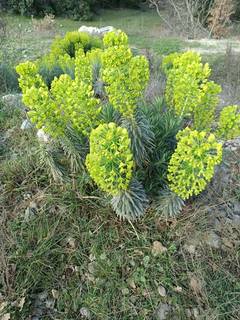
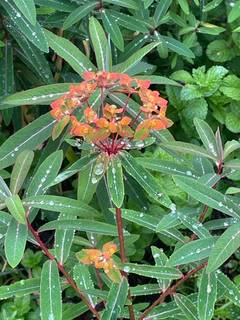
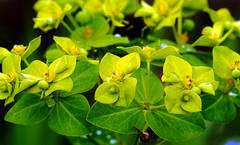
Yellow-green cyathia in umbel-like clusters subtended by paired heart-shaped yellow-green bractsFoliage Description
Blue-green, linear to lance-shaped, alternate, smooth, with entire margins; yellow-green heart-shaped bracts below the cyathiaGrowing Conditions
Sun Requirements
Requires 6-12 hours of direct sunlight daily
• Full Sun: 6+ hours of direct sunlight
• Partial Shade: 3-6 hours of direct sunlight
• Full Shade: Less than 3 hours of direct sunlight