Eryngium, Genus, maritimum, Species,
- Genus & species
sea holly
Europe, Mediterranean, and Black Sea coasts
Overview
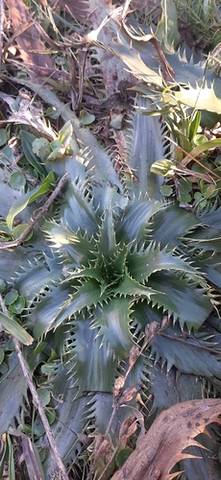
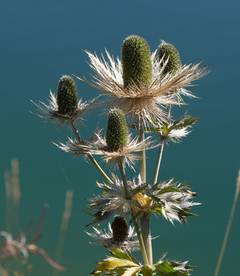
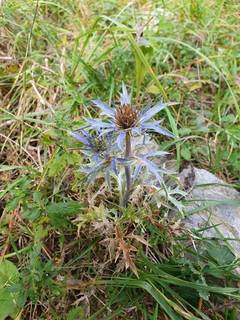
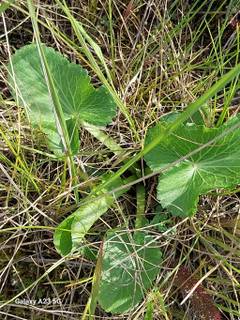
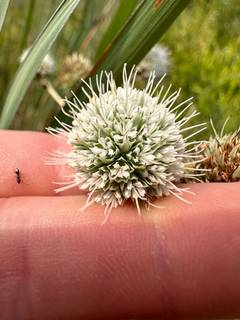
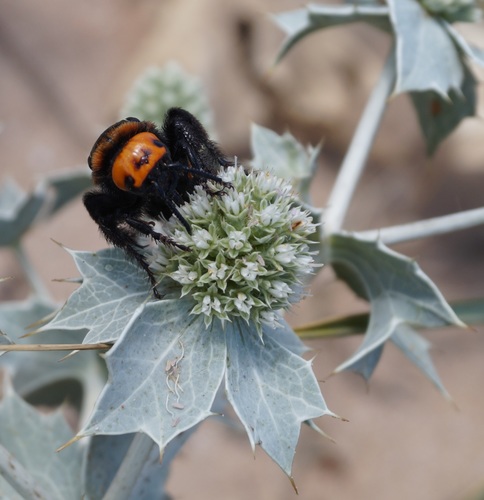
Eryngium maritimum is a clump-forming, spiny perennial in the carrot family Apiaceae, growing 8-24 inches (20-60 cm) tall and 12-18 inches (30-45 cm) wide from a deep, fleshy taproot. The thick, rounded, holly-like leaves are blue-grey and waxy, 1.5-5 inches (4-12 cm) long, with stiff white-veined margins ending in sharp spines. From July to September the branched stems carry dense, dome-shaped flower heads 0.6-1.2 inches (1.5-3 cm) across, made up of many tiny powder-blue flowers ringed by spiny, silver-blue bracts. The whole plant takes on a metallic blue cast as it flowers. The species grows on coastal sand dunes, shingle, and the upper edges of sandy beaches around the coasts of Europe, the Mediterranean, and the Black Sea, where its taproot reaches moisture deep below the surface. It withstands drought, salt spray, and shifting sand but needs sharp drainage and full sun, failing on heavy, wet, or shaded ground, and recovers poorly from root disturbance once established.
Native Range
Native to the sandy and shingle coasts of Europe, the Mediterranean, and the Black Sea, from Scandinavia and Britain south to North Africa and east to the Caucasus. It grows on mobile and fixed dunes, shingle banks, and the drift line of sandy beaches on sharply drained, salt-laden soils.Suggested Uses
Grown in coastal and seaside gardens, gravel and dry gardens, and sunny, sharply drained borders, and used as a long-lasting cut or dried flower. Its blue heads and spiny bracts add structure to gravel plantings and wildlife borders, where the flowers feed summer insects. It also helps stabilise loose sand on coastal banks.How to Identify
Appearance
Size & Dimensions
Height8" - 2'
Width/Spread1' - 1'6"
Colors
Bloom Information
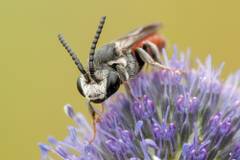
Flowering runs from July to September, the rounded heads opening powder-blue and holding their colour for several weeks. The nectar-rich flowers draw bees, wasps, butterflies, and many other insects to the dunes in high summer. As the heads age they fade to grey-brown and carry ribbed seeds armed with hooked scales.
Detailed Descriptions
Foliage Description
blue-greyGrowing Conditions
Sun Requirements
Requires 6-12 hours of direct sunlight daily
• Full Sun: 6+ hours of direct sunlight
• Partial Shade: 3-6 hours of direct sunlight
• Full Shade: Less than 3 hours of direct sunlight
Care & Maintenance
Care Guide
Eryngium maritimum grows in full sun on sharply drained, sandy or gravelly soils of low fertility, and tolerates drought, salt, and exposure once its taproot is down. It performs poorly on heavy clay, in shade, or on wet ground, where the crown is liable to rot. Because of the long taproot it is raised from seed or root cuttings and set out young into its final position, since established plants recover slowly from being moved. It needs no feeding and little water once settled, and the seed heads can be left standing for winter structure. Plants are slow to establish but long-lived in a dry, open site. Cold, wet winters are more damaging than low temperatures alone.Pruning
No regular pruning is needed. The dried flower stems can be cut back in late winter before new growth appears, or left over winter for their shape and seed. Taking out self-sown seedlings keeps the plant from spreading where it is not wanted.Container Growing
Suitable for container growing
Minimum container size: 5 gallons