Centaurea, Genus, nigrescens, Species,
- Genus & species
meadow knapweed
Overview
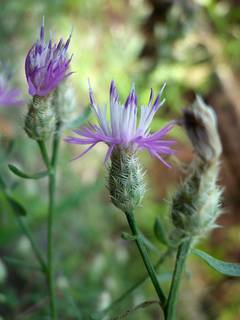
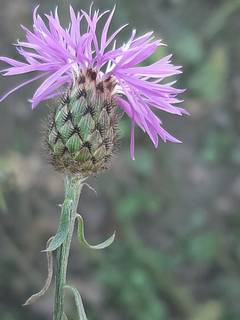
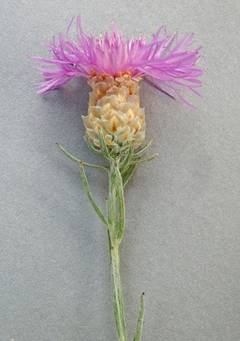
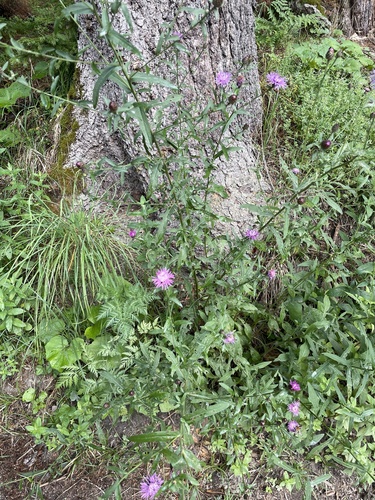
Centaurea nigrescens is a deep-rooted herbaceous perennial in the daisy family (Asteraceae) reaching 18-48 inches (45-120 cm) tall with a 12-24 inch (30-60 cm) spread. The currently accepted species concept includes plants formerly classified as Centaurea × pratensis and C. debeauxii, which are of hybrid origin between C. nigra (black knapweed) and C. jacea (brown knapweed). Stems are erect, wiry, and branching in the upper half, with short, rough hairs. Basal leaves are broadly lobed to lyrate, 4-8 inches (10-20 cm) long; upper stem leaves are narrower, lance-shaped, and entire. Flower heads are solitary at branch tips, 0.6-1 inch (15-25 mm) in diameter, with pink to purple ray-like florets surrounding tubular disc florets. Involucral bracts have dark brown to black, fringed (pectinate) tips. Plants develop a stout taproot and also spread by lateral root buds, forming expanding patches. Each plant produces 400-1,000 seeds annually. C. nigrescens is listed as a Class B noxious weed in Washington and Oregon. Dense stands reduce forage productivity in pastures and meadows by 50-90%.
Native Range
Centaurea nigrescens is native to central and southern Europe, occurring in meadows, grasslands, and roadsides from sea level to approximately 5,000 feet (1,500 m). Introduced to North America, the species is established primarily in the Pacific Northwest and northeastern United States in moist to mesic grasslands, pastures, and roadsides.Suggested Uses
Used in noxious weed identification training, particularly for separating Centaurea species in the Pacific Northwest. Studied in rangeland and meadow restoration ecology. The taxonomic complexity of the C. nigra/C. jacea hybrid complex is used in plant systematics coursework. C. nigrescens is a regulated Class B noxious weed in Washington and Oregon and is not planted horticulturally.How to Identify
Appearance
Size & Dimensions
Height1'6" - 4'
Width/Spread1' - 2'
Bloom Information
Flowers appear June through September. Individual flower heads bloom for 5-8 days. Flowering progresses from the terminal head downward on branching stems over 6-8 weeks. In the Pacific Northwest, peak flowering occurs in July through August. Seeds mature approximately 3 weeks after pollination and drop near the parent plant; wind dispersal is limited compared to pappus-bearing Centaurea species.
Detailed Descriptions
Flower Description
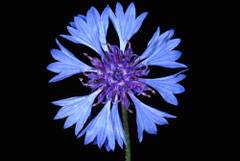
Pink to purple flower heads 0.6-1 inch (15-25 mm), involucral bracts with dark brown to black fringed tipsFoliage Description
Gray-green, lower leaves broadly lobed to lyrate, upper leaves narrowly lance-shaped and entireGrowing Conditions
Sun Requirements
Requires 6-12 hours of direct sunlight daily
• Full Sun: 6+ hours of direct sunlight
• Partial Shade: 3-6 hours of direct sunlight
• Full Shade: Less than 3 hours of direct sunlight