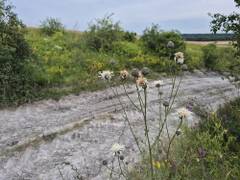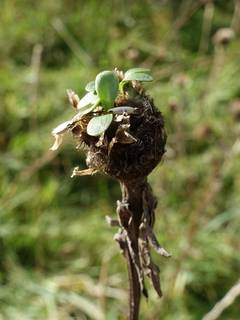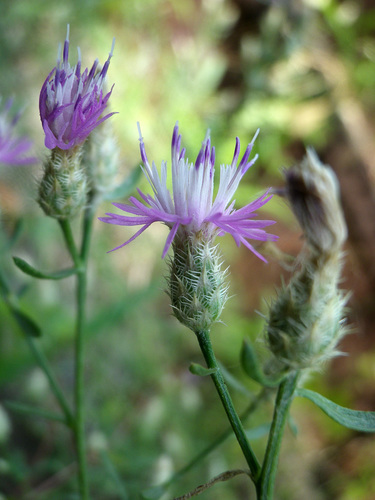
Centaurea, Genus, diffusa, Species,
- Genus & species
diffuse knapweed
Eastern Mediterranean, southeastern Europe, western Asia
Overview
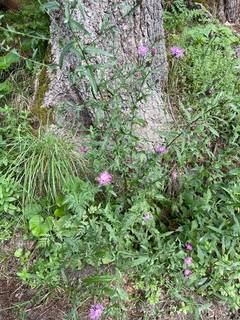
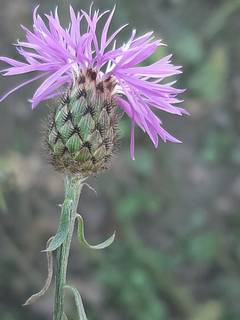
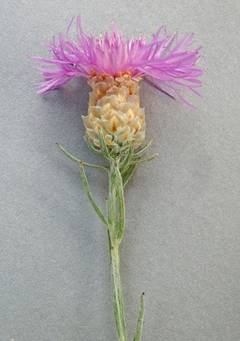
Centaurea diffusa is a biennial or short-lived perennial in the daisy family (Asteraceae) reaching 12-36 inches (30-90 cm) tall with a 12-24 inch (30-60 cm) spread. First-year plants form a basal rosette of finely pinnately dissected, gray-green leaves 2-6 inches (5-15 cm) long. Second-year stems are erect, wiry, and branched from the base, producing a bushy, tumbledown profile. Stem leaves are progressively smaller upward, becoming linear and bract-like. Flower heads are small, 0.3-0.4 inch (7-10 mm) wide, borne singly at the tips of numerous branches. Florets are white to lavender. Each involucral bract bears a terminal spine 0.08-0.2 inch (2-5 mm) long flanked by 4-5 pairs of shorter lateral spines, a diagnostic feature of the species. Each plant produces 400-900 seeds in low-density stands, rising to over 18,000 seeds in dense populations. At maturity, the dried stem breaks at the base and tumbles in wind, dispersing seeds over long distances. Roots release allelopathic compounds ((-)-catechin) that suppress germination of neighboring plant species. C. diffusa is listed as a Class B noxious weed in Washington State and is regulated across the western United States and Canada.
Native Range
Centaurea diffusa is native to the eastern Mediterranean region, southeastern Europe, and western Asia, occurring in dry grasslands, roadsides, and steppe habitats from sea level to approximately 4,500 feet (1,400 m). Introduced to North America in the early 1900s, the species is now widely established in the Pacific Northwest, intermountain West, and northern Great Plains in dry, well-drained sites.Suggested Uses
Used in noxious weed identification and management training for county weed boards, rangeland managers, and conservation district staff. Studied in invasion ecology research, particularly regarding allelopathic soil chemistry and biological control outcomes. Included in rangeland weed management curricula. C. diffusa is a regulated Class B noxious weed in the western United States and is not planted horticulturally.How to Identify
Appearance
Size & Dimensions
Height1' - 3'
Width/Spread1' - 2'
Bloom Information
Flowers appear June through September. Individual heads bloom for 3-5 days. The branched architecture carries dozens to hundreds of flower heads per plant, with flowering progressing from the upper terminal heads downward over 6-8 weeks. In the Pacific Northwest, peak flowering occurs in July through August. Seeds mature 2-3 weeks after pollination.
Detailed Descriptions
Flower Description
White to lavender flower heads 0.3-0.4 inch (7-10 mm), involucral bracts with terminal spine flanked by 4-5 pairs of lateral spinesFoliage Description
Gray-green, finely divided and pinnately dissected, covered in short hairsGrowing Conditions
Sun Requirements
Requires 6-12 hours of direct sunlight daily
• Full Sun: 6+ hours of direct sunlight
• Partial Shade: 3-6 hours of direct sunlight
• Full Shade: Less than 3 hours of direct sunlight