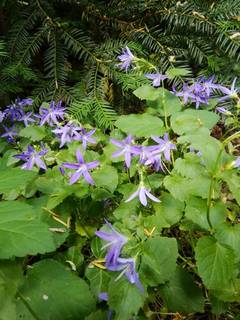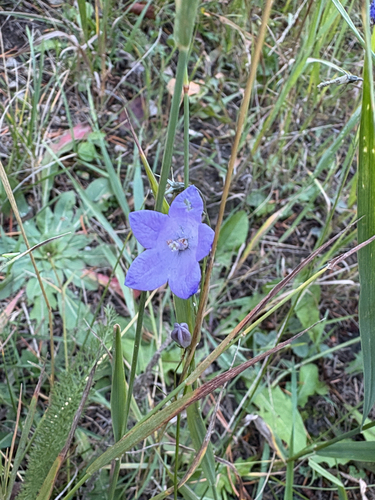
Campanula, Genus, petiolata, Species,
- Genus & species
western harebell
Overview
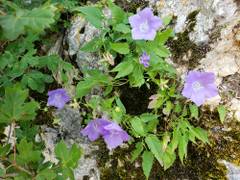
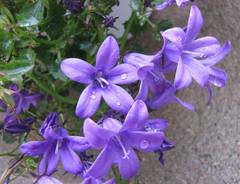
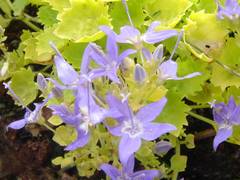
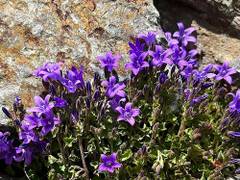
Campanula petiolata is a slender herbaceous perennial in the bellflower family, growing 4-20 in (10-50 cm) tall from a thin rootstock. Basal leaves are rounded to heart-shaped and often wither by flowering time, while the stem leaves are narrow and linear. From early summer into fall it bears nodding, bell-shaped flowers about 0.5-0.8 in (12-20 mm) long in shades of blue to violet, held singly or in loose few-flowered clusters on wiry stems. The five-lobed corolla flares at the mouth, and each flower is followed by a small nodding capsule that releases minute seed through basal pores. The plant spreads slowly by thin rhizomes and self-sows where the ground is open. It grows in open woods, rocky slopes, meadows, and grassland across much of western North America, from low elevations into the mountains. The wiry stems can flop in rich soil or shade, and the foliage adds little presence outside the flowering period. It is closely related to and often treated within the Campanula rotundifolia complex.
Native Range
Campanula petiolata is native to western North America, ranging from Alaska and western Canada south through the Rocky Mountains and intermountain region to the southwestern United States. It grows in grasslands, open woodland, and rocky slopes.Suggested Uses
Used in rock gardens, wildflower meadows, and the front of borders, spaced 8-12 in (20-30 cm) apart. Suited to naturalizing in lean, sunny sites. Combines with other low perennials and grasses in native and pollinator plantings.How to Identify
Appearance
Size & Dimensions
Height4" - 1'8"
Width/Spread6" - 1'
Bloom Information
Detailed Descriptions
Flower Description
blue to violetFoliage Description
greenGrowing Conditions
Sun Requirements
Requires 5-9 hours of direct sunlight daily
• Full Sun: 6+ hours of direct sunlight
• Partial Shade: 3-6 hours of direct sunlight
• Full Shade: Less than 3 hours of direct sunlight
Care & Maintenance
Care Guide
Grows in full sun to part shade on well-drained sandy, loamy, or rocky soils of low to moderate fertility. It tolerates drought once established and withstands cold to USDA zone 3. Soil pH from 6.0 to 7.5 is suitable. Water occasionally during establishment, then only in extended dry spells. Rich soils and shade produce lax, floppy stems with fewer flowers. It self-sows and spreads gently by rhizome without becoming aggressive.Pruning
Shearing plants back after the first flush of bloom encourages a second round of flowers and tidies lax stems. Spent flowering stems can be removed in late fall or left standing to self-sow. No other pruning is needed.Pruning Schedule
Prune: July & October
summerfall
Container Growing
Suitable for container growing
Minimum container size: 1 gallons