Image 1 of 3
1 / 3
© Ghislain118 http://www.fleurs-des-montagnes.net, some rights reserved (CC-BY-SA) · Wikimedia Commons
Campanula, Genus, garganica, Species, 'Dickson's Gold', Cultivar,
- Genus & species
- Cultivar
Dickson's gold bellflower
Species native to southern Italy (Gargano Peninsula) and Greece
Overview
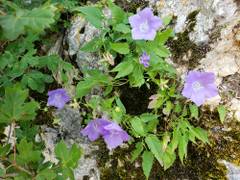
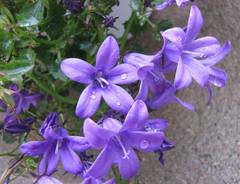
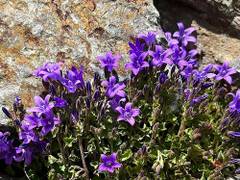
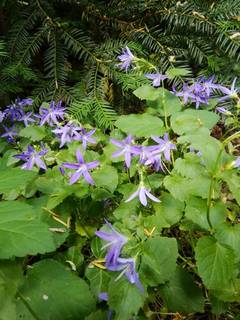
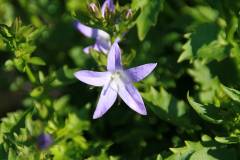
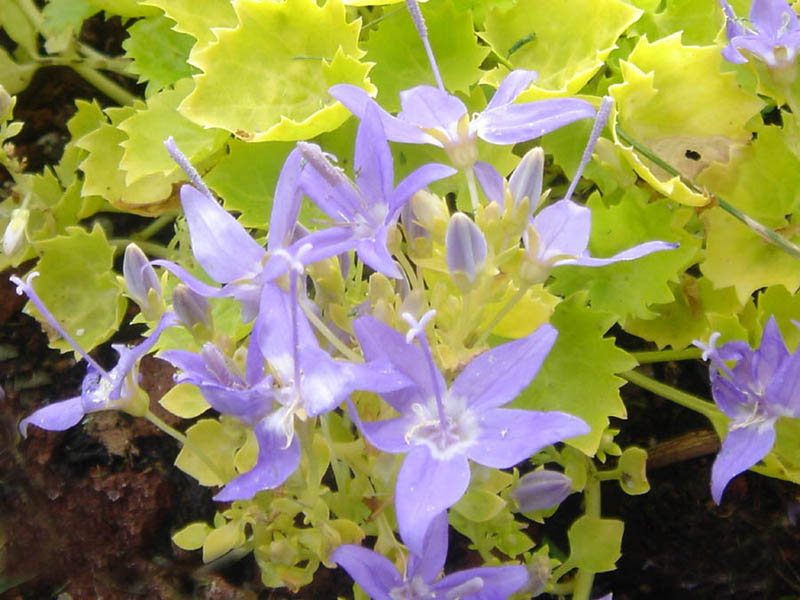
Campanula garganica 'Dickson's Gold' is a low, mat-forming, semi-evergreen perennial reaching 3–5 inches (8–13 cm) tall with a spread of 10–15 inches (25–38 cm). This cultivar is grown for the combination of golden-chartreuse foliage and blue-violet star-shaped flowers. Leaves are kidney-shaped to rounded, 0.5–1 inch (1.3–2.5 cm) across, bright golden-yellow to chartreuse in spring, maturing to lime-green by midsummer, with crenate (scalloped) margins. Star-shaped, blue-violet flowers 0.5–0.7 inch (1.3–1.8 cm) across with a white center eye appear in loose clusters from May through July. The contrast between the golden-chartreuse foliage and the blue-violet flowers is the primary ornamental feature. Growth rate is moderate; the plant forms a tight, creeping mat rooting at the nodes. The golden foliage is brightest in morning sun with afternoon shade; full sun in hot climates causes leaf scorch, while full shade produces greener foliage. The species is native to limestone rocks. Short-lived (3–5 years); allow self-sowing or divide regularly. Slugs feed on the foliage.
Native Range
The species Campanula garganica is native to southern Italy (Gargano Peninsula in Puglia) and Greece. It occurs on limestone cliffs, rocky walls, and scree at low to moderate elevations. 'Dickson's Gold' was selected in cultivation.Suggested Uses
Planted in rock gardens, alpine troughs, between stepping stones, and in wall crevices at 8–12 inch (20–30 cm) spacing. The golden foliage brightens shaded rock garden niches. Functions as a small-scale ground cover in partial shade. Grows in containers of at least 1 gallon (4 L), including troughs, shallow pans, and window boxes. The combination of gold leaves and blue flowers adds two-tone interest. Pair with silver-foliaged alpines and dark-leaved Ajuga for contrast.How to Identify
Appearance
Size & Dimensions
Height3" - 5"
Width/Spread10" - 1'3"
Bloom Information
Detailed Descriptions
Flower Description
Blue-violet with white center eyeFoliage Description
Golden-yellow to chartreuse (spring); lime-green (summer)Growing Conditions
Sun Requirements
Requires 3-6 hours of direct sunlight daily
• Full Sun: 6+ hours of direct sunlight
• Partial Shade: 3-6 hours of direct sunlight
• Full Shade: Less than 3 hours of direct sunlight
Care & Maintenance
Care Guide
Plant in well-drained, gritty, alkaline to neutral soil in morning sun with afternoon shade. The golden foliage is brightest in partial shade; full sun in hot climates (zone 7+) causes leaf scorch and bronzing. Full shade produces greener, less colorful foliage. The species tolerates drought on limestone and rocky soils. Consistent moisture during bloom extends the flowering period. Short-lived at 3–5 years; allow self-sowing for persistence or divide in early spring. Good drainage is essential; crown rot occurs in wet winter soils. Slugs and snails are the primary pest concern.Pruning
Shear spent flower stems after the main bloom flush in July. No other pruning required. Remove any damaged or dead foliage in early spring.Pruning Schedule
Prune: July
summer
Container Growing
Suitable for container growing
Minimum container size: 1 gallons