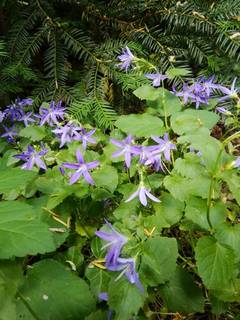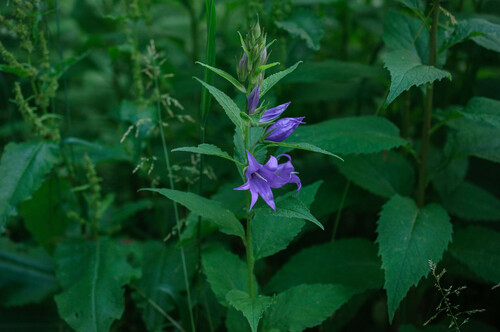
Campanula, Genus, latifolia, Species,
- Genus & species
giant bellflower
Overview
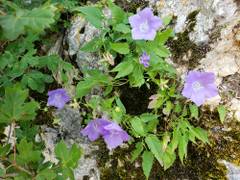
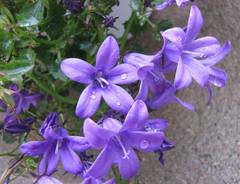
Campanula latifolia is an upright herbaceous perennial of the bellflower family, forming clumps 36-48 inches (90-120 cm) tall and about 24 inches (60 cm) wide. Stiff, unbranched stems rise from a basal rosette and carry large, coarsely toothed, oval leaves up to 5 inches (12 cm) long that taper to a point. From June to August the upper half of each stem bears a tall spike of large, tubular bell-shaped flowers 1.5-2.5 inches (4-6 cm) long, held singly in the leaf axils and facing outward. The flowers are usually soft violet-blue, though white forms occur, and open from the bottom of the spike upward. It grows from a thick, fleshy rootstock and a slowly spreading crown. Native to damp woodland and shaded stream banks, it grows well in shade where many flowering perennials will not. It can self-seed freely in cool, moist gardens. The stems die back fully in winter and regrow each spring.
Native Range
Native to Europe and western Asia, from Britain east to the Caucasus and Iran, where it grows in damp deciduous woodland, hedge banks, and shaded streamsides on fertile soils.Suggested Uses
Planted in woodland gardens, shaded borders, and cottage-style schemes, usually spaced 18-24 inches (45-60 cm) apart among ferns and other shade plants. It adds height and blue colour to dim corners where many perennials struggle. The flowers suit informal cutting.How to Identify
Appearance
Size & Dimensions
Height3' - 4'
Width/Spread1'6" - 2'
Bloom Information
Flowering runs from June to August, the large bells opening in sequence from the base of the spike upward. The flowers are rich in nectar and visited mainly by long-tongued bumblebees. Seed capsules follow and shed many tiny seeds through pores near the top.
Detailed Descriptions
Foliage Description
greenGrowing Conditions
Sun Requirements
Requires 2-6 hours of direct sunlight daily
• Full Sun: 6+ hours of direct sunlight
• Partial Shade: 3-6 hours of direct sunlight
• Full Shade: Less than 3 hours of direct sunlight
Care & Maintenance
Care Guide
Giant bellflower grows in partial to full shade on moist, fertile, humus-rich soil and grows most strongly where the ground stays cool and damp. It tolerates full sun only where soil moisture is reliable, and wilts in hot, dry positions. Plants are raised from seed sown in autumn or spring, or by division of the crown in early spring. No staking is usually needed despite the height, as the stems are stiff. Cutting spent spikes after flowering limits heavy self-seeding. The clump dies back to the rootstock in winter and reshoots in spring.Pruning
Cutting flower spikes back after blooming prevents prolific self-seeding and can encourage a few later flowers. Old stems are cleared to the base in late autumn or winter once they die down. Division of the crown every few years in spring keeps clumps healthy.Container Growing
Suitable for container growing
Minimum container size: 3 gallons