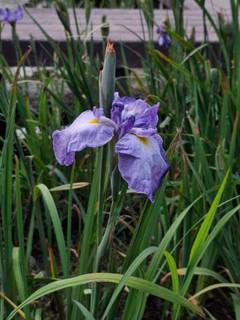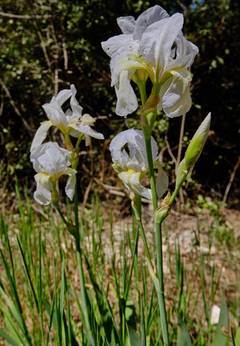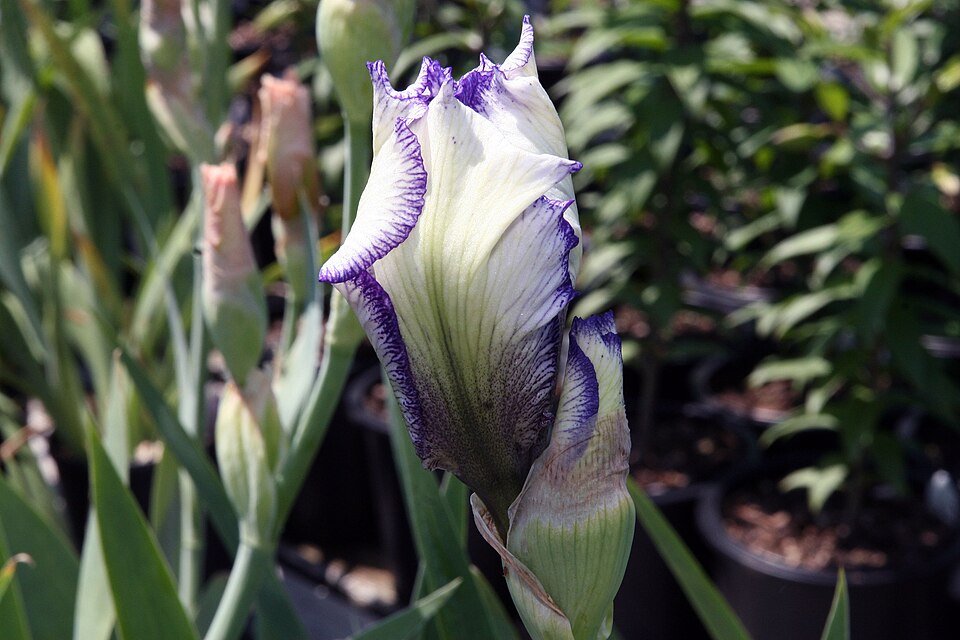
Iris, Genus, germanica, Species, 'Autumn Circus', Cultivar,
- Genus & species
- Cultivar
autumn circus reblooming bearded iris
Mediterranean Europe and Caucasus (parent species)
Overview
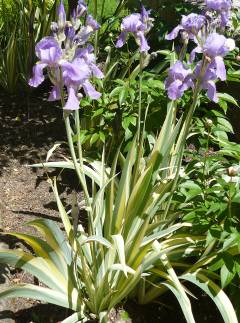
Iris germanica 'Autumn Circus' is a clump-forming herbaceous perennial of the Tall Bearded reblooming class, reaching 32-36 inches (80-90 cm) tall in bloom and forming spreading clumps 18-24 inches (45-60 cm) wide from horizontal rhizomes at or just below the soil surface. Each flower stem branches once or twice and carries 5-7 buds opening sequentially over 7-14 days; flowers measure 5-6 inches (13-15 cm) across with three upright standards in white to pale cream and three drooping falls in white ground heavily veined and stippled with violet-purple plicata patterning, marked with a yellow-orange beard at the base of each fall. Fan-shaped foliage of stiff sword-like leaves rises 22-28 inches (55-70 cm) in blue-green and persists through summer and into autumn rebloom. The cultivar reblooms reliably in zones 5-8, producing a primary spring flush from late May through June and a secondary autumn flush from August through October when summer water and balanced fertility are maintained. Rhizomes spread laterally at 2-3 inches (5-7.5 cm) per year and require division every 3-4 years to maintain bloom density. Plants are hardy through USDA zones 3-9; reliable rebloom occurs in zones 5-8, with marginal rebloom in zones 4 and 9. All parts contain irisin and iridin glycosides, producing oral and gastrointestinal irritation in dogs, cats, and humans if ingested in quantity. The rebloom cycle requires uninterrupted summer growth, so foliage damage from leaf-spot fungus directly reduces the autumn display.
Native Range
Iris germanica is a hybrid garden complex of uncertain wild origin, derived from I. pallida, I. variegata, and other Mediterranean and Central European species. Wild ancestors grew on open, rocky slopes from southern Europe through the Caucasus at 200-1,800 m (650-5,900 ft) elevation. 'Autumn Circus' is a Tall Bearded reblooming selection from cultivated breeding programs and does not occur in the wild.Suggested Uses
Used in mixed perennial borders and dedicated iris beds spaced 12-18 inches (30-45 cm) apart, paired with later-flowering perennials such as Phlox paniculata, Echinacea, and Sedum that overlap with the autumn rebloom cycle. Used along sunny driveways and walkway edges where well-drained soil supports rhizome health. Container culture is workable in 5-gallon (19 L) or larger pots with sharp drainage in zones 5-8, though winter survival in containers requires sheltered overwintering north of zone 6.How to Identify
Appearance
Size & Dimensions
Height2'8" - 3'
Width/Spread1'6" - 2'
Bloom Information
Primary bloom occurs late May through June in zones 5-7, early May through early June in zones 8-9, and June through early July in zones 3-4. Secondary autumn rebloom begins in August in zones 5-6 and extends through October in zones 7-8, with first hard frost ending the cycle. Each spring flower stem opens 5-7 flowers in sequence over 7-14 days; rebloom stems carry 4-6 flowers and follow a similar 7-14 day cycle. Continuous summer water and balanced fertility without high nitrogen are required for the autumn cycle; drought-stressed plants skip the rebloom flush.
Detailed Descriptions
Flower Description
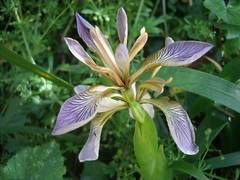
white to pale cream standards with white falls heavily veined violet-purple plicata pattern; yellow-orange beardFoliage Description
blue-greenGrowing Conditions
Sun Requirements
Requires 6-10 hours of direct sunlight daily
• Full Sun: 6+ hours of direct sunlight
• Partial Shade: 3-6 hours of direct sunlight
• Full Shade: Less than 3 hours of direct sunlight
Care & Maintenance
Care Guide
Performs in full sun with at least 6 hours of direct light, with light afternoon shade tolerated in zones 8-9. Soil should be well-drained loam to sandy loam with pH 6.5-7.0; heavy or poorly drained soils cause rhizome rot within 1-2 seasons. Rhizomes are set with the top half exposed to sun and only the roots and lower rhizome surface buried, spaced 12-18 inches (30-45 cm) apart for 3-4 year clump development. Watering needs are once weekly during the first growing season and continue through summer in years 2 and beyond to support autumn rebloom; drought stress from May through August suppresses the secondary flush. A balanced 5-10-10 fertilizer applied at 1 oz per square yard in early spring and again 2-3 weeks after spring bloom supports the rebloom cycle; high-nitrogen formulas promote bacterial soft rot and are not used. Iris borer (Macronoctua onusta), bacterial soft rot (Erwinia carotovora), and leaf spot are the main pressures; rhizomes showing soft, foul-smelling tissue should be excised back to firm tissue and dusted with sulfur.Pruning
Foliage may be cut back to 6 inches (15 cm) in late autumn after the secondary rebloom completes, removing leaf-spot inoculum before winter. Spent flower stems are cut at the base after the last flower fades on each stem, both in spring and autumn, to redirect energy into rhizome growth. Clumps are divided every 3-4 years in late summer (4-6 weeks after spring bloom and before the autumn cycle), discarding old central rhizomes and replanting only firm outer fans 12-18 inches (30-45 cm) apart.Pruning Schedule
Prune: November
fall
Container Growing
Suitable for container growing
Minimum container size: 5 gallons