Sambucus, Genus,
- Genus
elders
Temperate and subtropical regions worldwide
Overview
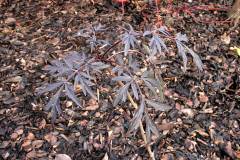
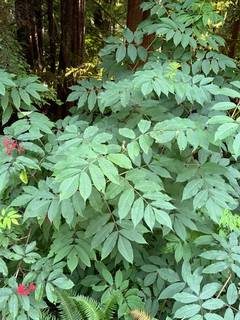
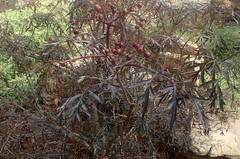
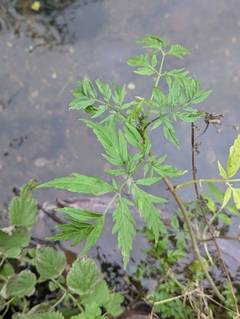
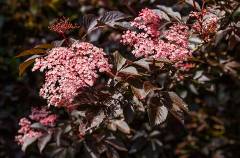
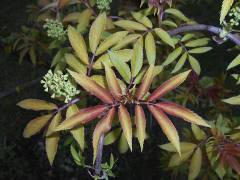
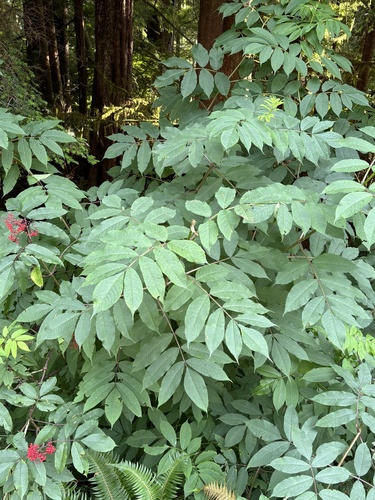
Sambucus is a genus of about 20 to 30 species of deciduous shrubs, small trees, and a few herbaceous perennials in the family Viburnaceae, distributed across temperate and subtropical regions worldwide. Most species reach 1-10 m (3-33 ft) with soft, pithy stems and large, opposite, pinnately compound leaves of 5 to 9 toothed leaflets. Small white or cream flowers are borne in broad, flat-topped or domed clusters up to 25 cm (10 in) across in late spring and summer. These ripen to clusters of small berry-like drupes, black, blue, or red depending on species. S. nigra, the European elder, and S. canadensis, the American elder, bear edible black fruit once it is cooked, while S. racemosa bears red fruit. The raw berries, leaves, bark, and roots contain cyanogenic glycosides and are toxic until the fruit is cooked. Plants grow quickly in moist, fertile soil and often sucker. Many species are grown for their flowers and fruit, and several cultivars have dark purple or finely cut foliage.
Native Range
Distributed across temperate and subtropical regions of both hemispheres, including Europe, Asia, North and South America, Africa, and Australia. S. nigra is native to Europe, while S. canadensis and S. racemosa are native across North America. The genus grows along woodland edges, stream banks, and roadsides in moist ground.Suggested Uses
Grown as informal hedging, wildlife shrubs, and screening in moist ground, and in edible gardens for the cooked flowers and fruit. Purple- and cut-leaved cultivars are used as foliage shrubs in mixed borders.How to Identify
Appearance
Size & Dimensions
Height3' - 33'
Width/Spread6' - 20'
Bloom Information
Detailed Descriptions
Flower Description
white to creamFoliage Description
greenGrowing Conditions
Sun Requirements
Requires 4-8 hours of direct sunlight daily
• Full Sun: 6+ hours of direct sunlight
• Partial Shade: 3-6 hours of direct sunlight
• Full Shade: Less than 3 hours of direct sunlight
Care & Maintenance
Care Guide
Elders grow in full sun to part shade in moist, fertile soil and tolerate seasonally wet ground. They are hardy to about -35 C (-31 F) in the hardiest species and grow rapidly, often sending up suckers and arching canes. Fruiting and flowering are heavier in full sun. The stems are weak and brittle, and old plants can become congested without renewal. Aphids, spider mites, and various fungal leaf spots may affect the foliage.Pruning
Stems are cut back in late winter, taking the oldest canes to the base to renew the plant. Cultivars grown for coloured foliage are cut hard each spring to produce larger leaves on vigorous new shoots. Suckers are removed to control spread.Pruning Schedule
Prune: February–March
early spring