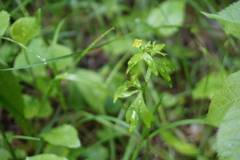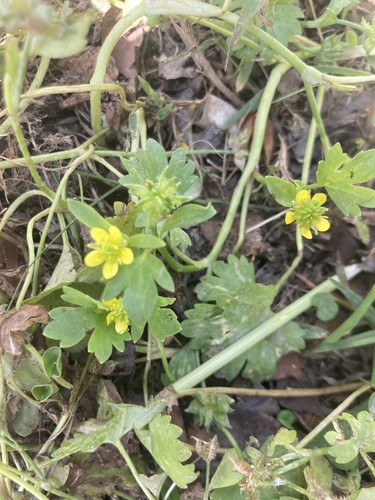
Ranunculus, Genus, muricatus, Species,
- Genus & species
rough-fruited buttercup
SunFull Sun – Part Shade
WaterMedium
Overview
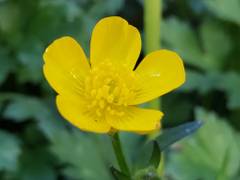
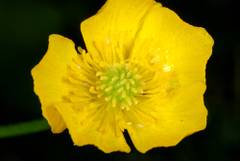
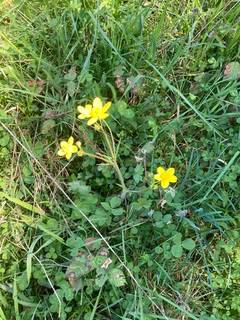
Ranunculus muricatus, rough-fruited buttercup, is a hairless winter annual of the buttercup family, growing 6-18 inches (15-45 cm) tall with branching, somewhat fleshy, ascending to sprawling stems. The glossy green leaves are rounded and divided into three coarsely toothed lobes, on long stalks toward the base. From spring it produces small, glossy yellow flowers about 0.4-0.6 inch (10-15 mm) across, each with five shining petals. The flowers give way to clusters of flattened seeds, or achenes, whose faces are covered in stiff spines or warts, the trait behind the common name. R. muricatus grows in damp, disturbed ground such as ditches, lawns, fields, orchards, and wet waste places, often on heavy soils. It germinates in cool weather, sets seed by late spring, and dies as the soil dries. Like other buttercups it contains protoanemonin, an irritant that is toxic to grazing animals and can blister skin, and it is widely regarded as a weed of pastures and cultivated ground.
Native Range
Native to the Mediterranean region and western Europe. It has naturalized widely as a weed across North America, especially the southern and western United States, and in Australia, South America, and other temperate areas.Suggested Uses
R. muricatus is not cultivated and occurs as a weed in lawns, pastures, gardens, and damp disturbed sites. It has little wildlife value because of its irritant sap. It is managed and removed rather than planted.How to Identify
Appearance
Size & Dimensions
Height6" - 1'6"
Width/Spread6" - 1'2"
Bloom Information
Glossy yellow flowers open in spring, mainly March to May, scattered along the branched stems. Each bloom lasts a few days and is followed by the characteristic spiny seed heads. Flowering and fruiting overlap before the plant dies back in early summer.
Detailed Descriptions
Foliage Description
glossy greenGrowing Conditions
Sun Requirements
Requires 4-10 hours of direct sunlight daily
• Full Sun: 6+ hours of direct sunlight
• Partial Shade: 3-6 hours of direct sunlight
• Full Shade: Less than 3 hours of direct sunlight
Water & Climate
Water Needs
Care & Maintenance
Care Guide
As a cool-season weedy annual, it germinates in fall and winter on damp, disturbed, often heavy soil in sun to part shade. It needs no cultivation and grows quickly in moist, fertile ground, tolerating compaction and short flooding. Where it is unwanted, hand-pulling or hoeing before the spiny seeds form is the simplest control, as the plant has shallow roots. Improving drainage and maintaining dense turf reduce its foothold in lawns. No watering or feeding is required. Each plant produces many spiny seeds that cling to fur, clothing, and tools, so removing plants before seed set limits its spread.Pruning
No pruning is needed for this annual. Where control is wanted, plants are pulled or cut before the spiny seed heads mature and detach. Mowing only delays seeding, since low plants can flower beneath the blade.Toxicity Warning
Toxic to pets and humansPlanting Guide
Planting Methods & Timing
Planting Method
direct sow
Direct Sow Timing
self-sows in fall
Days to Maturity
90–120 days
Plant Spacing
8 inches