Quercus, Genus, durata, Species,
- Genus & species
leather oak
California serpentine outcrops; Coast Ranges and Sierra Nevada foothills
Overview
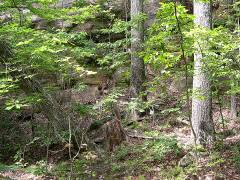
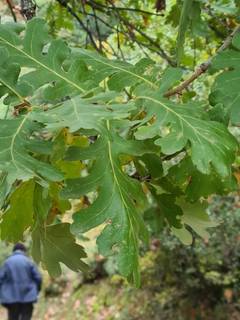
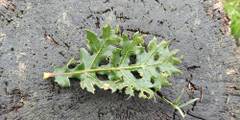
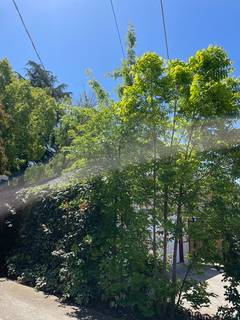
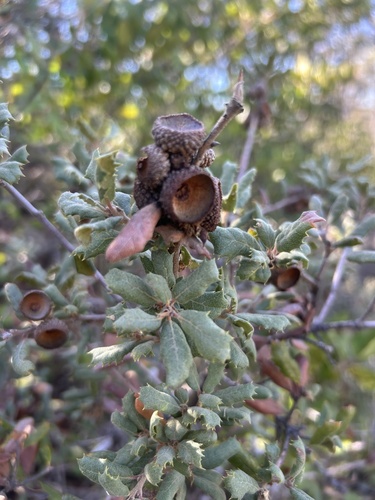
Quercus durata is an evergreen shrub or small tree reaching 3-13 feet (1-4 m) tall and 4-10 feet (1.2-3 m) wide, with the largest specimens occasionally to 16 feet (5 m). Branching dense and gnarled; bark gray and scaly. Leaves small, leathery, oblong to elliptic, 0.5-1.5 inches (1.3-4 cm) long, with margins curled under and bearing 1-3 short spines per side; upper surface dull gray-green, lower surface pale and finely hairy. Foliage often cupped (convex above) — the trait that gives the species its name. Monoecious; male catkins yellow-green, 1-2 inches (2.5-5 cm) long, in April-May. Acorns 0.4-0.8 inch (10-20 mm) long, in shallow cups covered with thin gray-pubescent scales, ripening annually in fall. Growth rate 4-8 inches (10-20 cm) per year on serpentine soils; faster off-serpentine but uncommon in cultivation. Endemic to serpentine substrates in California and serves as a bioindicator of underlying ultramafic geology. Lifespan 100-200 years; older specimens form multi-stemmed thickets via root crown sprouting.
Native Range
Endemic to California, occurring almost exclusively on serpentine and ultramafic soils in the Coast Ranges from Lake County south to San Luis Obispo County, with disjunct populations in the Sierra Nevada foothills and the San Gabriel Mountains (var. gabrielensis). Found in chaparral, serpentine seeps, and rocky outcrops at 300-5,000 feet (90-1,500 m) elevation. The species rarely occurs off serpentine substrates in the wild.Suggested Uses
Planted in California native plant gardens, serpentine restoration projects, and habitat plantings at 4-6 foot (1.2-1.8 m) spacing in zones 7-10. Used in slope stabilization on serpentine outcrops where most other woody species fail. Container culture is rare due to taproot disruption sensitivity; in-ground planting is the standard approach in cultivation.How to Identify
Appearance
Size & Dimensions
Height3' - 13'
Width/Spread4' - 10'
Colors
Bloom Information
Catkins appear April through May, peaking in late April. Individual catkins last 1-2 weeks; total flowering 2-3 weeks per plant. Acorns mature annually (single-season) in September-November and disperse through December.
Detailed Descriptions
Foliage Description
Dull gray-greenGrowing Conditions
Sun Requirements
Requires 6-12 hours of direct sunlight daily
• Full Sun: 6+ hours of direct sunlight
• Partial Shade: 3-6 hours of direct sunlight
• Full Shade: Less than 3 hours of direct sunlight
Care & Maintenance
Care Guide
Plants establish from acorns sown directly in fall on serpentine or low-fertility soils; high-fertility loams produce weak growth and shortened lifespan. Mature plants require no supplemental water in zones 8-10 once established. Tolerates 8-12 weeks without summer rain. Off-serpentine plantings show 30-50% lower vigor and slower growth. Few pest or disease pressures occur on natural serpentine substrate. Container plants are short-lived (5-8 years); nursery stock is typically transplanted before reaching 5-gallon size to limit taproot disruption.Pruning
Cut dead and crossing branches in late summer (August-September) when fungal activity is reduced. Light shearing for hedge use is limited to soft new growth in late spring; cuts into older wood frequently die back. Multi-stem thicket form is the natural habit; specimens trained to a single trunk require structural pruning over the first 5-10 years.Pruning Schedule
Prune: August–September
summer
Container Growing
Minimum container size: 15 gallons