Juniperus, Genus, scopulorum, Species,
- Genus & species
Rocky Mountain juniper
Native to western North America — British Columbia and Alberta south through the Rocky Mountains to Arizona and New Mexico, east to the Dakotas and western Texas, at 5,000-9,000 feet (1,500-2,700 m) elevation on dry rocky slopes, outcrops, and cliff faces
Overview
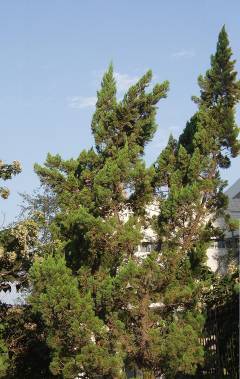
Juniperus scopulorum is Rocky Mountain juniper, an upright evergreen coniferous tree in the cypress family Cupressaceae growing 20-40 feet (6-12 m) tall and 8-15 feet (2.4-4.6 m) wide on a single trunk with a narrow pyramidal to columnar form at maturity and with reddish-brown bark that exfoliates in thin fibrous vertical strips. The species is the primary juniper of the Rocky Mountain cordillera, native to western North America from British Columbia and Alberta south through the Rocky Mountain chain to Arizona and New Mexico and east across the northern plains to the Dakotas and into western Texas, with the natural range centered on dry rocky slopes, exposed outcrops, and cliff faces at 5,000-9,000 feet (1,500-2,700 m) elevation — the specific epithet scopulorum is from Latin scopulus meaning cliff or rock and records the species' characteristic cliff-face habitat. The silvery-blue scale-like foliage tightly appressed in opposite decussate pairs on slender cord-like branchlets carries the intense pale-blue tone not matched by other North American native conifer species and serves as the primary field diagnostic that separates J. scopulorum from J. virginiana (eastern red cedar, which carries green-to-green-blue foliage and occupies the eastern half of the continent) where the two species overlap in the central Great Plains. Individual specimens of J. scopulorum reach substantial ages in the wild — tree-ring studies on cliff-face specimens in Utah, Colorado, and Wyoming have documented living trees exceeding 1,000 years of age, making the species one of the longer-lived conifers of the western cordillera. Limitation: the species is adapted to the 10-20 inch (25-50 cm) annual precipitation and the dry summer air of the Rocky Mountain interior, and the species is intolerant of the humid summer air and poorly drained soils of the eastern United States — Phomopsis tip blight, cercospora needle blight, and root rot all accelerate under humid conditions, and plantings east of roughly the 100th meridian progressively fail as atmospheric humidity and soil moisture rise. This humid-climate intolerance is the species' primary limitation outside the native range and rules out planting in the coastal southeastern and Gulf states. The species is also an alternate host for cedar-apple rust (Gymnosporangium juniperi-virginianae), and plantings within the 500-foot (150 m) spore dispersal radius of apple or crabapple orchards carry the disease-transmission risk common to the genus. Non-toxic. Deer-resistant. Very slow growth rate.
Native Range
Native to western North America — British Columbia and Alberta south through the Rocky Mountain cordillera to Arizona and New Mexico, east across the northern plains to the Dakotas, and south into western Texas. The species occupies dry rocky slopes, exposed outcrops, and cliff faces at 5,000-9,000 feet (1,500-2,700 m) elevation with 10-20 inches (25-50 cm) annual precipitation. The specific epithet scopulorum is from Latin scopulus meaning cliff or rock and records the characteristic cliff-face habitat.Suggested Uses
Used as a native specimen tree in western North American landscapes, windbreak and shelterbelt planting in prairie and high-plains regions, vertical evergreen accent in xeric and rock gardens, visual screen at 8-15 foot (2.4-4.6 m) spacing between trees, and native-plant restoration planting within the species' natural range from British Columbia and Alberta south through the Rocky Mountains to Arizona and New Mexico. The silvery-blue scale-like foliage that serves as the species field diagnostic, the narrow pyramidal to columnar architectural form that holds through multi-century lifespans, the documented longevity (cliff-face specimens in Utah and Colorado exceeding 1,000 years), the extreme cold and drought tolerance matched to the Rocky Mountain continental climate, and the species' role as winter bird food source (blue cones eaten by cedar waxwings, robins, and thrushes) combine to make J. scopulorum a foundation native coniferous tree for the arid and semi-arid western North American landscape. Humid eastern-US positions (coastal southeast, Gulf states, eastern seaboard) are unsuitable because of the species' humid-climate intolerance and resulting disease pressure. Sites within the 500-foot spore dispersal radius of apple or crabapple orchards are unsuitable because of the cedar-apple rust alternate-host relationship.How to Identify
Appearance
Size & Dimensions
Height20' - 40'
Width/Spread8' - 15'
Reproduction
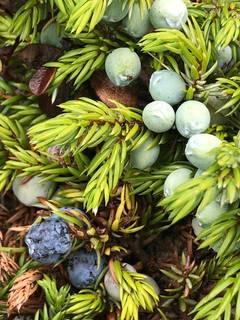
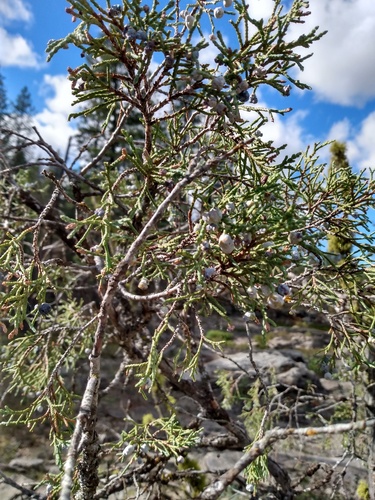
Male plants bear small yellow pollen cones at the branch tips in spring across a 2-week wind-pollinated release period. Female plants bear round blue to blue-black berry-like seed cones 0.25-0.3 inch (6-8 mm) across covered in a waxy glaucous bloom that ripen over 18-24 months and persist into the following winter. The blue berry-like cones are a winter ornamental feature and supply important winter food for cedar waxwings, American robins, hermit thrushes, and other berry-eating birds across the native range. Wind-pollinated.
Detailed Descriptions
Foliage Description
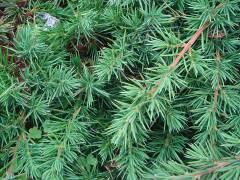
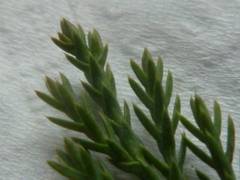
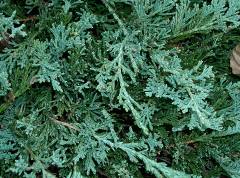
silvery-blue to blue-green, scale-like adult foliage (appressed, in opposite decussate pairs) on slender cord-like branchlets of approximately 1 mm thickness; the silvery-blue coloration is the intense pale-blue tone not matched by other North American native conifer species and serves as the primary field diagnostic separating J. scopulorum from the green-to-green-blue foliage of J. virginiana (eastern red cedar); juvenile awl-shaped needles occasionally appear on young growth and on vigorous shoots of young trees but give way to the adult scale foliage as the tree matures; evergreen year-roundGrowing Conditions
Sun Requirements
Requires 6-12 hours of direct sunlight daily
• Full Sun: 6+ hours of direct sunlight
• Partial Shade: 3-6 hours of direct sunlight
• Full Shade: Less than 3 hours of direct sunlight
Care & Maintenance
Care Guide
Site in full sun with 6-12 hours of direct sun per day in well-drained sandy, loamy, or rocky soil across a broad pH range of 5.5-8.5 (the native cliff-face habitat includes both acidic granitic and alkaline limestone substrates). Extreme drought tolerance develops once the root system is established — the species is adapted to 10-20 inch (25-50 cm) annual precipitation and the dry summer air of the Rocky Mountain interior, and supplemental summer irrigation is rarely needed. The species is intolerant of the humid summer air and poorly drained soils of the eastern United States: Phomopsis tip blight, cercospora needle blight, and root rot all accelerate under humid conditions, and plantings east of roughly the 100th meridian progressively fail as atmospheric humidity and soil moisture rise — the species is unsuitable for the coastal southeastern and Gulf states. The species is an alternate host for cedar-apple rust (Gymnosporangium juniperi-virginianae) — plantings within the 500-foot (150 m) spore dispersal radius of apple or crabapple orchards are unsuitable because of the disease-transmission risk. Non-toxic. Deer-resistant. Hardy in USDA zones 3-7.Pruning
Pruning is rarely needed — the natural narrow pyramidal to columnar form develops without intervention over the tree's very slow 8-15 year growth to mature stature. Pruning in early spring (March or April) is used only to remove dead, damaged, or crossing branches. Junipers do not regenerate from bare wood — pruning cuts must be made back to a junction with a green lateral branch rather than into leafless interior stems, because cuts into leafless wood will not produce new foliage. Shearing is avoided because the sheared surface exposes interior leafless stems that do not re-clothe, and the natural architectural form of this very slow-growing long-lived tree is lost.Pruning Schedule
Prune: March–April
early spring