Echinacea, Genus, angustifolia, Species,
- Genus & species
narrow-leaved coneflower
Central Great Plains of North America: Saskatchewan to Texas
Overview
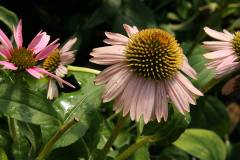
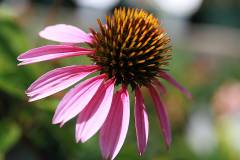
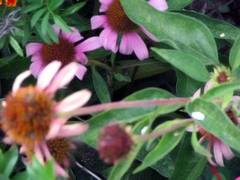
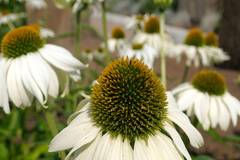
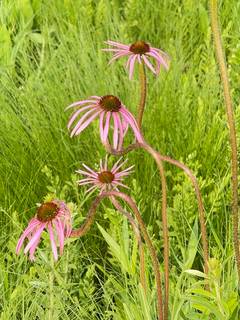
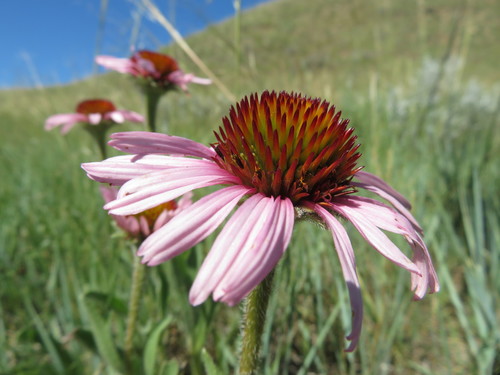
Echinacea angustifolia is a herbaceous perennial reaching 12-24 inches (30-60 cm) tall and 12-18 inches (30-45 cm) wide, forming an upright tap-rooted clump. Stems are stiff, hairy, and unbranched or sparsely branched, arising from a stout woody crown. Leaves are lance-shaped to narrow-elliptic, 3-8 inches (7.5-20 cm) long and 0.4-1 inch (10-25 mm) wide, hairy on both surfaces with three prominent veins. Flower heads are 2-3 inches (5-7.5 cm) across, with 8-21 pale pink to lavender (occasionally white) ray florets that droop or hold horizontally below a coppery to red-brown raised disc. Bloom occurs from June through August. Plants grow from a deep taproot 1-3 feet (30-90 cm) long that supports drought tolerance but makes division and transplanting difficult. Mature plants live 8-15 years in suitable sites; root harvest for traditional and herbal uses has caused population decline across the native range. Self-seeds modestly in disturbed sandy or rocky soils; seedling establishment is slow and unreliable in mulched garden beds.
Native Range
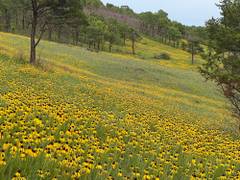
Native to the central Great Plains of North America from Saskatchewan and Manitoba south through North and South Dakota, Nebraska, Kansas, and Oklahoma to Texas, with disjunct populations into Minnesota and Iowa. Grows in dry to mesic shortgrass and mixed-grass prairies, rocky outcrops, and roadsides at elevations from 1,000 to 5,000 feet (300-1,500 m). Tolerates pH 6.0-8.5 and limestone-derived soils that exclude many garden perennials.Suggested Uses
Used in prairie restorations, dry meadow plantings, native medicinal herb gardens, and rock gardens, spaced 12-18 inches (30-45 cm) apart in well-drained soils. Plantings combine with Schizachyrium scoparium, Liatris punctata, and Dalea purpurea on calcareous prairie sites. Tolerates clay and seasonal flooding poorly; raised beds or sandy amendments help in heavy-soil regions.How to Identify
Appearance
Size & Dimensions
Height1' - 2'
Width/Spread1' - 1'6"
Bloom Information
Blooms June through August across the prairie range, with peak in July at mid-latitudes. Individual flower heads last 14-21 days; total bloom on a plant extends 4-6 weeks. Flower count per plant correlates with previous year's growing-season precipitation; drought reduces bloom by 40-60%. Bloom timing shifts 2-3 weeks earlier in zones 7-8.
Detailed Descriptions
Flower Description
pale pink to lavender (occasionally white) with coppery-red discFoliage Description
medium green; hairyGrowing Conditions
Sun Requirements
Requires 6-9 hours of direct sunlight daily
• Full Sun: 6+ hours of direct sunlight
• Partial Shade: 3-6 hours of direct sunlight
• Full Shade: Less than 3 hours of direct sunlight
Care & Maintenance
Care Guide
Plantings establish in well-drained sandy, loamy, or rocky soils with neutral to alkaline pH. Water during the first growing season; established plants tolerate 4-6 weeks of drought once the taproot reaches 12 inches (30 cm) deep. Mulches deeper than 1 inch (2.5 cm) over the crown hold moisture and increase crown rot risk; shallow mulch or none is the typical practice. Few pest problems occur in dry sites; aster yellows phytoplasma can deform flowers occasionally and infected plants are removed entirely. Transplanting is rarely successful on plants over 2 years old because of taproot disturbance. Fertilization is not required and reduces drought tolerance.Pruning
Spent flower stems can be cut at the base in late summer to limit self-seeding, or left through winter for habitat value and visual interest. Cone heads support finch and sparrow forage from October through February. Old stems are cut to ground level in late winter before new growth emerges in March or April.Pruning Schedule
Prune: February–March
winterearly spring
Container Growing
Suitable for container growing
Minimum container size: 5 gallons