Echinacea, Genus, paradoxa, Species,
- Genus & species
yellow coneflower
Ozark region of Missouri and Arkansas
Overview
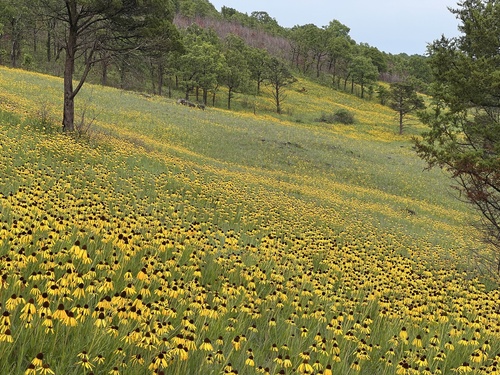
Echinacea paradoxa is the only Echinacea species with yellow ray florets — the 'paradox' referenced in its name, since all other species in the genus have pink, purple, or white rays. Plants in the daisy family (Asteraceae) grow 24-36 inches (60-90 cm) tall and 12-18 inches (30-45 cm) wide. Bright yellow drooping ray florets 2-3 inches (5-8 cm) long hang below a dark brown central cone, creating a form similar to E. pallida but in yellow rather than pale pink. The narrow, drooping ray shape confirms the species' close relationship with E. pallida, from which it likely diverged relatively recently in evolutionary terms. Dark green, narrow, smooth lance-shaped leaves are less rough-textured than E. pallida and E. purpurea. The species has an extremely limited native range, occurring only in the Ozark region of Missouri and Arkansas on dry, rocky dolomite and limestone glades. This narrow endemic status made it a target for conservation attention. The species develops a deep taproot and is drought-tolerant once established. E. paradoxa has become an important parent in modern coneflower breeding, contributing yellow pigments to hybrid cultivars that display the orange, sunset, and bicolor tones not possible from pink-rayed species alone. Deer avoid the foliage.
Native Range
Echinacea paradoxa is endemic to the Ozark Plateau of Missouri and Arkansas, where it grows on dry, rocky dolomite and limestone glades, chert prairies, and open cedar woodlands.Suggested Uses
Used in prairie restorations, native meadow plantings, and specialty perennial borders where the yellow coneflower adds a conversation-piece element. The yellow colour fills a gap that pink-rayed species cannot. Important as a breeding parent for yellow and orange hybrid coneflowers. Not suited to formal borders.How to Identify
Appearance
Size & Dimensions
Height2' - 3'
Width/Spread1' - 1'6"
Colors
Bloom Information
Flowering in June and July, approximately 4 weeks. Bright yellow drooping rays around dark cones. Dark seed cones persist through winter.
Detailed Descriptions
Flower Description
Bright yellow drooping ray florets around a dark brown coneFoliage Description
Dark green, narrow, lance-shaped, smoothGrowing Conditions
Sun Requirements
Requires 6-12 hours of direct sunlight daily
• Full Sun: 6+ hours of direct sunlight
• Partial Shade: 3-6 hours of direct sunlight
• Full Shade: Less than 3 hours of direct sunlight
Care & Maintenance
Care Guide
Plant in full sun with at least 6 hours of direct light. Well-drained, lean, rocky or sandy soil; the species tolerates calcareous ground. Heavy fertilising is avoided. Watering during establishment is sufficient. Established plants are not transplanted. Seed cones are left standing through winter.Pruning
All stems and seed cones are left standing through winter. The plant is cut to ground level in late winter before new growth.Pruning Schedule
Prune: March & November
fallearly spring