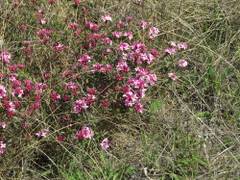
Daphne, Genus, tangutica, Species,
- Genus & species
tangut daphne
Western China (Gansu, Sichuan, Yunnan) and Tibet
Overview
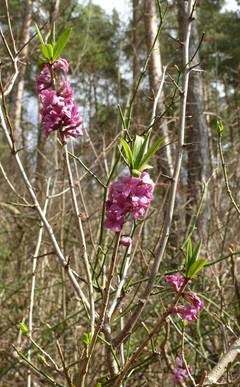
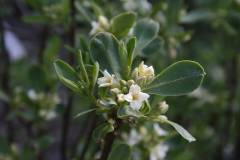
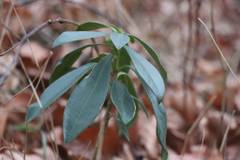
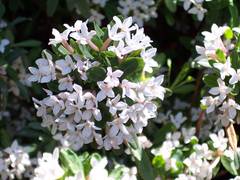
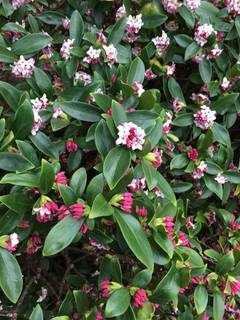
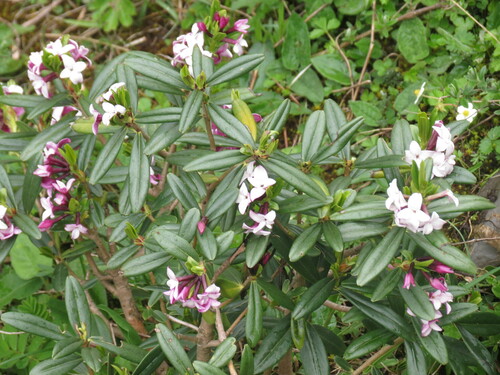
Daphne tangutica is a compact, rounded to dome-shaped, evergreen shrub reaching 2–4 feet (0.6–1.2 m) tall with a spread of 3–5 feet (0.9–1.5 m)—typically wider than tall. This Chinese species carries terminal clusters of tubular, fragrant flowers in March–April; buds are deep rose-purple opening to pale pink inside, and the deeper purple-rose coloration remains on the tepal exterior after opening, giving a bicolor effect that reads more strongly at close range than the uniform pink of D. × burkwoodii or the pale pink-white of D. odora. Leaves are narrowly elliptic, 1.5–3 inches (4–8 cm) long, glossy, dark green, leathery, and densely arranged along the branches. Red to orange fleshy fruits may follow flowering on pollinated specimens (though fruit set is sporadic in gardens). Growth rate is slow. The species holds up better than D. odora against sun exposure and wind, and the cold hardiness range extends one zone lower (zone 6 versus zone 7), which widens the practical growing range into more of the upper mid-Atlantic and interior Northwest. D. tangutica served as one parent of D. × transatlantica, the widely planted sterile hybrid with an extended reblooming season. All parts contain daphnin (a coumarin glycoside) and mezerein (a diterpene ester); ingestion causes severe gastrointestinal symptoms and sap contact causes skin blistering in sensitive people. The combination of March–April bloom, zone 6 cold hardiness, compact evergreen form, and greater sun tolerance makes this species among the more garden-adaptable daphnes in the genus.
Native Range
Daphne tangutica is native to western China—Gansu, Sichuan, and Yunnan provinces—and southeastern Tibet, growing in mountain scrublands and forest margins at elevations of 6,000–12,000 feet (1,800–3,600 m). The high-elevation native habitat explains the greater cold tolerance relative to the lower-elevation East Asian D. odora.Suggested Uses
Planted near entries, along pathways, and beside seating areas at 3–4 foot (0.9–1.2 m) spacing, where the March–April fragrance carries into the use zone at the close of winter. The compact, wider-than-tall evergreen form suits foundation plantings and low mixed borders. The species adapts to a wider range of garden sites than D. odora—tolerant of more sun, more cold, and more wind exposure—which makes it a workable substitute in zones 6–7 where D. odora is marginal. Grows in containers of at least 5 gallons (19 L) with a free-draining mix. Gardens used by unsupervised children or grazing pets are a poor fit because accidental ingestion of plant material causes severe gastrointestinal symptoms; the fleshy red fruits, when produced, carry the highest mezerein concentration and are the most hazardous plant part. Wet soils and hot, dry inland sites are also a poor fit.How to Identify
Appearance
Size & Dimensions
Height2' - 4'
Width/Spread3' - 5'
Bloom Information
Terminal clusters of tubular, fragrant flowers open in March–April. Buds are deep rose-purple; flowers open to pale pink inside with the purple-rose color remaining on the tepal exterior after opening, giving a bicolor effect. Red to orange fleshy fruits sometimes follow on pollinated specimens. Bloom duration is 3–4 weeks.
Detailed Descriptions
Flower Description
Deep rose-purple exterior, pale pink interior, bicolor, fragrantFoliage Description
Glossy dark green, narrowly elliptic, leatheryGrowing Conditions
Sun Requirements
Requires 4-8 hours of direct sunlight daily
• Full Sun: 6+ hours of direct sunlight
• Partial Shade: 3-6 hours of direct sunlight
• Full Shade: Less than 3 hours of direct sunlight
Care & Maintenance
Care Guide
Plant in partial shade to full sun in moist, well-drained, humus-rich, slightly acidic soil at pH 5.5–7.0. The species tolerates more sun than D. odora—full-sun exposure in zones 6–7 and partial shade in hotter climates match the high-elevation native habitat well. Drainage is the decisive factor: soils holding standing water after rain develop root rot within a single growing season and kill the plant, so a planting hole amended with 30–50% coarse grit or a raised mound 6–10 inches (15–25 cm) above grade handles heavy sites. Cold hardiness extends reliably through USDA zone 6 (−10°F / −23°C)—one zone hardier than D. odora. Root disturbance causes decline, so cultivation within the drip line is avoided once the plant is established. A 1-inch mulch of pine needles or shredded bark keeps roots cool. All plant parts contain daphnin and mezerein and are toxic; sap contact causes blistering irritation in sensitive people. Sudden death of established plants without obvious cause is a documented genus trait. More tolerant of wind exposure than D. odora.Pruning
Minimal pruning. Light shaping immediately after flowering is the only intervention the plant tolerates well. Hard pruning causes extensive dieback that often extends into adjacent healthy wood. Dead branches are removed as they appear, cutting back to the nearest point of healthy tissue.Pruning Schedule
Prune: May
late spring
Container Growing
Suitable for container growing
Minimum container size: 5 gallons