Acer, Genus, palmatum, Species, 'Crimson Queen', Cultivar,
- Genus & species
- Cultivar
crimson queen Japanese maple tree
Overview
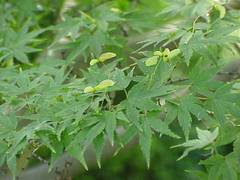
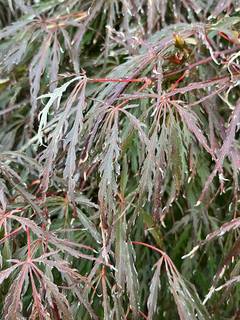
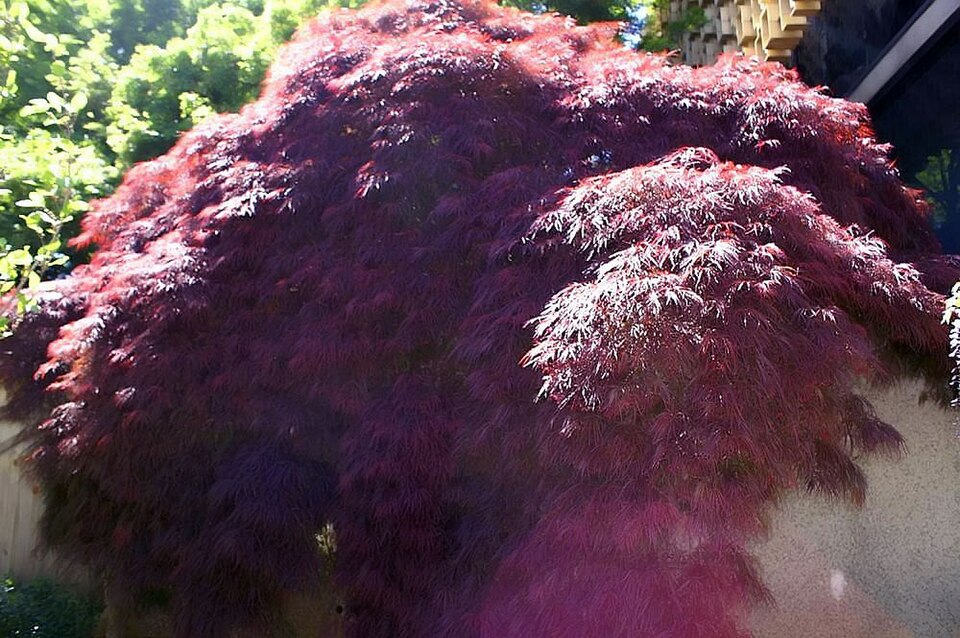
Acer palmatum 'Crimson Queen' is a deciduous dissectum-type Japanese maple reaching 8-10 feet (2.4-3 m) tall and 10-12 feet (3-3.7 m) wide at maturity, with a strongly weeping cascading habit and a dome-shaped to mushroom form on a short trunk. Leaves are palmately divided into 7-11 lobes that are themselves further dissected, creating a finely cut texture; individual leaves measure 3-4 inches (8-10 cm) across. Spring foliage emerges deep crimson-red and holds dark red to burgundy color through summer in zones 5-7, fading toward bronze-green in deep shade or in zone 8 heat. Fall color shifts to bright scarlet-red over 2-3 weeks before leaf drop. Small reddish-purple flowers appear in April-May before full leaf-out, followed by paired red-tinged samaras 0.5-0.8 inch (1.3-2 cm) long that ripen in late summer. Growth rate is slow at 6-12 inches (15-30 cm) per year, reaching mature size in 15-20 years. Leaf scorch develops on the south or west sides in zones 7-8 if afternoon shade is absent. Bark is gray-green and smooth on young branches, becoming ridged on mature trunks.
Native Range
The species A. palmatum is native to Japan, Korea, China, and the Russian Far East, occurring in mixed deciduous understory at 600-3,500 feet (180-1,070 m) elevation. The cultivar 'Crimson Queen' was selected and introduced in the United States in the 1960s and is propagated by grafting onto A. palmatum seedling rootstock.Suggested Uses
Planted as a specimen, accent in mixed shrub borders, or container tree at 12-15 foot (3.7-4.5 m) spacing in zones 5-8. Used in Japanese-style gardens, near water features, and as an understory tree beneath open-canopy oaks or pines in zones 7-8. Container culture in pots of at least 25 gallons (95 L) lasts 8-12 years before root-bound conditions limit plant health; winter protection is required for containers in zones 5-6.How to Identify
Appearance
Size & Dimensions
Height8' - 10'
Width/Spread10' - 12'
Bloom Information
Inconspicuous reddish-purple flowers appear in April through early May in zones 5-7 and from mid to late March in zone 8. Bloom occurs concurrent with or just before leaf emergence and lasts 7-14 days. Flowers are wind-pollinated and rarely noticed; samaras (paired winged seeds) follow and ripen from August through September.
Detailed Descriptions
Foliage Description
deep crimson-red emerging; dark red to burgundy summer; scarlet in fallGrowing Conditions
Sun Requirements
Requires 4-6 hours of direct sunlight daily
• Full Sun: 6+ hours of direct sunlight
• Partial Shade: 3-6 hours of direct sunlight
• Full Shade: Less than 3 hours of direct sunlight
Care & Maintenance
Care Guide
Water deeply twice weekly during the first three growing seasons, applying 1-2 inches (2.5-5 cm) per week. Mature trees tolerate 2-3 weeks without rain in zones 5-7 but show leaf curl and crisping in zones 7-8 after one week of drought combined with heat above 90°F (32°C). A 3-4 inch (7.5-10 cm) acidic mulch layer of pine bark or pine needles maintains root moisture and acidifies soil. Verticillium wilt (Verticillium dahliae) causes branch dieback on stressed trees and can kill specimens within 2-5 years; infected wood is removed and pruning tools are sterilized between cuts. Aphids and Japanese beetles feed on foliage in summer. Iron chlorosis develops on alkaline soils above pH 7.0; sulfur amendments correct symptoms.Pruning
Pruning is minimal and limited to dead, crossing, or downward-growing inner branches in late winter before bud break. Selective thinning of 10-20% of inner branches every 3-5 years opens the canopy and reveals the cascading branch structure. Heavy pruning into older wood produces water sprouts and disrupts the dome-shaped form. Cuts during active sap flow in spring leak heavily but rarely harm the tree.Pruning Schedule
Prune: February–March
winter
Container Growing
Suitable for container growing
Minimum container size: 25 gallons