Cotoneaster, Genus, spp., Multiple species,
- Genus
- Multiple species
cotoneasters
Temperate Asia, especially southwestern China and the Himalaya, plus Europe and North Africa
Overview
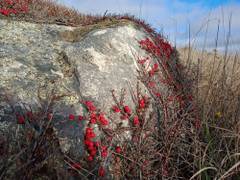
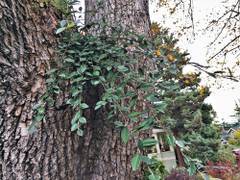
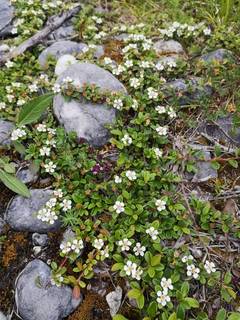
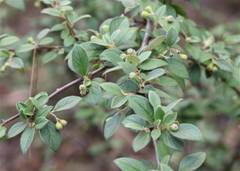
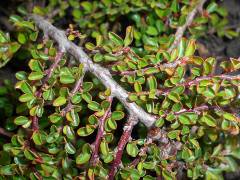
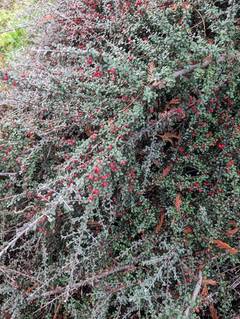
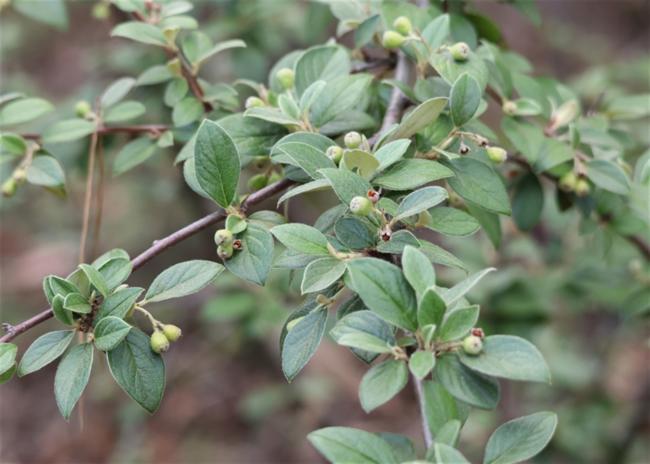
Cotoneaster is a genus of about 300 species of shrubs and small trees in the family Rosaceae, ranging from prostrate groundcovers a few centimetres tall to upright forms reaching 5 m (16 ft). Both deciduous and evergreen species occur. Leaves are alternate, simple, and untoothed, 0.5-12 cm (0.2-4.7 in) long, dark green above and often grey-felted beneath. Flowers are small, 5-10 mm (0.2-0.4 in) across, white or flushed pink, borne singly or in clusters in late spring. The fruit is a small pome, 4-12 mm (0.16-0.5 in) in diameter, ripening red, orange, or occasionally black and persisting into winter. Branches are often arranged in flattened, herringbone sprays in the low-growing species. The genus spans a wide range of habits, from C. horizontalis with its tiered branching to the arching C. lacteus. Several species have naturalized widely and are regulated as invasive in parts of North America, Australia, and New Zealand, where birds disperse the seeds. The pomes are eaten by birds but contain cyanogenic compounds and are not edible for people.
Native Range
Native to temperate regions of the Old World, with the greatest diversity in the mountains of southwestern China and the Himalaya, and additional species across Europe, North Africa, and temperate Asia. No Cotoneaster species is native to North America, though several introduced species have naturalized there.Suggested Uses
Low and prostrate species are used as groundcover on banks and over walls, while taller species serve as informal hedging and wildlife screening. The persistent fruit is a winter food source for birds in gardens. Invasive status restricts planting in several regions.How to Identify
Appearance
Size & Dimensions
Height4" - 16'
Width/Spread2' - 10'
Bloom Information
Flowering occurs in late spring, typically May to June. The small white to pink-flushed flowers are borne singly in low species and in branched clusters in larger ones. Flowering is followed by a long display of red to orange pomes from late summer into winter.
Detailed Descriptions
Flower Description
white to pinkFoliage Description
dark greenGrowing Conditions
Sun Requirements
Requires 4-8 hours of direct sunlight daily
• Full Sun: 6+ hours of direct sunlight
• Partial Shade: 3-6 hours of direct sunlight
• Full Shade: Less than 3 hours of direct sunlight
Care & Maintenance
Care Guide
Plants grow in full sun to part shade and tolerate a wide range of soils, including dry, rocky, and alkaline conditions, where drainage is good. Established plants withstand drought and wind exposure. Evergreen species are hardy to about -15 C (5 F), while several deciduous species tolerate -25 C (-13 F). Fireblight, a bacterial disease, can kill branches and is more severe in warm, wet springs. Cotoneaster also hosts woolly aphids and can develop silver leaf fungus after heavy cutting.Pruning
Little pruning is needed beyond taking out dead or diseased wood, done in late winter on deciduous species and after flowering on evergreens. Wall-trained C. horizontalis is shortened to fit its support. Cuts are made cleanly to limit silver leaf infection, which enters through large wounds.Pruning Schedule
Prune: February–March
early spring
Container Growing
Suitable for container growing
Minimum container size: 5 gallons