Image 1 of 15
1 / 15
Plant Reference
Cotoneaster, Genus, dammeri, Species,
- Genus & species
bearberry cotoneaster
Central China — Hubei province; rocky slopes and mountain forests at middle elevations
Overview
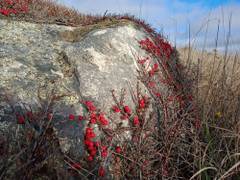
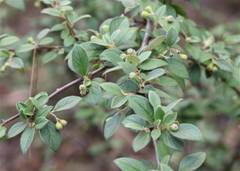
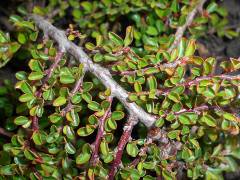
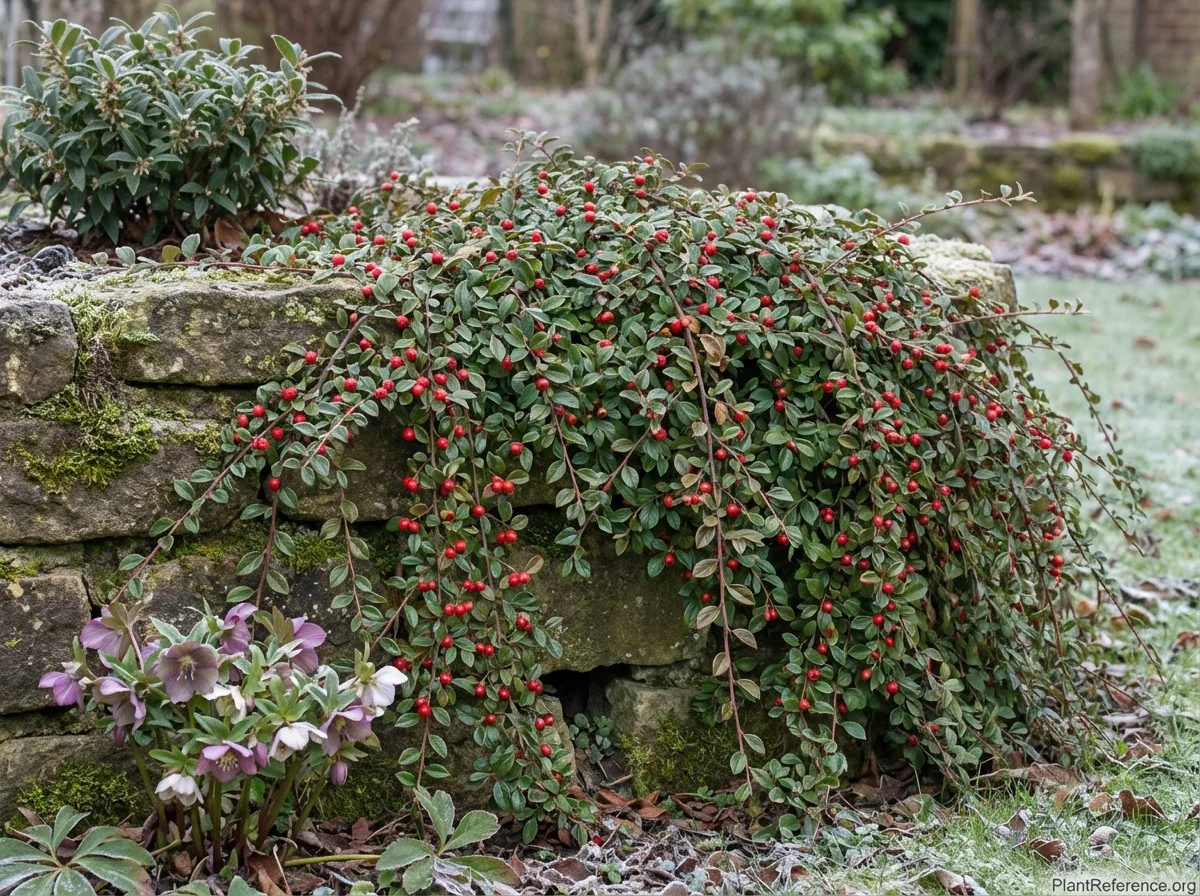
Cotoneaster dammeri is a prostrate spreading broadleaf evergreen shrub in the rose family Rosaceae growing 6–12 inches (15–30 cm) tall and spreading 6–8 feet (1.8–2.4 m) wide from a central root system that produces trailing stems that root at the nodes where they contact the soil surface. The species is named after Carl Lebrecht Udo Dammer (1860–1920), a German botanist who described several Chinese Cotoneaster species from collections made during the late 19th and early 20th century plant-hunting expeditions to central China. Leaves are glossy deep green on the upper surface, pale with short soft hairs beneath, small, elliptic, 0.5–1 inch (1.3–2.5 cm) long, and carried along the trailing stems in a dense arrangement that forms a ground-covering mat over several years of spread. Small white 5-petaled flowers 0.3 inch (8 mm) across open singly or in clusters of 1–3 along the trailing stems in May and June across a 2–3 week bloom period, and the flowers are followed by glossy bright red berries 0.3 inch (8 mm) in fall that persist on the stems into winter. Limitation: the species is susceptible to fireblight (Erwinia amylovora), a bacterial disease that produces sudden branch dieback with darkened curled leaves resembling fire-scorched growth — infected branches are cut at least 12 inches (30 cm) below the visible damage boundary with tools sterilized between cuts with 70% isopropyl alcohol or a 10% bleach solution to prevent spread, and severe infections call for complete removal of the plant. The species is classified as an invasive plant in parts of the Pacific Northwest of North America and in parts of northern Europe where bird-dispersed seed colonizes native forest margins and open scrub, and regional invasive species lists should be consulted before planting in jurisdictions where the species is restricted. The berries contain cyanogenic glycosides — mildly toxic to humans, cats, and dogs if ingested in quantity, producing gastrointestinal irritation and (at high ingested quantities) cyanide toxicity symptoms. Native to central China (Hubei province), growing on rocky slopes and mountain forests at middle elevations. Drought-tolerant once established and tolerates clay, sand, and loam soils across a wide pH range. Deer-resistant.
Native Range
Native to central China — Hubei province — growing on rocky slopes and in mountain forests at middle elevations. The species was introduced to western horticulture through plant-hunting expeditions to central China in the late 19th and early 20th centuries alongside many other Chinese Cotoneaster species, and Carl Dammer described the species from collection material preserved in European botanical institutions.Suggested Uses
Used as an evergreen ground cover on slopes, banks, retaining wall tops, and erosion-control plantings in USDA zones 5 through 9 at 6–8 foot (1.8–2.4 m) spacing between plants for continuous coverage. The prostrate trailing habit with nodal rooting produces a dense ground-covering mat that suppresses competing vegetation and holds soil on slopes, and the glossy red winter berries supply a secondary ornamental display and a winter food source for birds. Jurisdictions where the species is listed as invasive (parts of the Pacific Northwest of North America and parts of northern Europe) are unsuitable because of the bird-dispersed seed spread into native vegetation. Gardens where cat, dog, or child access to the berries is a concern should account for the cyanogenic glycoside toxicity, and sites with recurrent fireblight pressure from nearby Malus or Pyrus plantings are unsuitable because of the fireblight susceptibility shared across the Rosaceae family.How to Identify
Appearance
Size & Dimensions
Height6" - 1'
Width/Spread6' - 8'
Bloom Information
Small white 5-petaled flowers 0.3 inch (8 mm) across open singly or in clusters of 1–3 along the trailing stems in May and June across a 2–3 week bloom period. Honeybees and native solitary bees work the flowers for nectar during the spring bloom. Glossy bright red berries 0.3 inch (8 mm) develop through summer and ripen in fall, persisting on the trailing stems into winter where they supply food for birds and drive the bird-dispersed seed spread that is the mechanism behind the species' invasive behavior in some jurisdictions.
Detailed Descriptions
Flower Description
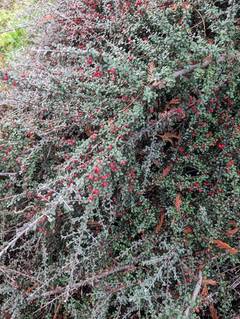
white 5-petaled flowers 0.3 inch (8 mm) across carried singly or in small clusters of 1-3 along the trailing stems in late spring; followed by glossy bright red berries 0.3 inch (8 mm) in fall that persist on the stems into winter where they supply food for birds and bird-dispersed seed spreadFoliage Description
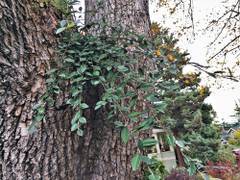
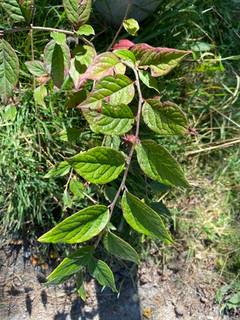
glossy deep green on the upper surface and pale with short soft hairs beneath; small elliptic leaves 0.5-1 inch (1.3-2.5 cm) long held along the trailing stems; the prostrate stems root where they contact the soil and produce a spreading ground-covering mat over several years; evergreen year-roundGrowing Conditions
Sun Requirements
Requires 4-8 hours of direct sunlight daily
• Full Sun: 6+ hours of direct sunlight
• Partial Shade: 3-6 hours of direct sunlight
• Full Shade: Less than 3 hours of direct sunlight
Care & Maintenance
Care Guide
Site in full sun to partial shade with 4–8 hours of direct sun per day in well-drained soil with a pH of 5.5–7.5. The species adapts to loam, sand, and clay soils and is drought-tolerant once the root system is established. The species is susceptible to fireblight (Erwinia amylovora), and infected branches are cut at least 12 inches (30 cm) below the visible damage boundary with tools sterilized between cuts with 70% isopropyl alcohol or a 10% bleach solution. The species is classified as invasive in parts of the Pacific Northwest of North America and in parts of northern Europe — regional invasive species lists should be consulted before planting in jurisdictions where the species is restricted. The berries contain cyanogenic glycosides and are mildly toxic to humans, cats, and dogs if ingested in quantity. Deer-resistant. Hardy in USDA zones 5–9.Pruning
Pruning is done in late winter (February or March) to remove dead stems, fireblight-infected branches, and any stems that have spread beyond the designed planting area. Fireblight-infected branches are cut at least 12 inches (30 cm) below the visible damage boundary with tools sterilized between cuts with 70% isopropyl alcohol or a 10% bleach solution to prevent spread of the bacterial disease to healthy stems. Light trimming through the growing season controls the spread of the trailing stems on slopes and banks where a bounded ground-covering mat is the design goal.Pruning Schedule
Prune: February–March
early spring