Corylus, Genus, colurna, Species,
- Genus & species
Turkish hazelnut
Southeastern Europe and western Asia (Balkans through Turkey to Iran; mountain forests from 1,500 to 6,000 feet / 450 to 1,800 m)
Overview
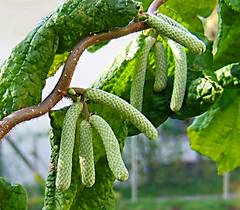
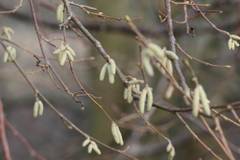
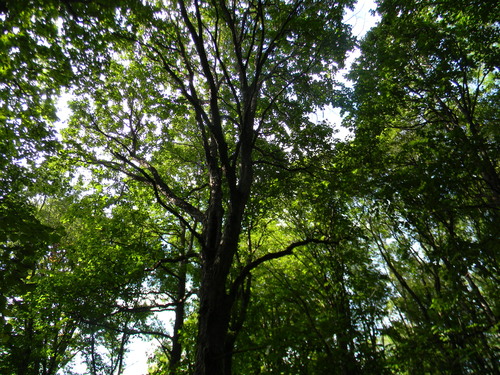
Corylus colurna is a medium to large symmetrically pyramidal deciduous tree in the birch family (Betulaceae) reaching 40–60 feet (12–18 m) tall with a spread of 20–30 feet (6–9 m). Unlike the multi-stemmed shrubby European hazel (C. avellana), this species develops a single straight trunk with a symmetrical pyramidal to conical crown; mature specimens read as formally structured even in forest settings. The bark becomes corky and deeply furrowed on mature trunks, giving the lower trunk significant winter character. Yellowish pendulous catkins 2–3 inches (5–8 cm) long dangle from the branches in February–March, before leaf-out. Leaves are broadly ovate 3–6 inches (8–15 cm) long, dark green, coarsely doubly serrate. Small edible hazelnuts develop enclosed in thick fringed spiny involucres (husks) that are larger and more deeply-cut than those of the European hazel. Fall color is yellow. Growth rate is moderate at 12–18 inches (30–45 cm) per year. Hardy to zone 4. The species tolerates urban conditions including heat island exposure, drought, poor soil, alkaline soil to pH 8.0, and air pollution, which is a combination uncommon among shade-tree species of this mature scale. No significant pest or disease problems. Resistant to eastern filbert blight (Anisogramma anomala), the disease that limits commercial C. avellana plantings in North America. The symmetrical pyramidal form combined with urban-stress tolerance suits this species to street-tree use where most comparable shade trees would fail.
Native Range
Corylus colurna is native to southeastern Europe and western Asia, from the Balkans through Turkey to Iran, where it occurs in mountain forests from 1,500 to 6,000 feet (450–1,800 m).Suggested Uses
Grown as a street tree, shade tree, and specimen in urban landscapes, parks, and large gardens at 20–25 foot (6–7.5 m) spacing. The symmetrical pyramidal form, urban-stress tolerance, and disease resistance make this species a strong street-tree option in municipal-planting contexts where disease pressure eliminates other candidates. Parking lot islands, median strips, and plazas match the species tolerance for heat, restricted root space, and poor alkaline soils. Corky deeply-furrowed bark and pendulous winter catkins carry winter ornamental interest through the dormant season. Small residential gardens are not suitable given the 40–60 foot mature height and the 20–30 foot crown spread; the species needs room to develop the pyramidal form.How to Identify
Appearance
Size & Dimensions
Height40' - 60'
Width/Spread20' - 30'
Bloom Information
Pendulous yellowish catkins 2–3 inches (5–8 cm) long open on bare branches in February–March. Small red female flowers at the shoot bud tips are inconspicuous relative to the male catkin display. Small edible hazelnuts in thick spiny involucres ripen in fall. Bloom duration is 3–4 weeks.
Detailed Descriptions
Flower Description
Yellowish; pendulous catkins 2-3 inches longFoliage Description
Dark green, broadly ovate 3-6 inches long, coarsely doubly serrate; yellow in fallGrowing Conditions
Sun Requirements
Requires 6-12 hours of direct sunlight daily
• Full Sun: 6+ hours of direct sunlight
• Partial Shade: 3-6 hours of direct sunlight
• Full Shade: Less than 3 hours of direct sunlight
Care & Maintenance
Care Guide
Grows in full sun in average to poor well-drained soil at pH 5.5–8.0, tolerating loam, clay, sand, and chalk. Hardy to zone 4. Alkaline soils up to pH 8.0 are tolerated, which extends the species planting range into calcareous urban fill soils where many shade trees fail. Clay and compacted urban subsoils are tolerated. Established plants tolerate drought. Urban stress tolerance includes heat-island exposure, reflected heat from paved surfaces, restricted root zones in tree pits, and air pollution. Transplants readily at balled-and-burlapped or container stages. The species is resistant to eastern filbert blight (Anisogramma anomala), the disease that destroys commercial C. avellana plantings in North America — this single disease-resistance trait is why urban planners selected the species for municipal plantings across the eastern United States and Europe. No significant pest problems.Pruning
Minimal pruning is required. Dead, crossing, or damaged branches are removed in late winter (January–February) before bud break. Young trees benefit from central-leader training during the first 5 years to reinforce the naturally pyramidal form. The symmetrical pyramidal crown develops without corrective pruning given adequate light. Lower limbs are removed for pedestrian clearance in street-tree positions.Pruning Schedule
Prune: January–February
winter