Cornus, Genus, unalaschkensis, Species,
- Genus & species
bunchberry
Alaska south through British Columbia, Washington, Oregon, and northern California, east through the Rocky Mountains; moist conifer forests, bogs, and subalpine meadows
Overview
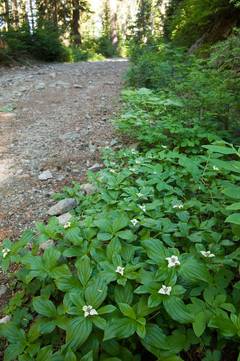
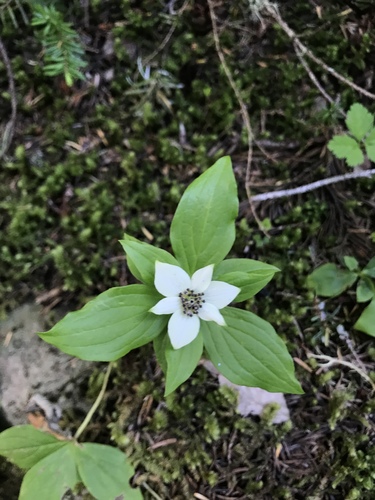
Cornus unalaschkensis is western bunchberry (Alaskan bunchberry), a low spreading deciduous perennial ground cover growing 2-8 inches (5-20 cm) tall and 12-24 inches (30-60 cm) wide; spreads slowly by underground rhizome to form a dense low mat over time. 4 white petal-like bracts (each 0.4-0.75 inch / 10-19 mm) surround a tiny central cluster of greenish-white true flowers, giving the appearance of a single 4-petaled flower 1-1.5 inches (2.5-4 cm) across, in May through July (4 weeks). Tight clusters of vivid coral-red drupes 0.25 inch (6 mm) develop in August-September. Foliage forms a terminal whorl of 4-6 elliptic to ovate leaves 1-3 inches (2.5-7.5 cm) with arcuate (curved parallel) dogwood venation, turning red in fall. Family Cornaceae; older sources often list this species as Cornus canadensis (eastern bunchberry), but molecular and morphological evidence supports treating C. unalaschkensis as a distinct western species. Native to Alaska south through British Columbia, Washington, Oregon, and northern California, east through the Rocky Mountains. Found in moist conifer forests, bogs, and subalpine meadows. Cool moist forest floor habitat is essential, and plants are difficult to establish in warm lowland gardens. Bunchberry stamens release pollen at over 22,000 m/s² when triggered by an insect. Berries are edible but bland-textured (sometimes called crackerberry for the dry mealy texture). Non-toxic. Hardy in zones 3-8. Grown in part to full shade. Growth rate is slow.
Native Range
Native to Alaska south through British Columbia, Washington, Oregon, and northern California, east through the Rocky Mountains. Found in moist conifer forests, bogs, and subalpine meadows.Suggested Uses
Cornus unalaschkensis is grown as a native ground cover in shaded woodland gardens, native plant gardens, and on cool moist forest floors, spaced 12-24 inches (30-60 cm) apart. Establishment is difficult in warm lowland gardens. Berries are edible but bland-textured and non-toxic. Hardy in zones 3-8.How to Identify
Appearance
Size & Dimensions
Height2" - 8"
Width/Spread1' - 2'
Bloom Information
Late spring through mid-summer (May-July). 4 white petal-like bracts (each 0.4-0.75 inch / 10-19 mm) surround a tiny central cluster of greenish-white true flowers; bract display lasts about 4 weeks. Bee-pollinated via explosive pollen release. Coral-red drupe clusters follow in August-September.
Detailed Descriptions
Flower Description
4 white petal-like bracts (each 0.4-0.75 inch / 10-19 mm) surround a tiny central cluster of greenish-white true flowers; the bracts give the appearance of a single 4-petaled flower 1-1.5 inches (2.5-4 cm) across, in May-July; followed by tight clusters of vivid coral-red drupes 0.25 inch (6 mm) in August-September.Foliage Description
Green above, pale beneath; arranged in a terminal whorl of 4-6 elliptic to ovate leaves 1-3 inches (2.5-7.5 cm) with arcuate (curved parallel) dogwood venation; turns red in fall.Growing Conditions
Sun Requirements
Tolerates up to 3 hours of direct sunlight daily
• Full Sun: 6+ hours of direct sunlight
• Partial Shade: 3-6 hours of direct sunlight
• Full Shade: Less than 3 hours of direct sunlight
Care & Maintenance
Care Guide
Grown in full to partial shade with 0-3 hours of direct sun. Soil is moist, humus-rich, acidic loam or peat with a pH of 4.5-6.0. Cool moist forest floor habitat is essential; plants are difficult to establish in warm lowland gardens. Spreads slowly by underground rhizome. Berries are edible but bland-textured and non-toxic. Hardy in zones 3-8.Pruning
No regular pruning is required. Winter-damaged foliage is cut back in early spring (February-March) before new growth emerges.Pruning Schedule
Prune: February–March
early spring