Cornus, Genus, racemosa, Species,
- Genus & species
grey twig dogwood
Eastern and central North America (Quebec to North Carolina, west to Oklahoma)
Overview
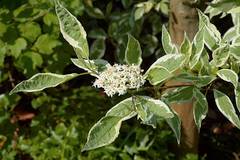
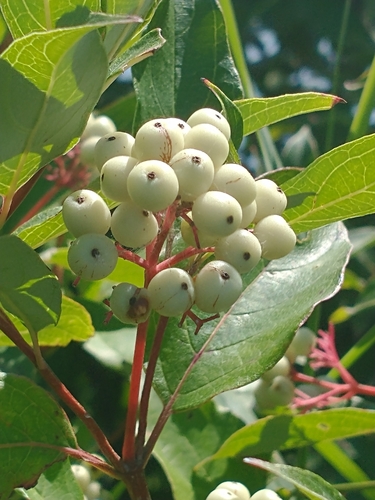
Cornus racemosa is a deciduous multi-stemmed shrub or small tree reaching 6-15 feet (1.8-4.6 m) tall and 6-12 feet (1.8-3.7 m) wide at maturity on individual stems. Leaves are elliptic to lanceolate, 2-4 inches (5-10 cm) long, opposite along the stems with arcuate venation, dark green through summer and shifting to red, burgundy, and purple tones in fall before leaf drop. Pyramidal panicles 1-3 inches (2.5-7.5 cm) tall of small creamy-white flowers appear in late May and June, separating the species from the flat-topped corymbs of related dogwoods. White drupes 0.25 inch (6 mm) long develop on bright red pedicels in August, with the red pedicels persisting on the stems for 4-6 weeks after the fruit is consumed by birds. Stems are slender, grey to grey-brown, with smooth bark on young growth and exfoliating plates on older trunks. Multi-stemmed habit produces a thicket-forming colony in moist sites; root suckers extend 18-30 inches (45-75 cm) per year and form clonal patches of 10-30 stems within 5-7 years. Plant lifespan is 30-50 years on individual stems, indefinite at the colony level through continuous suckering.
Native Range
Native to eastern and central North America from southern Quebec and Ontario south to North Carolina and west to Iowa, Nebraska, and Oklahoma. Found in moist forest edges, stream banks, fence rows, abandoned fields, and limestone outcrops from sea level to 4,000 feet (1,200 m) elevation.Suggested Uses
Used in naturalized hedgerow plantings, wildlife habitat plantings, riparian buffers, and erosion-control plantings on slopes in zones 4-8. Planted in mass groupings of 5 or more at 6-8 foot (1.8-2.4 m) centers along property lines and pond margins where the suckering thicket form is acceptable. Container culture is uncommon due to the suckering habit; large containers of 15 gallons (57 L) or more support 2-3 years of growth before sucker pressure compromises pot integrity.How to Identify
Appearance
Size & Dimensions
Height6' - 15'
Width/Spread6' - 12'
Bloom Information
Pyramidal panicles of creamy-white flowers appear in late May through mid-June in zones 4-7, with peak bloom lasting 10-14 days. Bloom is concentrated on second-year wood. White drupes on red pedicels develop in August and are typically consumed by 30-40 bird species within 1-2 weeks of ripening; the red pedicels persist for 4-6 weeks after fruit removal.
Detailed Descriptions
Foliage Description
dark greenGrowing Conditions
Sun Requirements
Requires 4-10 hours of direct sunlight daily
• Full Sun: 6+ hours of direct sunlight
• Partial Shade: 3-6 hours of direct sunlight
• Full Shade: Less than 3 hours of direct sunlight
Care & Maintenance
Care Guide
Spacing of 6-10 feet (1.8-3 m) accommodates mature width on individual stems, with allowance for clonal spread of 18-30 inches (45-75 cm) per year. Established plants tolerate occasional flooding for 1-2 weeks and also survive 3-4 weeks of summer drought in zones 5-7. Powdery mildew develops on leaves in humid late-summer conditions; disease is cosmetic and does not affect plant survival. Stem cankers from Cytospora fungi can develop on stressed or wounded stems. Suckering spread is the primary maintenance concern, and severing root suckers at the soil line in early spring restricts colony spread. Plants are tolerant of urban site conditions including compacted soils, road salt, and air pollution.Pruning
Selective stem removal of the oldest one-third of stems in late winter (February-March in zones 5-7) maintains stem density and renews flower production on second-year wood. Hard rejuvenation cutback to 6-12 inches (15-30 cm) above ground produces dense regrowth within one season. Sucker removal at the soil line is performed annually in maintained landscape settings to restrict colony spread.Pruning Schedule
Prune: February–March
winterearly spring