Cornus, Genus, macrophylla, Species,
- Genus & species
large-leaved dogwood
East Asia (Japan, China, Korea, eastern Himalayas)
Overview
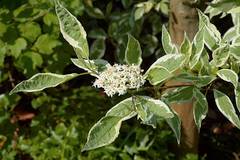
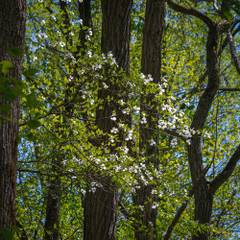
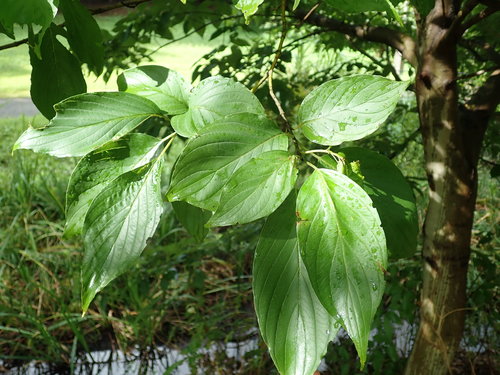
Cornus macrophylla is a medium to large, broadly spreading, deciduous tree reaching 30–50 feet (9–15 m) tall with a spread of 25–40 feet (7.5–12 m). This species has the largest leaves of any commonly grown dogwood—ovate to elliptic, 4–8 inches (10–20 cm) long and 2–4 inches (5–10 cm) wide, medium to dark green with prominent parallel veins and opposite arrangement. The leaves give the tree a bold, coarse texture unlike any other Cornus. Large, flat-topped cymes 4–6 inches (10–15 cm) across of small creamy-white flowers appear in July–August—later than any other dogwood species in this collection. Blue-black drupes 0.25 inch (6 mm) on red pedicels ripen in September–October. The tree develops a broad, rounded crown with age and relatively smooth gray bark. Growth rate is moderate to fast at 12–24 inches (30–60 cm) per year. No showy bracts. Uncommon in cultivation but adapted to a wide range of soils. Fall color is variable, typically yellowish to brownish-purple.
Native Range
Cornus macrophylla is native to East Asia—Japan, China, Korea, and the eastern Himalayas—occurring in mountain forests and woodland margins from 3,000 to 8,000 feet (900–2,400 m).Suggested Uses
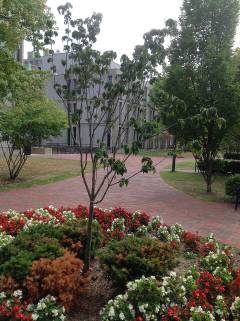
Planted as a shade tree in large gardens, parks, and estates at 20–30 foot (6–9 m) spacing. The bold, coarse-textured foliage contrasts with finer-leaved trees and shrubs. The late-summer bloom fills a gap after other dogwoods finish. Functions as a large specimen or canopy tree. The blue-black fruit feeds birds. Not suitable for small gardens or confined spaces due to the broad mature spread. Uncommon in cultivation; a collector's tree.How to Identify
Appearance
Size & Dimensions
Height30' - 50'
Width/Spread25' - 40'
Bloom Information
Large, flat-topped cymes 4–6 inches (10–15 cm) across of small, creamy-white flowers appear in July–August—the latest-blooming dogwood in this collection. Blue-black drupes on red pedicels ripen September–October. Bloom duration is 2–3 weeks.
Detailed Descriptions
Flower Description
Creamy-white in large flat-topped cymesFoliage Description
Medium to dark green, very large ovate 4-8 inches, prominent veinsGrowing Conditions
Sun Requirements
Requires 4-10 hours of direct sunlight daily
• Full Sun: 6+ hours of direct sunlight
• Partial Shade: 3-6 hours of direct sunlight
• Full Shade: Less than 3 hours of direct sunlight
Care & Maintenance
Care Guide
Plant in full sun to partial shade in moist, well-drained soil. Tolerates a wider range of soil types than most dogwoods, including alkaline conditions. Consistent moisture during establishment. Provide adequate space for the broad, spreading mature canopy of 25–40 feet (7.5–12 m). No serious pest or disease problems. More drought-tolerant than C. kousa or C. florida once established.Pruning
Minimal pruning. Remove dead, crossing, or damaged branches in late winter. Preserve the natural broadly rounded form. Train to a single leader when young if a tree form is desired.Pruning Schedule
Prune: February–March
winter