Clematis, Genus, ligusticifolia, Species,
- Genus & species
western white clematis
Overview
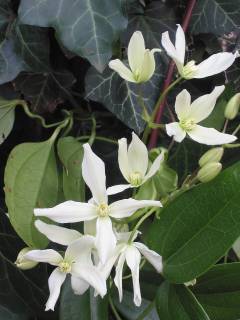
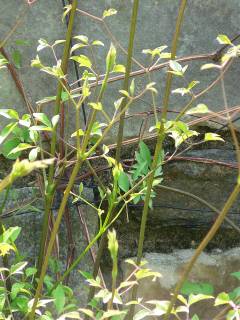
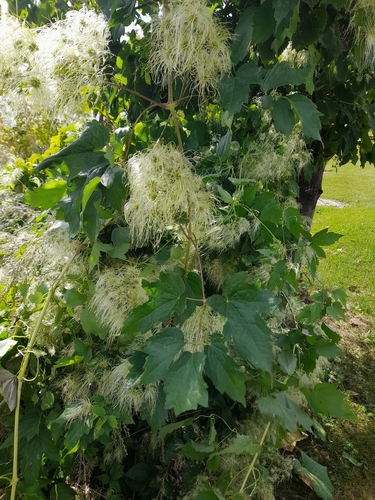
Clematis ligusticifolia is a deciduous woody climber that ascends 6-20 ft (2-6 m) by twining leaf stalks over shrubs, fences, and trees. The stems are ribbed and become woody at the base with age. Leaves are pinnately compound with five to seven leaflets, each 1-2.4 in (2.5-6 cm) long, coarsely toothed or lobed, and bright green. Plants are dioecious, carrying male and female flowers on separate individuals. The flowers lack petals; four creamy-white sepals 0.2-0.5 in (6-12 mm) long surround a cluster of stamens or pistils, borne in branched clusters from June to August. Female plants develop rounded heads of achenes, each tipped with a feathery silver-gray style 1-1.6 in (2.5-4 cm) long that persists into autumn and gives the common name old man's beard. The species grows along streambanks, washes, and roadside thickets across the West. All parts contain protoanemonin, an irritant compound released when the foliage is cut or chewed. It spreads readily by seed and layering, which can crowd smaller plants in confined gardens.
Native Range
Native to western North America, from British Columbia south to California and Baja California, and east to the Great Plains in Montana, the Dakotas, and New Mexico. It occupies riparian corridors, canyon bottoms, and disturbed roadsides up to 8,500 ft (2,600 m).Suggested Uses
Used to cover fences, arbors, and trellises, and for bank stabilization along streams where the roots bind soil. Planted in native and wildlife gardens, spaced 5-8 ft (1.5-2.5 m) apart, where the flowers draw native bees and the seed heads persist through winter.How to Identify
Appearance
Size & Dimensions
Height6' - 20'
Width/Spread3' - 6'
Bloom Information
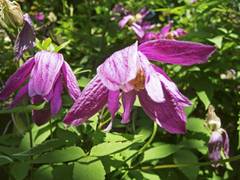
Flowers open from June to August, with male and female blossoms on separate plants. Each flower is creamy-white, about 0.4-0.8 in (1-2 cm) across, and carried in many-flowered clusters. Feathery seed heads follow on female plants from late summer into fall.
Detailed Descriptions
Foliage Description
bright greenGrowing Conditions
Sun Requirements
Requires 4-10 hours of direct sunlight daily
• Full Sun: 6+ hours of direct sunlight
• Partial Shade: 3-6 hours of direct sunlight
• Full Shade: Less than 3 hours of direct sunlight
Care & Maintenance
Care Guide
Grows in full sun to part shade in moist, well-drained soil, and tolerates seasonal drought once established. It accepts a soil pH from about 5.5 to 7.5 and a range of textures including loam, sand, and rocky ground. Roots do well in cool, shaded soil while the top growth climbs into sun. Hardy to USDA zone 4, roughly -30 F (-34 C), with stems dying back in severe cold and regrowing from the base. Established plants need little supplemental water in regions with summer rain. Rapid growth may call for a sturdy support and annual containment.Pruning
Pruning is done in late winter while dormant, cutting stems back to a framework or near ground level to control spread. The species flowers on new growth, so hard pruning does not remove the coming season's bloom. Removing spent seed heads limits self-seeding.Pruning Schedule
Prune: February–March
winterearly spring