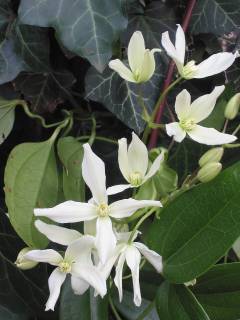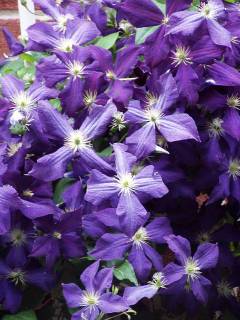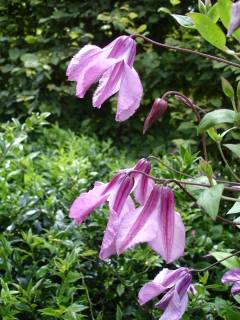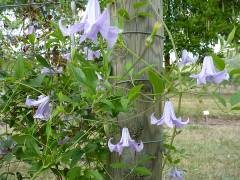
Image 1 of 4
1 / 4
© Leonora Enking from West Sussex, England, some rights reserved (CC-BY-SA) · Wikimedia Commons
Clematis, Genus, ×, Hybrid, 'Arabella', Cultivar,
- Genus
- Hybrid
- Cultivar
arabella clematis
Garden hybrid; parentage involves {Clematis integrifolia} and large-flowered hybrids
Overview
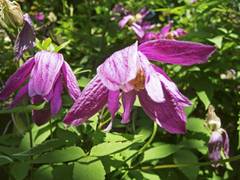
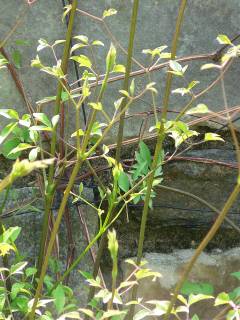
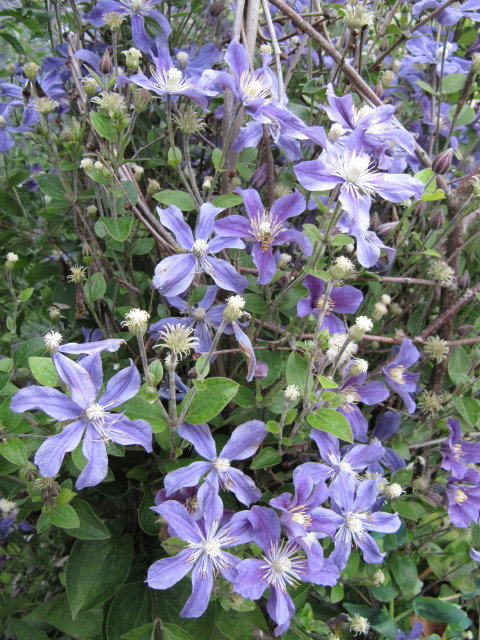
Clematis × 'Arabella' is an integrifolia-type hybrid clematis that behaves as a herbaceous perennial rather than a true climbing vine. Plants grow 36–60 inches (90–150 cm) long and 36–48 inches (90–120 cm) wide, with semi-scrambling stems that lack twining petioles and cannot climb supports on their own. The stems either sprawl along the ground as a ground cover or can be draped through shrubs and over low structures. Open, nodding flowers 2–3 inches (5–8 cm) across with 4–6 tepals open blue-violet and age through purple-blue to pale blue, so flowers at multiple stages of color are visible simultaneously on a single plant. Bloom is continuous from June through October — a 16–20 week display, longer than most clematis cultivars in cultivation. All flowers are produced on new growth from the current season, making this a Group 3 (hard prune) clematis: all stems are cut to 6 inches (15 cm) above ground in late winter. The herbaceous habit means stems die to the ground in winter even without pruning. The non-climbing growth is a fundamental difference from typical clematis and changes garden use — 'Arabella' is planted like a perennial, not trained on a trellis. The extended bloom, simple Group 3 pruning, and tolerance of a range of soil and light conditions have made this a frequent recommendation for gardeners new to the genus. All parts contain protoanemonin, irritating and toxic if ingested.
Native Range
Clematis × 'Arabella' is a garden hybrid involving C. integrifolia (native to southeastern Europe and central Asia) and large-flowered hybrid clematis. It was raised by Barry Fretwell in Devon, England.Suggested Uses
Used as a ground cover, draped through low shrubs, or cascading over retaining walls. The non-climbing habit suits 'Arabella' to perennial borders where it weaves among neighbors. Container culture works in pots of 7 gallons (26 L) or more without a support. The 16–20 week bloom season and simple Group 3 pruning suit gardeners new to the genus.How to Identify
Appearance
Size & Dimensions
Height3' - 5'
Width/Spread3' - 4'
Bloom Information
Flowering begins in June and continues continuously through October, a display of 16–20 weeks. Flowers open blue-violet and age through purple-blue to pale blue. No deadheading is needed; new flowers replace spent ones without intervention. Feathery silver seed heads develop on older flowers while new ones continue opening.
Detailed Descriptions
Flower Description
Blue-violet aging to purple-blue then pale blueFoliage Description
Medium green, simple, ovateGrowing Conditions
Sun Requirements
Requires 5-10 hours of direct sunlight daily
• Full Sun: 6+ hours of direct sunlight
• Partial Shade: 3-6 hours of direct sunlight
• Full Shade: Less than 3 hours of direct sunlight
Care & Maintenance
Care Guide
Plant in full sun to partial shade with at least 5 hours of direct light. Well-drained, average soil is acceptable. Unlike climbing clematis, 'Arabella' does not need a trellis or support — planting it as a perennial allows the stems to sprawl or drape through neighboring plants. Group 3 pruning: cut all stems to 6 inches (15 cm) above ground in late February–March. All flowers appear on new growth. Water regularly during establishment; drought-tolerant once rooted. Light fertilization in spring is sufficient.Pruning
Group 3 (hard prune): All stems are cut to 6 inches (15 cm) above ground in late February–March. The herbaceous stems die to the ground in winter naturally. All flowers are produced on new growth, so hard pruning does not reduce bloom.Pruning Schedule
Prune: February–March
early spring
Container Growing
Suitable for container growing
Minimum container size: 7 gallons